US tech outages: officials insist no cyberattack, 1 week on
US tech outages at the FAA, Microsoft and major banks are not a cyberattack, Trump officials told Congress. Here is what it means for travelers and banks.
Updated 20 Nov 2026, 22:21 (UK time): White House National Cyber Director Sean Cairncross has been removed from his post in the wake of the US tech outages, with President Trump saying he fired him because he “didn’t think that person was good enough”, and a successor has been named.
Sean Cairncross is out as White House national cyber director, removed after a week of US tech outages that halted departures nationwide and took down the National Security Agency’s network for classified material. President Donald Trump did not dispute that he fired Cairncross, telling reporters at the White House: “Because I didn’t think that person was good enough.” Cairncross said in a statement that it was an honour to serve and that he was proud of the administration’s work on cybersecurity.
The departure is the first personnel consequence of the outages. The NSA’s classified channels were down for three days before service was restored, and Kirsten Davies, until now the Pentagon’s chief information officer, is set to take the cyber director job, an appointment that still requires Senate confirmation.
Trump again insisted the failures were unconnected, calling the air traffic control and banking disruptions “all separate events” caused by companies and agencies upgrading systems. He asked Congress for $50 billion to rebuild air traffic control rather than patch it, a request already meeting resistance: the FAA has received $12 billion from lawmakers, and members of both parties have questioned whether more money is the answer while existing funds remain unspent.
A change at the top is the first real political price extracted by the US tech outages, but it answers none of the questions my earlier reporting raised. No agency has published a timeline for each failure, and until one does, the public is still being asked to take the word of the same government that has just changed the official giving that word.
US tech outages that took down Microsoft services, bank apps and the FAA’s flight system were not the work of hackers, senior officials told Congress on Wednesday. The administration is now trying to steady public confidence a day before Donald Trump meets Xi Jinping and Vladimir Putin in China. The director of national intelligence said the failures were separate maintenance problems, not a coordinated attack.
Key points
- Director of National Intelligence Jay Clayton told the House Homeland Security Committee that the US tech outages were “separate service outages associated with maintenance and technical changes”, not a coordinated or state-sponsored attack.
- Secretary of State Marco Rubio said there is “zero evidence” the incidents are related to each other or to hostile actors.
- A rare nationwide FAA ground stop for flights was ordered last week, while Microsoft Outlook and several major banks also failed.
- The National Security Agency said its internal network for classified material went down on Tuesday during “scheduled routine maintenance”.
What officials told Congress about the US tech outages
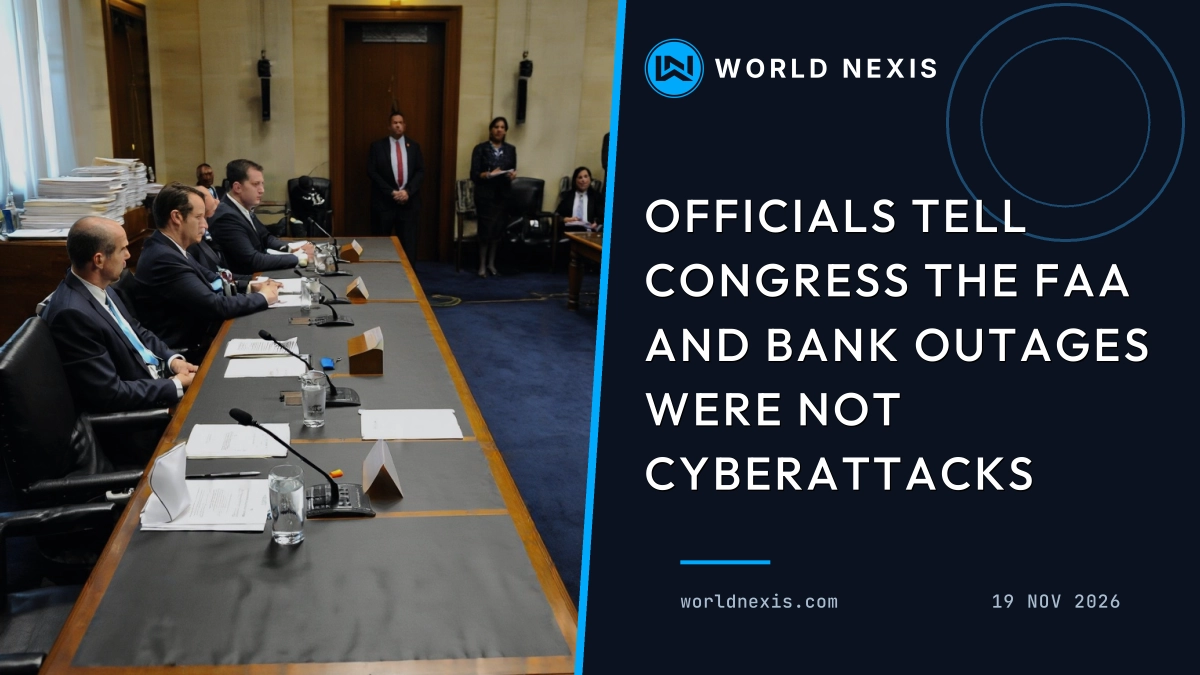
Clayton appeared alongside Homeland Security Secretary Markwayne Mullin and Deputy FBI Director Christopher Raia at the House Homeland Security Committee’s annual hearing on worldwide threats to the homeland, held 25 years after the September 11 attacks. The session became the most detailed public account yet of what went wrong.
In his opening remarks, Clayton said: “I understand the timing of these incidents can raise questions, and it should.” He went on: “Based on what we know today, after a great deal of diligence, these are separate service outages associated with maintenance and technical changes. They are not a coordinated or state-sponsored attack.”
Asked by Representative Dan Goldman of New York whether the failures were linked, Clayton replied: “We have no indication that these events are related.” He then warned that older systems will keep breaking, saying the rising speed of compute means legacy systems “that were old six months ago in a year are a lot older”.
On a background call with reporters, a senior administration official said: “We have no indication that this is a cyberattack, that these incidents are some kind of cyberattack, that these incidents are connected to a particular actor or groups of actors, or that there’s any type of state sponsorship here.” The official said the government has “a great deal of confidence” that system upgrades, patching and hardware changes explain the failures.
Three failures, three different causes
The US tech outages have been unusually varied in scope, and officials reject the idea of one thread linking them. Rubio, speaking the day before the hearing, called the failures “completely unrelated” and said they had “nothing to do with a cybercriminal”, a “hostile actor or another country”.
He described the US tech outages as “unsettling” but argued that they have mundane roots. “Each of them are distinct, and they’re different in their causation,” he said, adding that there is “zero evidence” of a common cause or malign intent.
The incidents have grounded flights, cut off access to work systems, limited access to bank accounts and disrupted classified communications. The NSA said its network issues occurred during “scheduled routine maintenance” and that “mission-critical capabilities remain fully operational and our ability to defend national security continues”.
The Federal Aviation Administration ordered a rare nationwide ground stop last week, halting departures across the country. Microsoft’s Outlook service and several large banks also reported failures, which is why the FAA ground stop became the most visible symbol of a much wider problem.
Why it matters
For anyone caught up in the US tech outages, the practical message is that these failures were ordinary — and that ordinary is now expensive. A ground stop cascades through crew rosters and connections, a banking outage lands on payday, and a classified network failure slows decisions.
The deeper issue is trust. When unrelated systems fail inside a single week, the public has no independent way to check the government’s word. Confidence in digital infrastructure becomes a political question, not just an engineering one, and the next US tech outages will be judged against what officials said this week.
Analysis
Having covered cybercrime and critical infrastructure for World Nexis News, I look first for the fingerprint of an attack: a shared vendor, a shared exploit, a shared timing window, or a ransom demand. None of that has surfaced. Instead we have different operators, different failure modes and one agency publishing its own maintenance notice, which is what accumulated technical debt looks like when it lands at once.
I think the administration’s explanation is the better supported of the two competing accounts, and Rubio’s zero-evidence line is a fair summary of what has been disclosed. The strongest counter-argument is that “no indication” is a judgment, not proof. A patient adversary testing response times would want exactly this: agencies insisting nothing is coordinated while publishing no logs.
What would settle it for me is a published timeline for each failure and an outside review of the air traffic systems in particular. Until then, the reasonable position is that the US tech outages were probably accidents — and that we are one coincidence away from an accident that looks exactly like an attack.
What happens next
The political calendar now collides with the diplomatic one. Trump is due to hold a trilateral meeting with Xi and Putin on the sidelines of the APEC summit in Shenzhen on Thursday, with questions about the US tech outages following him to the table.
Clayton told lawmakers that scrutiny is legitimate. “The American people should ask us these questions,” he said, which means follow-up queries now sit on the oversight calendar rather than being closed off by a single hearing.
What we don’t know yet
- Whether any agency will publish technical logs or timelines that support the maintenance explanation.
- What precisely triggered the FAA ground stop, and how many flights and passengers were affected.
- Whether the companies involved, including Microsoft, will give their own accounts.
- Whether lawmakers will seek a formal assessment beyond the public testimony already given.
Related coverage
- Tech outages unrelated, Rubio insists, after 5 disruptions
- Cambridge Word of the Year 2026: ‘human’ wins amid AI fears
- Apple outage: iCloud, Apple Pay restored after 2,000 reports
Further reading
- BBC correspondents discuss historic Trump, Xi and Putin meeting
- All-Star Panel: Officials Try to Ease Concerns Over Tech Outages
About the author: Priya Nair is the Technology Correspondent at World Nexis News (WNN), covering technology. The analysis section reflects the writer’s view.

Priya Nair
Priya Nair is Technology Correspondent at World Nexis News, covering artificial intelligence, cybersecurity, consumer devices and the companies building them. Based in London, she explains how new technology works, who it affects and what the evidence actually shows, with attention to privacy, competition and the…