Tech outages unrelated, Rubio insists, after 5 disruptions
Tech outages across Microsoft, the FAA, US banks and the NSA are unrelated, Secretary of State Marco Rubio says, as experts warn on resilience.
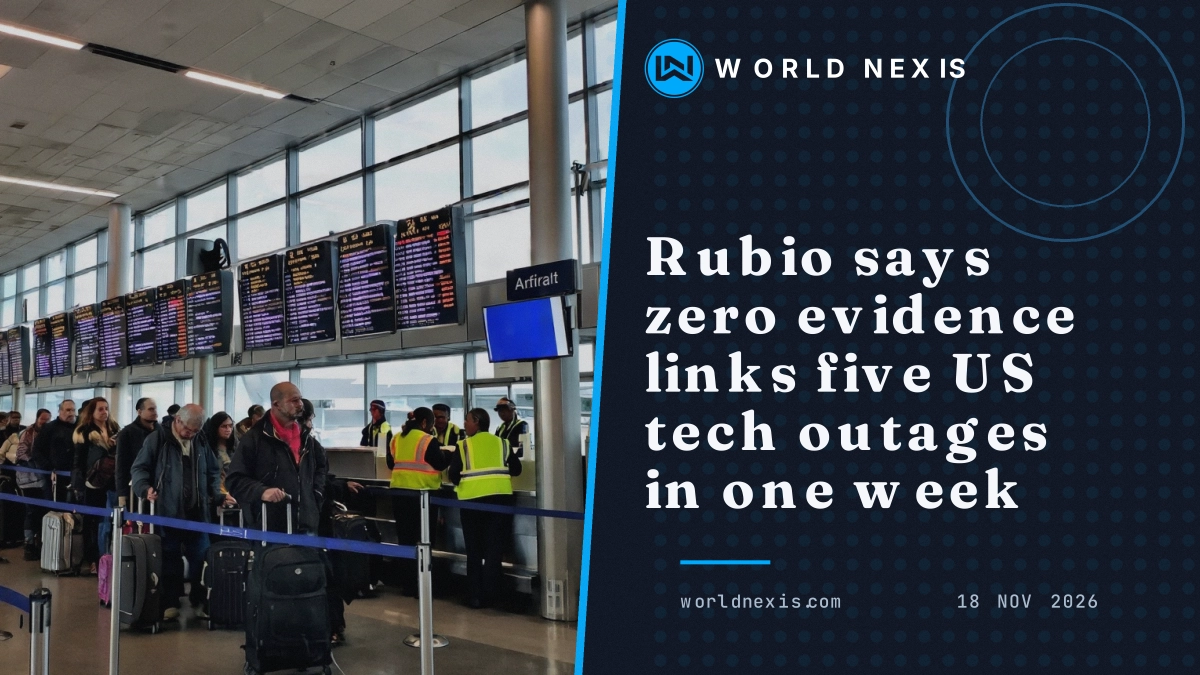
Secretary of State Marco Rubio said there is “zero evidence” that the tech outages hitting US air travel, banking and government systems are connected, telling a news conference in the Philippines that the country is not under systemic attack. The failures began on Thursday with a worldwide Microsoft disruption and ran through Friday’s Federal Aviation Administration ground stop, outages at major banks and Apple services, and an internal National Security Agency network going offline on Tuesday.
Key points
- Rubio said the tech outages at Microsoft, the FAA and the banks are “completely unrelated one from another”, with no reason to suspect hackers, criminals or a nation state.
- Microsoft blamed a technical issue for Thursday’s disruption; officials traced Friday’s nationwide ground stop to a contractor carrying out maintenance updates.
- Senator Mark Warner said there is no sign of an attack, but warned that artificial intelligence is making vulnerabilities easier to find.
- Brock Lameres of Montana State University said the incidents could be “a series of coincidences” and that resilience matters more than blame.
Rubio says tech outages are ‘distinct’ and unconnected
Rubio, speaking on Wednesday morning local time while travelling with President Donald Trump, rejected speculation that a single adversary was behind the sequence. “The Microsoft incident has nothing to do with what we saw with the FAA. The FAA has nothing to do with what we saw with the banks a few days ago,” he said. “These issues that we’ve seen from a technical standpoint are completely unrelated one from another.”
He added: “We have zero evidence or any reason to believe that any of these isolated or individual instances have anything to do with nefarious actors, with cyber hackers, with criminals, with another nation state, with a malign actor of any kind.” Rubio acknowledged that people are fearful and uncertain, and said he wanted to be clear that the United States is not under systemic attack. “Each of them are distinct, and they’re different in their causation,” he said.
Each of the tech outages has drawn a different explanation. Microsoft said its disruption to Outlook and Teams was linked to a technical issue rather than malicious or cyber activity. Federal officials identified a contractor performing maintenance updates as the cause of Friday’s ground stop, though CBS News reported that key questions remain about the underlying cause of the systemwide failure. Disruptions at JPMorgan Chase, Bank of America, U.S. Bank and Apple’s services have since been resolved.
The NSA network caught up in the tech outages
On Tuesday the National Security Agency’s internal network, used to store and share classified information, went offline, according to multiple US officials quoted by CBS News. The agency said it “experienced temporary degradation” during scheduled routine maintenance, the Hindu BusinessLine reported. Workday was also among the platforms affected during the week.
Senator Mark Warner, vice chair of the Senate Intelligence Committee, said there was no indication the incidents resulted from an attack, but argued that AI is changing the risk picture. “AI is making it possible to identify vulnerabilities across enormous numbers of systems at unprecedented speed,” he wrote on X. “It feels like every day brings another reminder that AI is moving faster than our ability to manage its consequences.”
Asked about AI’s role, Rubio declined to speculate, saying every incident is unique and referring questions to individual companies. Trump, attending the ASEAN economic conference in Manila, played down the run of incidents, saying things “like that happen” and that “it’s fine”, according to the Hindu BusinessLine.
Why tech outages ripple far beyond where they begin
In Montana, whether the failures were linked matters less than what they reveal about dependence on software. Brock Lameres, a professor of electrical and computer engineering at Montana State University, told KTVQ there is no evidence pointing to a coordinated cyberattack. “There’s no evidence at this moment that it is a cyber attack,” he said. “So it could be a series of coincidences that just all are happening at once.”
Lameres argued that the deeper problem is concentration. “When one fails, it has kind of a trickle-down effect and it influences a whole bunch of other computer chips,” he said. “We didn’t use computer chips every second of the day, but now we do.” He added that systems must be built to survive failure, with backups and cybersecurity designed in from the start.
Distance offers little protection. Jeff Roach, director of aviation and transit at Billings Logan International Airport, said nationwide aviation problems reach Montana with a lag. “Typically we don’t see the impact here for a few hours,” he said, long enough for a fault elsewhere to strand passengers locally.
Hospitals carry the highest stakes. Justin Ott, chief information officer at One Sky Health, formerly Billings Clinic, said the system did not experience the recent tech outages but plans on the assumption that something will fail. “It’s not if it’s going to go down. It’s when it’s going to go down,” he said. “We don’t look at it as a technology issue. We look at it as a patient care issue.”
Security specialists told the Hindu BusinessLine that most tech outages are not attacks, but that confusion creates openings for fraud. Cynthia Kaiser, a former senior FBI cyber official now at the firm Halcyon, said a single technical failure or software update “can cascade with outsized effects across critical systems”. Consumers were urged to use multi-factor authentication, turn on automatic updates, choose strong passwords and stay alert to scams.
Analysis
Having covered cyber policy for WNN, I look first at causation rather than the calendar. Five failures in six days look like a pattern, but a pattern is not a conspiracy, and nothing in the public record points to one hand behind a Microsoft patch, an FAA contractor and an NSA maintenance window. On attribution I side with Lameres: “zero evidence” is an accurate description of what is known, and Rubio was right to say it plainly before speculation hardened into fact.
The strongest counter-argument is that “no evidence” describes the present, not the past, and officials reach for it quickly, which can close down the questions that root-cause work exists to answer. That is a fair warning, and it is why the unresolved details of the FAA ground stop deserve scrutiny rather than a shrug. It still does not make the opposite claim any more supportable.
What matters more for readers is the conclusion Lameres draws. Whether or not these tech outages share a cause, the week showed that a maintenance update, a router or a routine patch can reach an airport queue, a hospital ward and a classified network within hours. Resilience is not a slogan; it is the backup generator, the paper record and the rehearsed downtime drill.
What happens next
Rubio said the administration is “always on the lookout” for potential attacks, but did not announce any new measures. He is travelling with Trump ahead of a trilateral meeting with Russian President Vladimir Putin and Chinese President Xi Jinping this week.
Key questions remain about the underlying cause of Friday’s systemwide FAA ground stop, while Microsoft has said its own disruption was technical rather than malicious. Security specialists told the Hindu BusinessLine that consumers should enable multi-factor authentication, switch on automatic updates, use strong passwords and watch for scams that follow high-profile tech outages.
Related coverage
- Bank outages ease as Apple confirms iCloud and Apple Pay disruption
- Apple outage: iCloud, Apple Pay restored after 2,000 reports
- Jensen Huang testimony: Congress sets 1 December showdown
Sources
- Rubio says there (cbsnews.com)
- Why recent tech outages could have ripple effects in Billings (ktvq.com)
- Tech outages and cybersecurity risks: 5 ways to protect your data (thehindubusinessline.com)
- Rubio says ‘zero’ information that US outages are linked or caused by a malign actor (wlwt.com)
- Rubio says ‘zero’ information that US outages are linked or caused by a malign actor (arabnews.com)
About the author: Priya Nair is World Nexis News’s Technology Correspondent, covering technology. The analysis section reflects the writer’s view.

Priya Nair
Priya Nair is Technology Correspondent at World Nexis News, covering artificial intelligence, cybersecurity, consumer devices and the companies building them. Based in London, she explains how new technology works, who it affects and what the evidence actually shows, with attention to privacy, competition and the…