UK retail sales rise 0.7% as clothing and stockpiling lift October
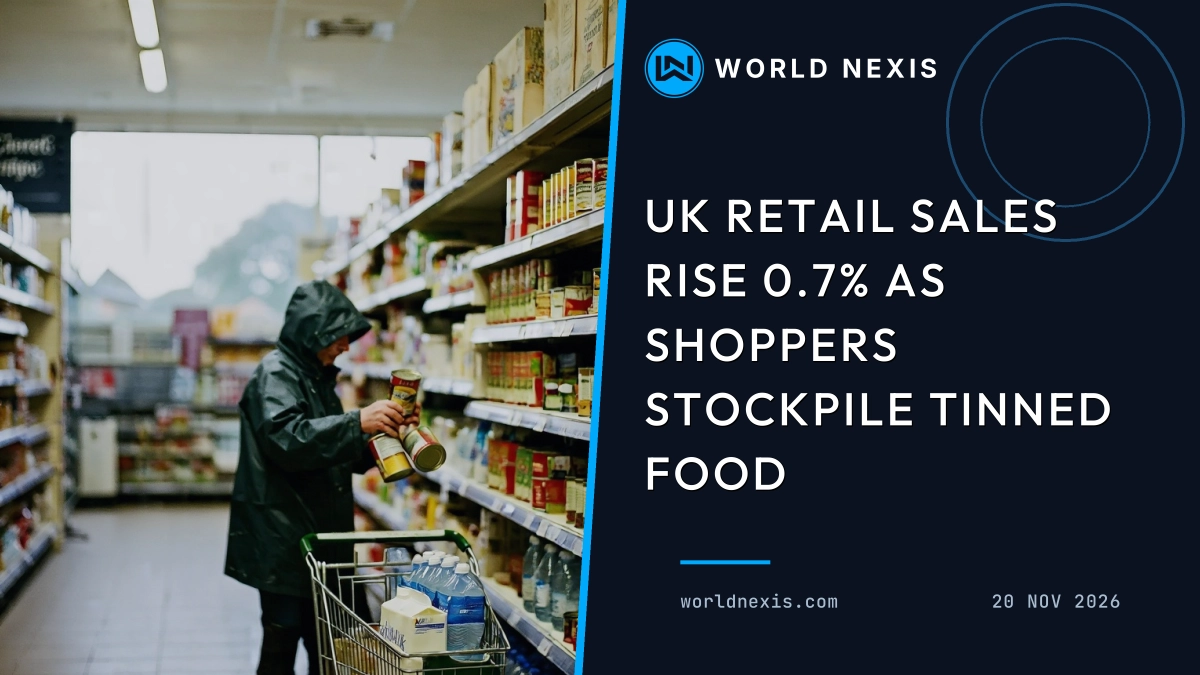
UK retail sales volumes rose 0.7% in October as supermarkets reported stockpiling of tinned food and UHT milk after the government's Be Ready campaign.
Updated 20 Nov 2026, 09:41 (UK time): Fresh ONS detail shows October’s UK retail sales gain was broader than stockpiling, with clothing volumes up 1.5% and motor fuel volumes down 2.2%, correcting the earlier picture that fuel supported the month.
The ONS breakdown of October’s UK retail sales rebound is wider than the headline suggested. Alongside the food store gain, clothing and footwear volumes rose 1.5% on the month as more typical autumn weather replaced the warm September that had dented demand for autumn and winter ranges. Other non-food stores recorded their strongest rise since January, helping total non-food volumes up 1.1%. Non-store retail, mainly online, rose 0.9%.
The fuel line cuts the other way. Motor fuel volumes fell 2.2% in October, the steepest drop since April, as higher pump prices kept motorists away. That corrects our earlier framing: fuel did not add a second prop to the month, it subtracted from it. The stockpiling story sits on a narrower base than first appeared.
The same morning brought public finance figures. Government borrowing was £17bn in October, below analysts’ forecasts of about £18bn but £0.8bn above the same month last year, while debt interest of £11.2bn was the highest October reading on record, pushed up by inflation at 3.6%.
My reading is unchanged on the food effect but firmer on the composition: a month lifted by tinned goods, a wardrobe refresh and a weak September base is not a consumer recovery. One honest caveat on the new numbers — the clothing gain may simply be weather catching up, not confidence returning.
UK retail sales volumes rose 0.7% in October, the Office for National Statistics said on Friday, as supermarkets reported a lift in demand for tinned food and long-life milk after ministers launched the Be Ready emergency preparedness campaign. The gain beat economists’ forecasts of a 0.1% fall and reversed a 0.6% decline in September.
Key points
- UK retail sales volumes climbed 0.7% in October, against a forecast decline of 0.1%.
- Food store sales rose 0.8% month on month, the strongest increase in six months.
- Supermarkets told the ONS that sales of long-life items such as tinned goods and UHT milk rose after government advice.
- Sales volumes were 0.4% higher in the three months to October than in the previous quarter.
The UK retail sales rebound in numbers
October’s reading marks a sharp turnaround from a weak September. The ONS now estimates that sales volumes fell 0.6% that month, a deeper decline than it first reported. The October move therefore started from a lower base than the original figures implied.
Economists had expected a small decline, so the release landed as an upside surprise. Over the three months to October, sales volumes were 0.4% higher than in the previous quarter, a smoother reading that irons out monthly noise.
Food stores did most of the work. Sales volumes there rose 0.8% on the month, the best performance in six months, as households restocked cupboards with goods that keep. The ONS collects that detail from retailers themselves, so the shift in shopping habits comes from supermarket tills rather than survey estimates.
“Supermarkets have told us that sales of long-life food items such as tinned food and UHT milk were boosted by the government’s ‘Be Ready’ campaign,” said Grant Fitzner, chief economist at the ONS.
Fuel offered a second, smaller support. Fitzner said fuel sales had been “recovering from earlier low levels, despite pump prices rising again”.
Inside the Be Ready stockpiling effect
The Be Ready campaign sits behind part of the UK retail sales gain. It asks households to keep around three days’ worth of bottled water and non-perishable food at home, so that essential services can be restored without a scramble.
In October, Defence Secretary Wes Streeting warned that households and businesses should prepare for “increasingly sophisticated cyber attacks” and for potential disruption to essential supplies, urging them to stock key items.
The products named by supermarkets are built for storage. Tinned goods and UHT milk last for months without refrigeration, and both fit the non-perishable category the government advised households to hold.
Food shops move the national number
Grocery volumes carry real weight in the monthly retail index, which is why a change in weekly shopping habits shows up quickly at national level. October’s overall gain came with food leading the way, while the long-life lines gave the clearest signal of why.
Why it matters
For households, the UK retail sales figures are a reminder that preparedness has a cost. Three days of bottled water and non-perishable food is a modest outlay for most families, but the same shop weighs far more heavily on the tightest budgets.
For the economy, the rebound flatters a single month of growth without showing that consumers feel better off. Spending prompted by a warning about cyberattacks and severe weather can fade once the cupboard is full, which leaves retailers with a weaker autumn than the headline suggests.
Analysis
On this beat I spend most of my time separating demand that repeats from demand that happens once, and on that test the October UK retail sales print looks more like a one-off top-up than the start of a consumer recovery. The composition gives it away: food stores up 0.8%, long-life lines singled out by name, and a government campaign that told shoppers exactly what to put in the trolley. A planned shop is easy to complete and hard to repeat the following month.
There is a fair counter-argument. Money in a supermarket till is still money, it supports output in the quarter, and a household with three days of supplies is less likely to strip the shelves if a disruption actually arrives. Public preparedness has genuine value, and the ONS has measured it honestly.
Even so, I side with the cautious reading. The ONS itself describes food sales as boosted by the campaign, which is a policy effect rather than a sign of confidence. I would want November and December food volumes, once the campaign news fades, before calling this a recovery in UK retail sales.
What happens next
Attention now turns to the next monthly release, which will show whether the UK retail sales rebound carried into the winter or stopped once cupboards were full. Retailers will also be watching whether shoppers repeat the three-day shop, or drift back towards fresh food and discretionary spending.
What we don’t know yet
Whether the October lift was a first stockpile for most households or a top-up for a few. And whether the extra spending came out of other budgets, leaving total household spending roughly unchanged.
Related coverage
- Food bank donations critically low at 43% of Trussell sites
- Australian shares lose $174bn in worst week since March 2020
- Anthropic IPO closes up 17% as protests target record debut
Further reading
- Tinned food and long-life milk boost retail sales after ‘Be Ready’ campaign launch
- Supermarkets drive UK retail rebound as shoppers stockpile tins and UHT milk
About the author: Daniel Whitmore is the Business & Markets Editor at World Nexis News (WNN), covering business & markets. The analysis section reflects the writer’s view.

Daniel Whitmore
Daniel Whitmore is Business & Markets Editor at World Nexis News, based in New York. He leads coverage of companies, economies, markets and the forces that move them, from central bank decisions to corporate earnings and the cost-of-living pressures facing households on both sides of…



