Trump tariff proposal: 14 economies face major hikes in 2027
The Trump tariff proposal would add 20% on Chinese goods and hit 14 economies from early next year, raising costs for US shoppers and businesses.
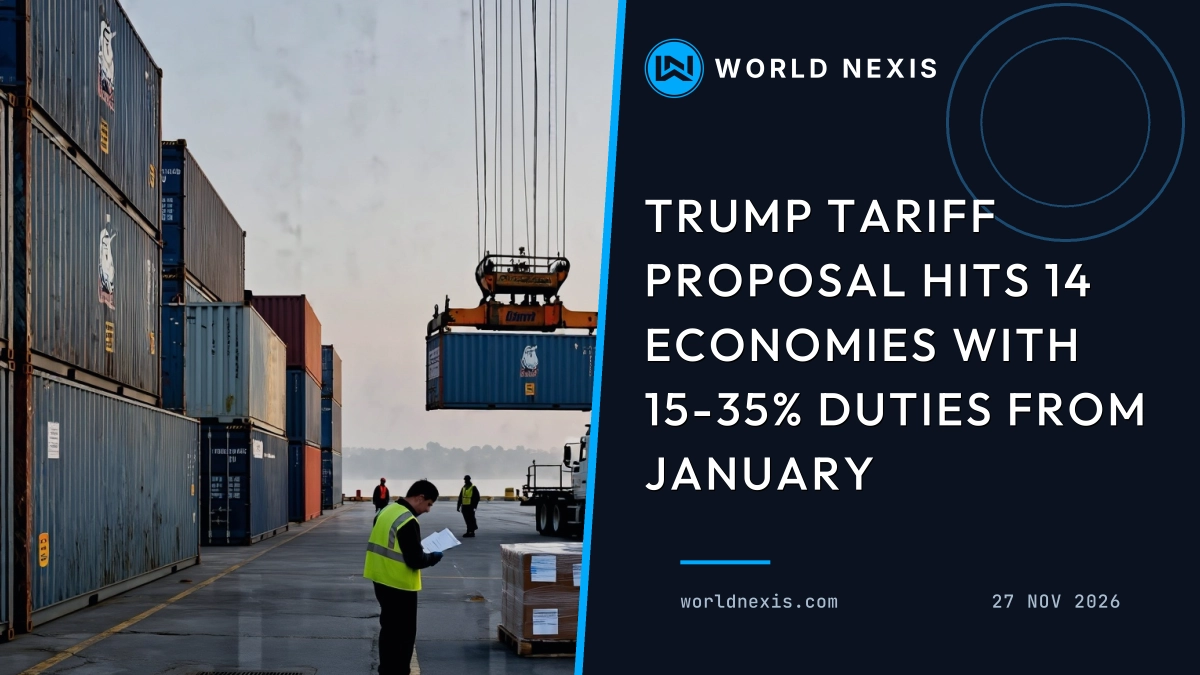
The Trump tariff proposal has entered its public comment phase, and the duties it sets out would not apply before January at the earliest. The package covers 14 economies, adds 20 percentage points to Chinese imports and sets levies of 15% to 35% on selected goods from the European Union, India, Japan and others.
Nothing is being collected yet. A senior administration official said a comment period must run first, and Jamieson Greer, the US Trade Representative, said he did not think any of the duties “would actually take effect earlier than a couple months from now”.
Key points
- Under the Trump tariff proposal, Chinese imports would face an additional 20%, taking the combined China tariffs to 45%, and officials say that extra charge could double to 40% if Beijing does not honor the trade truce.
- The other partners would face rates between 15% and 35%, aimed at specific product lines rather than whole economies.
- The Section 301 tariffs rest on the Trade Act of 1974, the route the White House took after the Supreme Court struck down its earlier global levies.
- All 14 governments have been informed, and the administration says it does not expect retaliatory action.
What the Trump tariff proposal would change
The administration’s case centers on excess factory capacity. Greer argues that too many partners are expanding manufacturing output without expanding the demand that would absorb it. “They’re increasing supply overseas without actually increasing consumption overseas,” he said. “We have a very consumption-driven economy, and we should be producing more of that here in the United States.”
That argument closed months of investigations. The USTR found that the acts, policies and practices of 14 economies relating to structural excess capacity in manufacturing “are unreasonable and burden or restrict U.S. commerce”.
The Trump tariff proposal treats China differently from the rest. The new 20% would sit on top of pre-existing 25% levies tied to forced technology transfer, which is how the combined rate reaches 45%. Officials have also said the extra charge could double to 40% if Beijing breaks the truce that talks are meant to protect.
For everyone else the design is narrower. The proposed duties are meant to replace the levies the Supreme Court invalidated rather than stack on existing charges, and Mexico and Norway remain under investigation with no new rates proposed for either.
Tariffs have been the centerpiece of the president’s economic agenda, presented as a way to rebuild US manufacturing, protect jobs and shrink the trade deficit. Each court ruling has narrowed how he can pursue that, pushing the administration toward smaller, more heavily documented cases.
The legal gamble behind the Trump tariff proposal
The Supreme Court’s decision earlier this year to invalidate most of the tariffs imposed under the International Emergency Economic Powers Act reshaped the agenda in a single stroke. It forced the government to issue refunds to thousands of affected businesses and sent officials hunting for other statutes, including Section 232, which covers imports judged a national security threat.
Section 301 is slower by design. It lets the USTR respond only once it has determined that a partner’s practices are unfair, and that determination has to be published, tied to product lines and opened to comment before any money is collected. That is why the timetable now runs into next year rather than next week.
Pushback from trading partners
Beijing has rejected the logic of the plan. “Tariff wars and trade wars serve no one’s interests,” Chinese foreign ministry spokesperson Guo Jiakun said. “Relevant issues should be resolved through consultation on the basis of equality, mutual respect and mutual benefit.”
Greer has framed the package as a negotiating instrument as much as a tax, saying the US expects “a broad, even a plurilateral negotiation to talk about excess capacity and how to resolve it”.
Why it matters
Tariffs are taxes on imported goods, and the cost is usually passed through to buyers. Under the Trump tariff proposal, US households would see the first visible effects in early 2027, when the duties are due to begin, and would feel them on whichever product lines survive the comment period.
The average statutory US tariff rate stands at 11.2%, according to the Yale Budget Lab, so this package lands on an economy that has already absorbed several rounds of duties. For companies importing from several of the 14 economies at once, the compliance paperwork may matter as much as the rate itself.
Analysis
Having covered markets and central banking for World Nexis News for five years, I read this proposal less as a shock than as a repair job. The number that matters is not the 45% headline on China. It is whether these duties can survive a courtroom, because the last set did not.
In my view the Trump tariff proposal has been built for durability over spectacle. Section 301 findings take time, and the January window allows a comment period that would be hard to unpick later. The strongest counter-argument is that the levies largely replace what already existed, which is why Capital Economics’ Stephen Brown called the announcement “not as alarming as it looks”. He may be right about the arithmetic and still wrong about the effect, because companies price the expectation of a tariff, not only the final rule.
Where I part company with the White House is on the consumer side. A 15% to 35% band on targeted goods will show up in import prices long before it shows up in court filings, and January is close enough that shoppers, not lawyers, will feel it first.
What happens next
The comment period runs first. Officials point to January as the earliest point for completing those procedural steps, and Greer has said nothing will take effect sooner than a couple of months.
Negotiations with all 14 partners are expected to continue, with the administration aiming at a plurilateral conversation on excess capacity. The Mexico and Norway investigations remain open, so further proposals are possible there.
What we don’t know yet
Three questions are unresolved. The final product lists have not been published, so the real rate on any given shipment is still unknown. It is unclear whether the conditional increase on China would be triggered. And no court has yet tested this use of Section 301, which means the timetable for the Trump tariff proposal could be rewritten again.
Related coverage
- Pentagon drone talks: GM and Ford face major conversion test
- Trump tariffs: major duties hit 14 US trading partners
- Trump Putin talks: he urges major pull-back in Europe
Further reading
- Trump administration to introduce new tariffs on China, EU and 12 other major trading partners
- Trump admin proposes new tariffs on China, EU and 12 other trading partners
About the author: Daniel Whitmore is the Business & Markets Editor at World Nexis News (WNN), covering business & markets. The analysis section reflects the writer’s view.

Daniel Whitmore
Daniel Whitmore is Business & Markets Editor at World Nexis News, based in New York. He leads coverage of companies, economies, markets and the forces that move them, from central bank decisions to corporate earnings and the cost-of-living pressures facing households on both sides of…



