Al Gore newspaper deal keeps 113-year-old Courier alive
The Al Gore newspaper deal for the 113-year-old Carthage Courier keeps all staff and ends 50 years of family ownership, as 170 US papers closed in a year.
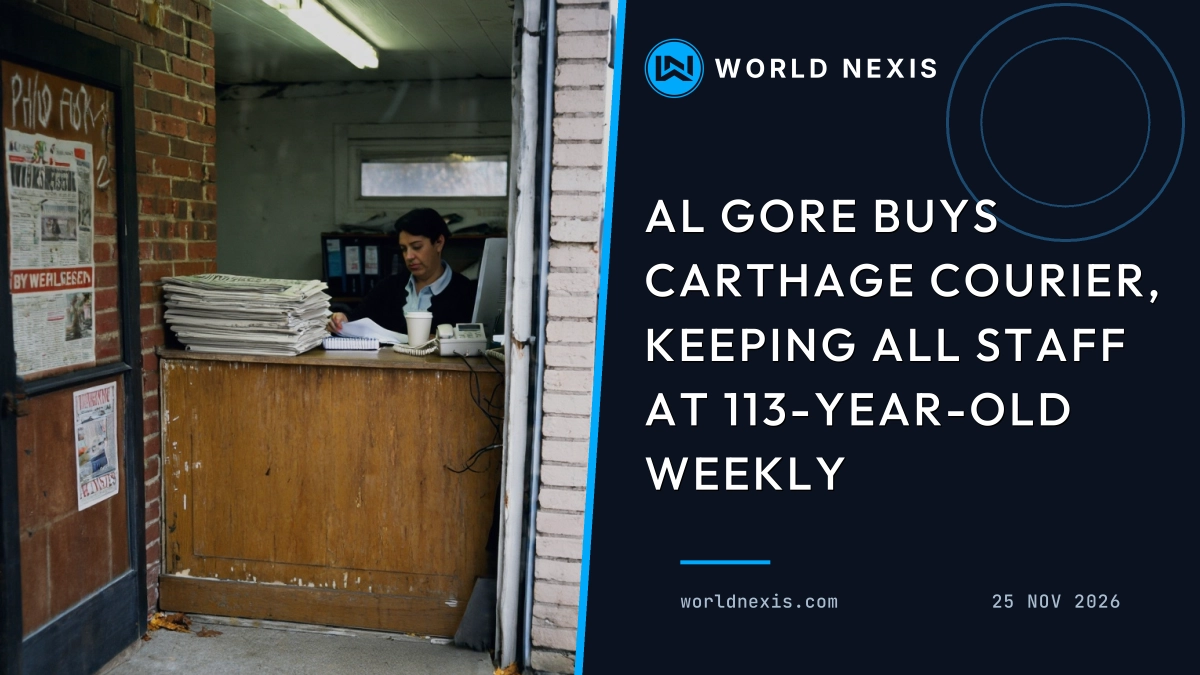
The Al Gore newspaper deal for the Carthage Courier will keep every current employee in place, the 113-year-old weekly has confirmed, with publication continuing while ownership passes from the Lake family over the coming weeks. Terms of the sale were not disclosed.
Gore, the former vice president whose hometown is Carthage, cast the purchase as the preservation of a local institution rather than a media investment. “I am a firm believer that a free, independent local press is irreplaceable for the enduring health of our community,” he said in a statement.
Key points
- The Al Gore newspaper purchase ends 50 years of Lake family ownership of the Carthage Courier, a weekly serving Smith County, Tennessee.
- All current staff will be retained and the paper will keep publishing through a transition expected to close in the coming weeks.
- Longtime publisher Scott Winfree moves to a part-time advisory role because of health issues; Roger Wells becomes publisher.
- The Courier published its first edition in July 1913 and serves a county of roughly 20,000 people about 55 miles east of Nashville.
What the Al Gore newspaper deal changes in Carthage
The Al Gore newspaper deal is a change of owner, not of personnel. The Courier said every current employee will be kept on, and that editions will continue without a break during the handover. The sale agreement is expected to be finalized in the coming weeks.
The bigger internal shift is at the top of the paper. Scott Winfree, its longtime publisher, will move into a part-time advisory role because of health issues, and Roger Wells will succeed him as publisher.
In comments on the Al Gore newspaper deal, Gore credited the Lake family’s “decades of leadership in supporting independent news here in Smith County”. He said that when his hometown paper came up for sale, he saw “an opportunity to help preserve the Courier as an independent voice for Carthage and Smith County”.
A 113-year-old paper and a 50-year family run
The Courier has chronicled Smith County since July 1913, covering local government, education and community affairs. Its own history includes the early political career of Gore’s father, Albert Gore Sr., who represented Tennessee in both the House and the Senate.
The Carthage Courier sale ends five decades of family ownership. The Lake family put the paper on the market this fall, and Geraldine Lake, who ran it with her husband Hershel, died in early November.
The Al Gore newspaper purchase also returns him to journalism, the trade he worked in before politics. He served as a military reporter in the US Army during the Vietnam War and later worked as an investigative reporter at The Tennessean in Nashville. He went on to co-found the cable network Current TV with Joel Hyatt in 2005, which was sold to Al Jazeera in 2013.
The market behind the Al Gore newspaper deal
Local ownership of small papers is getting rarer. According to an October report from Northwestern University’s Medill School of Journalism, more than 425 local newspapers changed hands in the past year, up 75% year on year. Over the same period 170 papers closed or merged, and the number of US counties without a locally based professional news outlet rose to 238.
That consolidation has widened local news deserts across the country, and it is the backdrop to this sale. Tim Franklin, who chairs the local news program at Medill, said Carthage residents may approach the deal with “some healthy skepticism” about a politician owning their paper. He said he would nonetheless be surprised if the Courier “becomes a mouthpiece for the Democratic Party”, and wondered whether Gore might write a column and whether the paper would stay tightly focused on local news.
Why it matters
For households in Smith County the immediate effect is continuity: the same reporters, the same weekly edition, and an owner with a personal stake in the place. That matters because the Courier carries the meetings nobody else attends, from county commissions to school boards, and that record is hard to rebuild once it stops.
Nationally, the Al Gore newspaper deal is a modest test of a much bigger question. Can individual buyers with local roots slow the loss of local news, or do they only postpone it?
Analysis
As a business editor, I look first at the counterfactual in any small-town sale. The realistic alternatives for a 113-year-old weekly whose family owner has just died are usually a regional chain, a consolidator or closure, and none of those promises to keep the whole staff on day one. On the evidence in the public statements, this is the least disruptive of the available outcomes.
I also think the skepticism is fair. A paper covering county politics with a former vice president as proprietor carries an obvious conflict risk, and Franklin’s test about a “mouthpiece” is the right one to apply. The answer should be judged by what the Courier prints about local campaigns over the next two years, not by the owner’s party label.
My view is that the facts support the sale. The strongest counter-argument, that political ownership corrodes trust in a paper that has none to spare, is real, but a trust problem can be argued about in public, while a closed newsroom cannot.
What happens next
The Al Gore newspaper deal is expected to close in the coming weeks, after which Wells takes over as publisher and Winfree moves into his advisory role. The paper has said it will publish as normal throughout, so readers should see no gap in editions.
What we don’t know yet
The price and full terms were not disclosed. Neither side has set out plans beyond keeping the current team, which leaves open questions about page counts and digital investment, and about whether Gore will write for the paper at all. The first editions after the handover will show whether anything changes in how county politics is covered.
Related coverage
- Kushner Albania resort: $130m land deal faces forgery inquiry
- Scottish independence referendum: SNP’s 12-year EU warning
- Thanksgiving meal prices climb 3% as turkey costs bite
Further reading
- Al Gore buys hometown Tennessee newspaper, vows to preserve local outlet’s ‘independent voice’
- Al Gore to Buy Hometown Tennessee Newspaper Carthage Courier
About the author: Daniel Whitmore is the Business & Markets Editor at World Nexis News (WNN), covering business & markets. The analysis section reflects the writer’s view.

Daniel Whitmore
Daniel Whitmore is Business & Markets Editor at World Nexis News, based in New York. He leads coverage of companies, economies, markets and the forces that move them, from central bank decisions to corporate earnings and the cost-of-living pressures facing households on both sides of…



