Thanksgiving meal prices climb 3% as turkey costs bite
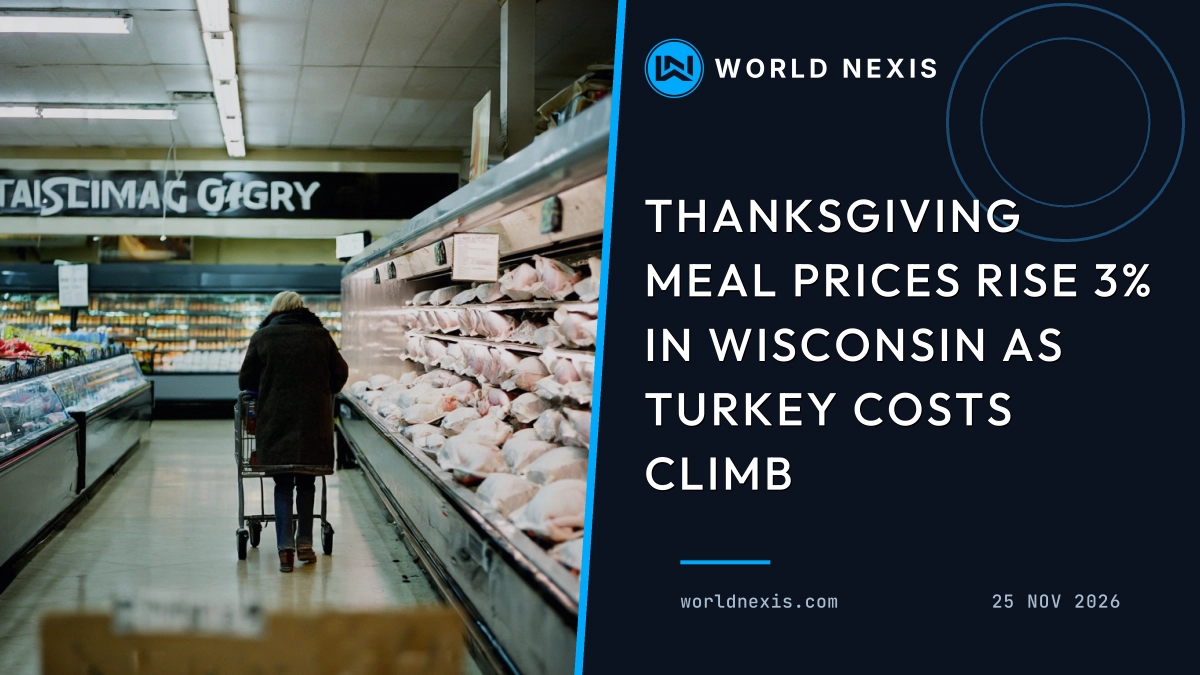
Thanksgiving meal prices are up about 3% in Wisconsin and 6% nationally, with turkey the biggest driver. Here is what it means for your grocery bill.
Updated 27 Nov 2026, 03:21 (UK time): Food banks across the U.S. report a surge in families seeking Thanksgiving help, and a powerful nor’easter has delayed more than 2,000 flights and postponed the Macy’s parade, moving the cost story from shelf prices to queues and airports.
Food banks around the country are reporting heavier demand than they planned for in the final days before Thanksgiving. The Tarrant Area Food Bank in North Texas said more than 5,400 families turned out at its annual distribution outside AT&T Stadium after it had prepared for about 4,000, with the first car queueing from 10pm the night before. Its president and chief executive, Julie Butner, said the turnout showed how many households are struggling. In Virginia, an estimated 3,000 families sought help, and groups in Reno also reported a bigger response than last year.
The organisations point to the same numbers in our earlier reporting: a traditional meal costing about 6% more than a year ago on the American Farm Bureau Federation’s basket, with a whole turkey up roughly 10%. What has changed is where that increase shows up. A grocery receipt is a private calculation; a line of cars is a public one, and several states are now seeing it at once.
Travel has been disrupted too. A powerful nor’easter along the East Coast delayed more than 2,000 flights and led to more than 400 cancellations, and the Macy’s Thanksgiving Day Parade was postponed, with forecasters warning of coastal flooding during a period when AAA expects 81.5 million people to travel at least 50 miles.
The basket averages we published explain the shape of this holiday, but the queues explain its mood. I would still treat charity turnout as a rough gauge rather than a statistic — a well-publicised giveaway will always pull a crowd — yet the fact that food banks ran short of turkeys is harder to argue with than any percentage.
Thanksgiving meal prices are climbing again after three flat years in Wisconsin, where the state Farm Bureau’s annual survey puts a dinner for 10 at about 3% more than last year. The same survey found a 16-pound turkey costing $1.12 more than in 2025, a rise of roughly 4%.
It is the first increase in three years, and it lands on households already stretched by the weekly shop. Nationally, the American Farm Bureau Federation puts the traditional meal at $58.63 — 6% above a year ago, but still below the record $64.05 of 2022.
Key points
- The Wisconsin Farm Bureau survey shows Thanksgiving meal prices up about 3% for 10 people, the first rise in three years.
- A 16-pound turkey is $1.12 more expensive in Wisconsin, about 4%, while the national Farm Bureau reckons a bird at around $24, up roughly 10%.
- Retailers are undercutting both surveys: Walmart advertises a $35 basket for 10, Target a $30 meal for six and Aldi a dinner for 10 under $39.
- Gas is well below its summer peak but above last Thanksgiving, with the national average at $3.61 a gallon.
Why Thanksgiving meal prices are climbing
The two surveys of Thanksgiving meal prices measure different baskets, so their headline figures were never going to match. Wisconsin’s exercise prices a set of popular items for a meal serving 10. The national American Farm Bureau survey has tracked a fixed basket for more than 40 years.
Both trace the increase back to the farm gate rather than the checkout. Cassie Sonnentag, senior director of public relations at the Wisconsin Farm Bureau Federation, said a higher shelf price does not hand growers a windfall.
“So even though we’re seeing those prices jump on the grocery store side, farmers are not making a windfall from that purchase,” she said. “We’re coming off of a very challenging year when it comes to diesel prices, fuel costs, different inputs like fertilizer and different applications.”
The Wisconsin body said the turkey market is showing signs of recovery, but that growers continue to face challenges, with costs and last year’s bird flu cases behind the increase.
Faith Parum, deputy chief economist at the American Farm Bureau Federation, framed the national number the same way.
“The overall increase in our annual survey reflects the rising costs of getting food from the farm to your dinner table,” she said. “High diesel prices and a shortage of farm labor have taken a toll on the farm level of the food supply chain.”
Inside the national basket, cranberries, whole milk and dinner rolls went up. Veggie trays, frozen pie crusts, frozen green peas and whipping cream came down.
Turkey prices drive the split between surveys
Almost all of the disagreement sits with one item. The American Farm Bureau puts a 16-pound bird at around $24, roughly 10% more than a year earlier, making it the single biggest driver of its overall rise. Wisconsin’s survey found a 4% move.
That gap is a reminder that turkey is not priced like other groceries. Mark Hamrick, an economic analyst, called it “the supermarket’s favorite loss leader, a product priced at or below cost to bring you into the store.” He said grocers pay about $1.80 a pound wholesale and sell many birds for a fraction of that.
Which is why Thanksgiving meal prices at the checkout undercut both farm bureaus. Walmart says its $35 basket of 26 items feeds 10 and costs 12% less than a year ago. Target is promoting a $30 meal for six, and Aldi a dinner for 10 for under $39. The Wells Fargo Agri-Food Institute, using its own basket, puts the typical meal for 10 at $78.93 — 0.4% cheaper than last year.
Hamrick’s advice was to shop deliberately rather than fill the cart. “There’s an opportunity for consumers to be smart,” he said, “and by smart, to save money strategically.”
Gas, travel and the wider grocery bill
Getting to the table costs more too. AAA put the national average for regular unleaded at $3.61 a gallon on Tuesday, down from $4.29 a month ago but up from $3.06 a year ago. Minnesota’s statewide average is $3.43, about 52 cents above last Thanksgiving, and diesel there is up $1.77.
Travel volumes remain near record levels. AAA expects 81.5 million people to travel at least 50 miles between Tuesday, November 24, and Monday, November 30 — a 0.1% dip from 81.6 million and the end of a three-year streak of records.
“After three years of record highs, the number of travelers is slightly lower partly because of higher travel costs this year,” said Stacey Barber, vice president of AAA Travel. “But travelers won’t notice much of a difference on the roads and at the airports, since projected volumes remain near record levels.”
Why it matters
The wider inflation picture has cooled, but food is the line item households meet every week. The most recent consumer price index figures put grocery prices 1.8% higher than a year earlier, restaurant prices 3.5% higher and food overall 2.5% higher.
Those percentages look small on paper and compound quietly in practice. The Thanksgiving dinner cost is only one line in the household budget, yet it is the line families compare out loud, with the receipts still on the counter.
Analysis
I have spent five years at World Nexis News watching farm-gate costs feed through to supermarket shelves, and Thanksgiving meal prices are the clearest illustration of that chain I have seen this year. My instinct is to distrust any single basket, and this holiday proves the point: $58.63 from the American Farm Bureau and $78.93 from Wells Fargo describe two different dinners, and a 6% national rise sits awkwardly beside Wisconsin’s 3%.
On balance, the evidence supports the retailers’ side of this argument better than the survey averages do. Turkey is being sold as a loss leader, which means shoppers who plan can beat almost every headline number published this week. The strongest counter-argument is that the deals assume a car, a large store nearby and the time to cook from scratch; a household buying a prepared meal or shopping at a convenience store pays the full increase and then some.
What I am watching is wholesale turkey at about $1.80 a pound. If retailers keep absorbing that gap through December, farm-level inflation will take another quarter to surface in the food-at-home index, and shoppers may conclude the squeeze is over when it is only being subsidized at the door. Grocery inflation near 1.8% is not a crisis. It is a slow tax on the weekly shop, and it is why a $35 basket matters more this year than a $58.63 average.
What happens next
For Thanksgiving meal prices, the immediate test comes at the checkout this week. AAA’s travel window runs from Tuesday, November 24, to Monday, November 30, so the heaviest days on the roads and at the airports come after the meal itself.
On the supply side, the Wisconsin Farm Bureau says the turkey market is recovering while growers keep facing elevated costs, which means pressure built up on the farm has not yet worked through the chain. Walmart, Target and Aldi have priced their baskets for the holiday itself.
What we don’t know yet
Whether Wisconsin’s 3% rise is a one-off bounce or the start of a longer run. Neither farm bureau has published an outlook for 2027 prices, and the two surveys weight their items differently, so the national 6% figure cannot be cleanly compared with the state number.
It is also unclear how much of the national increase survives the discounting. If the loss leaders hold through December, the gap between what shoppers pay and what the surveys say will be unusually wide.
Related coverage
- Center Parcs costs hit tipping point, boss warns of red tape
- Trev Alberts exit costs Michigan $21m in major buyout twist
- Turkey pardon 2026: Trump to spare Freedom and Feather
Further reading
- Minnesota gas prices up 52 cents from last Thanksgiving
- Thanksgiving meal prices up about 3% from last year, Wisconsin Farm Bureau survey says
About the author: Daniel Whitmore is the Business & Markets Editor at World Nexis News (WNN), covering business & markets. The analysis section reflects the writer’s view.

Daniel Whitmore
Daniel Whitmore is Business & Markets Editor at World Nexis News, based in New York. He leads coverage of companies, economies, markets and the forces that move them, from central bank decisions to corporate earnings and the cost-of-living pressures facing households on both sides of…



