Scottish independence referendum: SNP’s 12-year EU warning
Scottish independence referendum warning: SNP MP Seamus Logan argues Labour cannot block a new Scottish vote while flirting with EU re-entry.
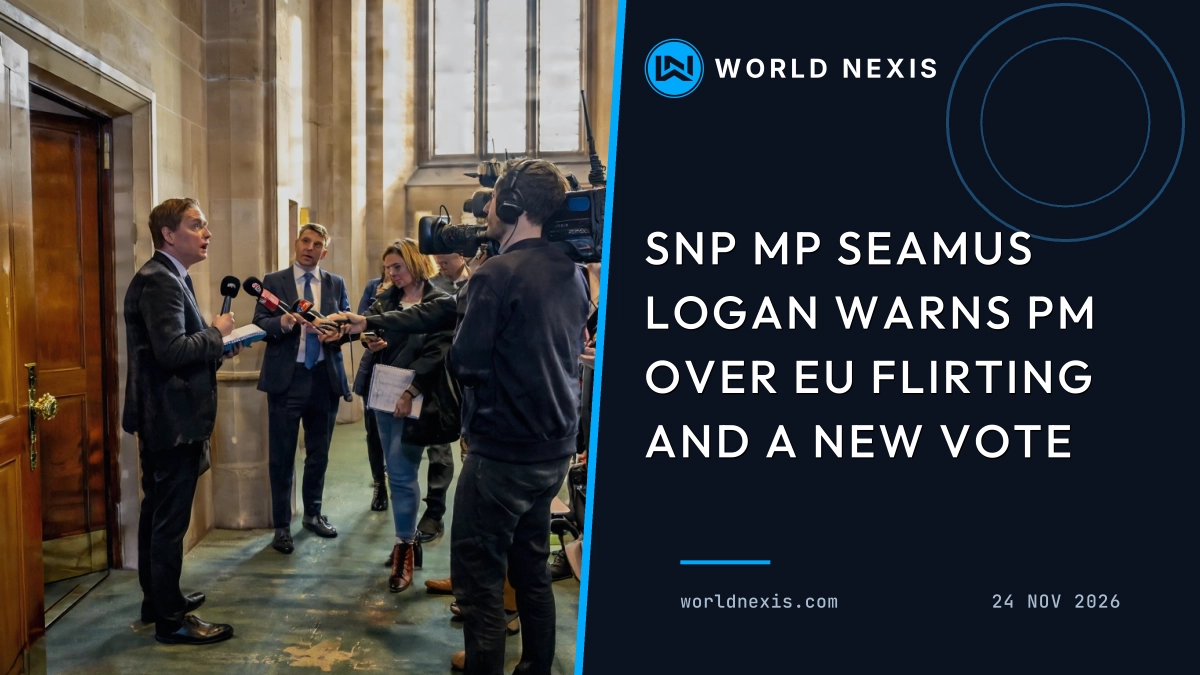
An SNP MP has delivered a direct Scottish independence referendum warning to Andy Burnham, arguing that the Prime Minister cannot explore a return to the European Union while refusing Scotland a fresh vote 12 years after the last one. Seamus Logan, who represents Aberdeenshire North and Moray East, spoke ahead of a Westminster Hall debate on a second Scottish independence referendum.
Key points
- SNP MP Seamus Logan said the Prime Minister’s “democratic credentials will collapse” if he flirts with another Brexit vote while blocking a Scottish one.
- Andy Burnham has said a repeat of the 2014 vote is “off the table” and has resisted Scottish First Minister John Swinney’s calls to revisit it.
- A UK Government spokesperson said another Scottish independence referendum is “off limits” and would be a “damaging distraction”.
- The Prime Minister plans “brainstorming” talks with the EU over the next 12 months on the future relationship.
Inside Logan’s Scottish independence referendum warning
Logan used the run-up to the debate to press the argument directly on the Prime Minister. He said: “Andy Burnham’s democratic credentials will collapse if he thinks he can flirt with the idea of another referendum on Brexit, while at the very same time telling the people of Scotland he will block their right to a referendum on independence.”
He then set out the comparison at the centre of his Scottish independence referendum warning. He asked how any Labour politician or prime minister could claim Scotland cannot revisit the independence decision taken 12 years ago, if Labour now accepts that people can revisit the EU decision taken 10 years ago.
“It is welcome that the Labour Party now seem to accept that in a democracy people have the right to change their mind – if that principle applies to Brexit, it equally applies to Scotland’s future.”
Logan went further on Labour’s policy, saying: “It’s time for the Labour Party to stop standing in the way of Scottish democracy and it’s time for them to finally come clean on their policy – what is their position on the democratic route for the people of Scotland to decide their own future?”
He also argued that Labour’s “roadblock to Indyref 2 is running out of road”. He predicted the next UK election could return a hung parliament, meaning the Prime Minister would have to “deal with the SNP on a day-to-day basis”.
In those circumstances, he said that where the alternative is Reform UK leader Nigel Farage, the SNP would keep Andy Burnham in post, but would hold the power to secure its referendum. He added: “SNP MPs would leverage that power to secure the best deal for Scotland, hold the Labour government’s feet to the fire and secure a referendum on independence.”
The EU deals behind the Scottish independence referendum warning
The row lands at a moment when the UK’s relationship with Brussels is moving. At last week’s summit the Prime Minister struck deals covering food and agriculture exports, emissions trading and a youth experience scheme.
Over the next 12 months he intends to hold “brainstorming” discussions with the European Union about the options available for the future relationship. Rejoining is said to be among the options under discussion, which is the ground Logan has chosen to fight on.
On Scotland, the government’s position has not shifted. The Prime Minister has resisted John Swinney’s calls for the 2014 independence referendum to be revisited, saying the matter is “off the table”.
A UK Government spokesperson said: “The Prime Minister’s agreement with the EU is great news for Scotland and the whole of the UK.” The spokesperson added that the Prime Minister has been clear that another Scottish independence referendum is off limits, and that it would be a “damaging distraction” from growth and the cost of living.
Why it matters
The Scottish independence referendum question decides who controls tax, welfare and public spending in Scotland, so the answer changes what households can expect from public services. It also decides how much leverage Scottish MPs carry in a hung parliament, where a handful of votes can move a budget.
The European side is not abstract either. The new deals cover food and agriculture exports and emissions trading, which feed into farm incomes, food prices and the costs faced by energy-intensive employers.
Analysis
Having covered devolution and local democracy for World Nexis News, I look first at the consistency of a constitutional argument rather than its volume. Logan’s best point is not that independence would be good or bad. It is that the government is applying two different rules to two referendums.
In my view the facts support him on that narrow question. If ministers accept that voters can revisit a decision taken in 2016, then refusing to revisit a decision taken in 2014 needs a stronger answer than “off the table”. The strongest counter-argument is the government’s own: that reopening the constitutional question would be a damaging distraction from growth and the cost of living.
That is a serious claim, but it is an argument about priorities rather than principle, and it sits awkwardly beside a government willing to spend 12 months discussing its future relationship with the EU. I side with Logan that the inconsistency is the government’s weakest point. I do not think that automatically means a vote should be held now, and the SNP’s talk of keeping a Labour government in post is a bargaining position rather than a settled promise.
What happens next
The Westminster Hall debate is a non-binding forum, so nothing in law changes. The pressure point is the 12-month window of “brainstorming” talks with the EU, during which every concession will be measured against the SNP’s demand for a Scottish independence referendum.
A general election is the only route that could change the arithmetic. Logan expects a hung parliament and has set out the price the SNP would attach to keeping the Prime Minister in post.
What we don’t know yet
It is not confirmed whether rejoining the EU is a formal option in the talks or a background idea, and no timetable for another Brexit vote has been set. Nor is there any guarantee that the SNP would hold the balance of power after the next election.
Related coverage
- Brexit debate warning as Sunak tells Burnham not to reopen
- Battery manufacturing warning over Australia’s minerals
- Waymo service pause: Bay Area storm warning for Thanksgiving
Further reading
- PM warned ‘flirting’ with EU membership could increase calls for Indyref2
- PM warned ‘flirting’ with EU membership could increase calls for Indyref2
About the author: Liam O’Connor is the UK Politics Reporter at World Nexis News (WNN), covering uk politics. The analysis section reflects the writer’s view.

Liam O'Connor
Liam O'Connor is UK Politics Reporter at World Nexis News, covering Westminster, devolved politics and the issues that matter to voters across England, Scotland, Wales and Northern Ireland. Based in London, he reports from primary sources — Hansard, official statements, published data — and explains…



