USS Theodore Roosevelt arrives as Middle East carriers hit 3
USS Theodore Roosevelt has arrived in the Middle East, giving the US three aircraft carriers in the region as Trump weighs options in the Iran war.
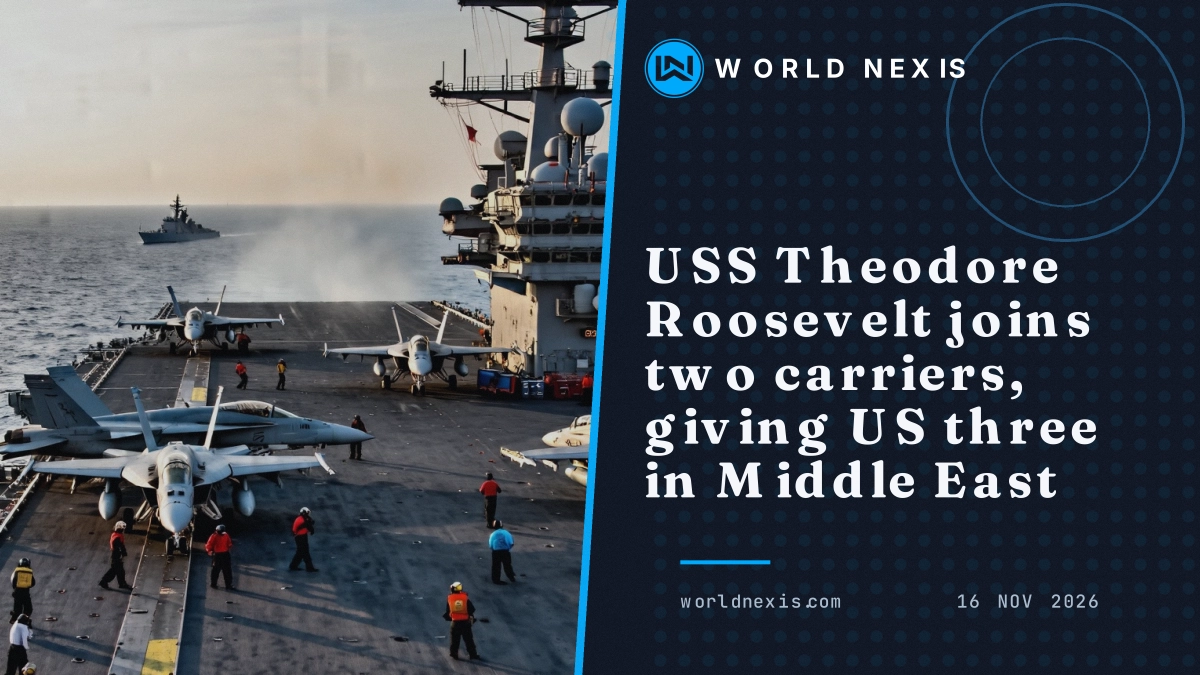
Updated 17 Nov 2026, 13:30 (UK time): US Central Command publicly rejected Iran’s claim that its drones hit a radar system in Bahrain, saying the third attack in five days was intercepted with no damage or injuries, while Trump said he takes an alleged Iranian ‘dirty bomb’ plot against Washington ‘very seriously’.
US Central Command has publicly rejected Iran’s claim that its drones struck a radar system at a base in Bahrain on Tuesday, saying the attack was defeated. According to CBS News, CENTCOM called the Revolutionary Guard’s assertion false and said multiple one-way attack drones were intercepted “without any damage to U.S. equipment or injury to American personnel.” Bahrain said its air defences brought down the drones after a security alert urged residents to seek shelter, and an all-clear was issued with no deaths or injuries reported, Reuters reported via Fox News.
Separately, President Trump said he is taking “very seriously” a CNN report that Iran may have explored a chemical “dirty bomb” plot targeting officials in Washington, warning that if such a plan exists Tehran “will pay a price the likes of which no country has ever paid before,” CBS reported. The White House said there are no credible threats to the homeland at this time, and Iran’s foreign ministry spokesman, Esmaeil Baqaei, dismissed the reporting as baseless.
The Revolutionary Guard also claimed on Tuesday that another tanker struck a mine and caught fire near the Strait of Hormuz, according to the semi-official Tasnim agency cited by CBS — a fourth such claim in three days. Trump’s nominee for Navy secretary is meanwhile due to face questions on the Iran war at a Senate confirmation hearing, the Monterey Herald reported.
My take: The official rebuttal is the significant part. CENTCOM is now contesting Tehran’s claims in public, point by point, which suggests Washington wants the record straight even as it advertises the USS Theodore Roosevelt’s presence.
Updated 17 Nov 2026, 12:15 (UK time): US Central Command publicly confirmed the USS Theodore Roosevelt’s arrival and detailed the fleet, while Iran’s Revolutionary Guard claimed a third strike on a US radar site in Bahrain in under a week, ending a two-month lull, and Qatar urged restraint.
The USS Theodore Roosevelt’s arrival is now officially confirmed. US Central Command said in a social media post on Monday that the third carrier had reached the Middle East, the Guardian reported — a shift from earlier in the week, when neither CENTCOM nor the Navy’s 5th Fleet would discuss the movement. The Guardian also reported the Arabian Sea flotilla now includes 13 destroyers, two cruisers and a littoral combat ship, with two more destroyers in the Red Sea.
According to the Guardian, the Roosevelt deployed alongside the USS Makin Island amphibious readiness group, which includes the USS John P. Murtha and USS Anchorage landing ships and roughly 2,000 marines; those ships have not yet reached the region. The carrier arrived nearly two weeks after midterm elections in which voters handed Trump’s Republicans major losses.
The confirmation came as the conflict flared again. Iran’s Islamic Revolutionary Guard Corps claimed for the third time in less than a week to have targeted a US radar system in Bahrain, CBS News reported, ending a two-month lull in strikes on US targets there. Authorities said the first two attacks were intercepted, and Bahrain reported the new one. Qatar’s foreign ministry spokesman, Majed Al Ansari, called on “all parties” to exercise restraint and warned of an “extremely serious” threat to efforts to reach a deal, CBS reported.
My take: The public confirmation matters more than the extra hulls. Washington is now willing to advertise the build-up while Tehran tests Bahrain three times in a week — both sides are bargaining with force, not winding down.
Updated 17 Nov 2026, 03:00 (UK time): Vice President JD Vance said on Fox News that Trump will end the Iran war well before 2028 and ruled out a “forever war,” while Iran claimed a third tanker hit a mine near Hormuz and barred IAEA inspectors from bombed nuclear sites until the war “permanently ended.”
Vice President JD Vance said the Iran war will not become another “forever war,” telling Fox News host Laura Ingraham in an interview aired Monday night that President Donald Trump will end it well before the two of them leave office. Vance ruled out a 10- or 15-year commitment and said “frankly even” a two-year one was unacceptable, adding he has “full confidence” the president will get the US out “with great results.” He told critics they “can attack me all they want.”
The remarks are notable because Trump had recently removed Vance from the peace talks. The Independent reported that Vance has tried to keep his distance from an unpopular war since what it called a disastrous Republican defeat in the midterms, and he wrote on X this month that any honest conversation about the party’s losses “must start there.”
In the Gulf, Iran’s regular navy claimed a third tanker struck a mine east of Hormuz after switching off its identification and navigation systems and entering a prohibited area, following a Revolutionary Guards claim a day earlier that two others were hit. No vessel names, flags or precise locations were given. Iranian outlets also reported that IAEA inspectors will not be admitted to bombed nuclear sites until the war has “permanently ended.”
A US military source quoted by CBS confirmed all three carriers are present but said some of the overlap reflected routine carrier rotations and did not necessarily signal a lasting three-carrier deployment — a qualification Iranian coverage dropped.
My take: Vance’s return to the airwaves after being sidelined from the talks is the real signal here, and it points toward winding down rather than a new offensive.
Three US aircraft carriers are now in the Middle East after the USS Theodore Roosevelt arrived in the region, a US official confirmed on Monday, adding thousands of troops to a naval force that is unusually large for a war now more than eight months old.
The official spoke to the Associated Press on condition of anonymity to discuss sensitive military operations. Neither US Central Command nor the Navy’s 5th Fleet would confirm the movement when asked by Anadolu. The Pentagon has not detailed its force posture in the Gulf.
Key points
- The USS Theodore Roosevelt entered CENTCOM’s area of responsibility with its accompanying strike force.
- It joins the USS George H.W. Bush, in the region since April, and the USS George Washington, deployed there since August.
- Scores of smaller Navy ships are maintaining a blockade of Iranian shipping.
- Axios reported the arrival on Sunday; the New York Times had said the carrier was expected within a day.
What the USS Theodore Roosevelt arrival changes in the Gulf
The USS Theodore Roosevelt is a Nimitz-class carrier built by Northrop Grumman in Virginia and in active service for 40 years. It is the flagship of Carrier Strike Group 9, whose current deployment began on 27 September. According to Middle East Monitor, citing Axios, the ship left Singapore earlier this month and transited the Strait of Malacca before entering the region.
Two carriers already in the Arabian Sea make up the rest of the force that the USS Theodore Roosevelt now joins. The USS George H.W. Bush has been on an extended deployment since April as flagship of Carrier Strike Group 10. The George Washington, normally forward-deployed to Japan, has operated there with Carrier Air Wing 5 since August.
Three carriers at once is rare. Navies usually stagger deployments so a single strike group covers a theatre. Holding three on station strains air wings, escorts and crews, and it signals that Washington wants visible capacity rather than a short demonstration.
An Iran war still short of a deal
The build-up, including the USS Theodore Roosevelt’s arrival, comes as the Iran war runs past eight months with no agreement in sight. The conflict opened with coordinated US and Israeli strikes in late February, and Operation Epic Fury began on 28 February. Diplomatic efforts between Washington and Tehran have stalled.
President Donald Trump recently removed Vice President JD Vance from the peace talks. He then declared on social media that Washington no longer needs an agreement with Iran. Tehran has ruled out United Nations nuclear inspections, Fox News reported.
The US military has nevertheless denied an Israeli media report that it was preparing to resume operations against Iran. It dismissed claims of regional force posture changes as “pure speculation”. Middle East Monitor also reported that Qatar and the US have discussed regional de-escalation and maritime navigation.
Casualties continue to accumulate. The Army identified two victims killed in an attack on a Jordan air base, and Trump said Iran would pay “many times over”, according to Fox News.
Trump disputes the war’s costliest account
On Monday Trump attacked CBS’ 60 Minutes over its investigation into a deadly Iranian drone attack on a US Army post in Kuwait. In a Truth Social post, he said the programme’s new leadership was “even worse than their predecessors”.
He wrote that Iran had fired between 8,000 and 9,000 one-way attack drones since 28 February, and that only two got through. Those two caused US fatalities on the first day, he said, hitting targets in Kuwait and Saudi Arabia.
Trump also cited roughly 2,000 Iranian ballistic missiles, one of which caused American fatalities in Jordan. “99.99% of Iranian missiles and drones have been shot down or, in any event, not caused U.S. deaths,” he wrote.
CBS said its eight-month investigation examined the 23 US service members killed and 800 wounded in the conflict. A CBS insider said the report found that leadership at the Kuwait post had ignored warnings, missed intelligence that Port Shuaiba was on Iran’s target list, lacked a counter-drone system and had no on-site physician. Six soldiers died there, the insider said.
The network said satellite imagery and video documented damage to at least 31 American military and diplomatic sites across eight countries. The Pentagon previously defended precautions at the installation, and spokesman Sean Parnell posted about the site’s fortifications on X in March.
Analysis
Having covered conflict and force posture for WNN, I look first at what militaries say when they are actually preparing something. The Pentagon’s answer here matters. If a new offensive were days away, officials would not be knocking down the story this hard.
In my view the facts support the signalling explanation better than the war-preparation one. Trump has said publicly that he does not need a deal and has pulled his vice president out of the talks, yet he has kept the fighting bounded and has argued at length that US defences are holding. The USS Theodore Roosevelt gives him leverage and a visible option without committing to a new phase. The strongest counter-argument is that removing Vance, Iran’s refusal of inspections and this scale of deployment describe preparation as easily as pressure, and the gap between the two can close in a single drone strike.
What happens next
The USS Theodore Roosevelt will join the blockade of Iranian shipping alongside the Bush and the George Washington. Trump has said he is keeping his options open as the war continues.
Confirmation of the deployment has come only from an anonymous US official, and neither CENTCOM nor the 5th Fleet has commented publicly. Diplomatic efforts between Washington and Tehran remain stalled.
Related coverage
- Canary Islands migrants: 2,200 arrivals surge in two days
- Helen Haines leaves hospital a month after alleged ramming
- Chinese automakers could fill Canada auto gap, Carney warns
Sources
- Trump criticizes ’60 Minutes’ bosses as ‘even worse’ as he challenges Iran war report (foxnews.com)
- Third American aircraft carrier arrives in the Middle East as Trump keeps options open in Iran war (gazettextra.com)
- US increases carrier presence in Middle East to 3 as USS Theodore Roosevelt arrives in region: Report (middleeastmonitor.com)
- Third American aircraft carrier arrives in the Middle East as Trump keeps options open in Iran war (wdtimes.com)
About the author: Marcus Ellington is World Nexis News’s International Correspondent, covering world affairs. The analysis section reflects the writer’s view.

Marcus Ellington
Marcus Ellington is International Correspondent at World Nexis News, reporting on diplomacy, conflict and the political forces reshaping Europe, the Middle East, Asia and the Americas. Based in London, he focuses on explaining why events unfold as they do, using official statements, diplomatic documents and…