Liberian Thanksgiving: a unique 143-year national holiday
Liberian Thanksgiving falls on the first Thursday of November. How a holiday brought by American settlers became a national day of gratitude in Liberia.
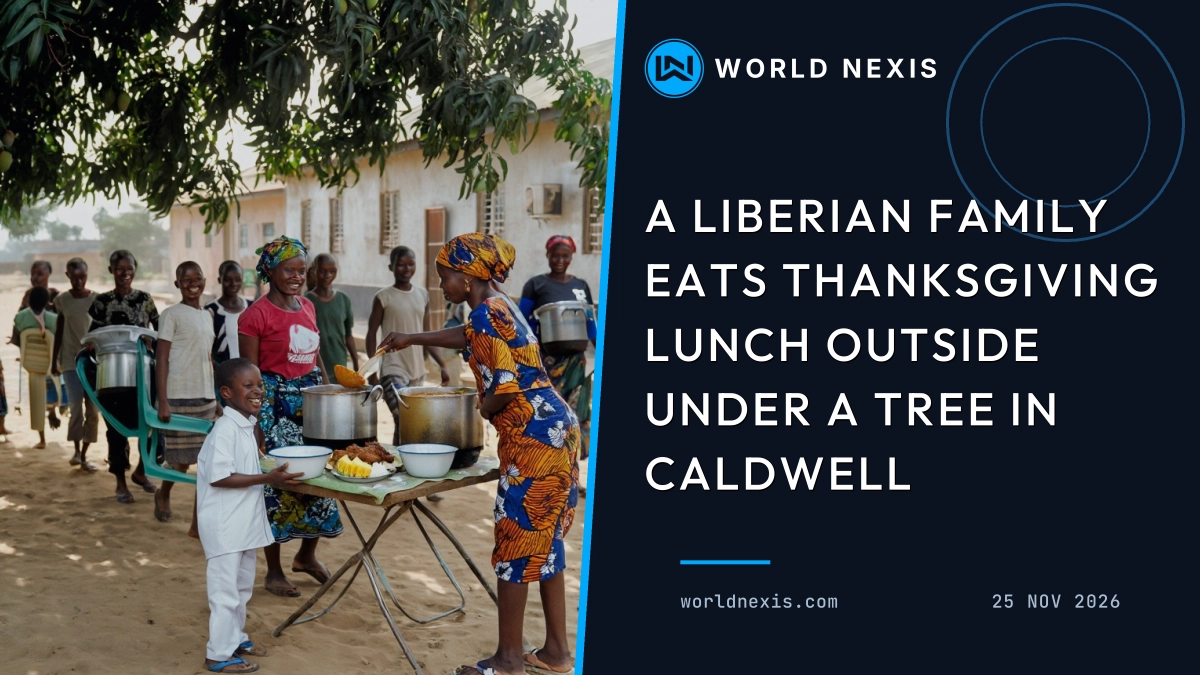
Liberian Thanksgiving falls on the first Thursday of November, and for Yvonne Capehart Weah that means a family party in Caldwell so large that nobody can sit around a dining table. The holiday dates to the first half of the 19th century, when the American Colonization Society established the community that grew into Liberia, and it became a national holiday by law in 1883.
Key points
- Liberian Thanksgiving is held on the first Thursday of November, weeks ahead of the American holiday.
- The custom arrived with Black American settlers, some born free and some emancipated from slavery, whose departure was sometimes voluntary and sometimes forced.
- In 1883 President Alfred Francis Russell, an Episcopalian priest, prayed for protection against British incursions, and the legislature made the day a national holiday that same year.
- Households mark it with church or mosque services, new clothes and a mid-afternoon meal of chicken, jollof rice and stews rather than turkey.
How Liberian Thanksgiving began
The tradition took shape in the first half of the 19th century, when the American Colonization Society established the settlement that would become Liberia. Its first settlers were Black Americans, both free-born and emancipated from slavery, and their departure was sometimes voluntary and sometimes forced.
“The settlers from America brought that Thanksgiving Day tradition to Liberia,” Weah said. Once transplanted, the observance evolved in response to national events.
Liberia declared independence in 1847, but Britain kept trying to take swathes of its territory. In 1883, President Alfred Francis Russell, an Episcopalian priest, called upon God to help halt the incursions. Weah describes that invocation as a “prayer of protection against the intruders, preventing intrusion into our territory.”
The Liberians held their sovereignty. That year the legislature formally established Thanksgiving as a national holiday, built around the religious gratitude of that moment.
Thanksgiving in Liberia has been fixed to the first Thursday of November ever since, while the United States observes its own version later in the same month.
Church, new clothes and a table under the tree
Weah’s family, like many in Liberia, starts the day at church. The holiday is not confined to Christians. Sekou Muhammad Sheriff, a YouTuber who travels his country to showcase its culture and heritage, points out that Muslims pray at the mosques on the same day. “Muslims, Christians, and others — everybody observe this day as a holiday,” he said.
For Sheriff, the day meant a new outfit when he was a boy. His father would buy him a “shirt-trouser suit” and a pair of slippers, and his favourite was a white one. He has since grown used to stews made with sweet potato leaves and with snails collected from the garden. “We call it king’s meat,” he said. “It is very, very nice.”
The Liberian Thanksgiving meal differs from household to household. Weah’s family does not serve turkey. “We don’t do turkey,” she said, “but we do chicken. We do fried chicken, smoked chicken, roasted chicken.” Jollof rice, watermelon and pineapple go on the table with stews including fufu and soup, a mix of cassava, fish, chicken, okra and chilli pepper. “It has to be [at] every Thanksgiving,” she said.
The venue is outside, under a tree. “When we come together, the group become [so] large that you are not able to sit around a dining table,” Weah said. “And when we meet, it’s almost like we’re having a party.”
She sums up the day this way: “It’s giving thanks to God for our freedom, for divine protection. It’s giving thanks to God for unity and for the harvest.”
Why it matters
For Liberians, the first Thursday of November is a statutory pause that crosses faith lines. Churches and mosques fill on the same morning, and families travel back to townships such as Caldwell for a meal that is deliberately not the American one. The Liberian Thanksgiving plate is a statement of identity as much as a dinner.
The day also places gratitude next to hardship. Sheriff did not have the resources to host a gathering this year, but he says he remains thankful to God for keeping him healthy and for keeping Liberia peaceful after civil conflict tore the country apart from 1989 to 1997 and again from 1999 to 2003.
Analysis
Having reported on West Africa and its diaspora for World Nexis News, I look first at how a holiday earns its date. Here the detail that decides it is 1883. A custom carried over by settlers could easily have stayed a private anniversary of arrival; instead the legislature tied Liberian Thanksgiving to a moment when the country believed it had been saved from foreign intrusion, and that is what made it national.
In my view the facts support Weah’s reading better than the “American export” one. Turkey is out, chicken, jollof rice and fufu are in, and mosques as well as churches fill on the same morning. A borrowed day that changes its date, its menu and its worshippers belongs to the people who keep it. The strongest counter-argument is that a holiday carried over by a settlement project cannot fully shed the imprint of that project, which is fair, and Liberians are better placed to argue it through than outsiders are.
What I will watch is whether Liberian Thanksgiving can still do the work of holding a country together across faith and region more than two decades after its civil wars ended. Sheriff’s answer, gratitude for health and for peace, carries more weight than any menu.
What happens next
Liberian Thanksgiving has already been marked this year. It returns on the first Thursday of November, when families such as Weah’s will gather again under the tree in Caldwell.
The open question is how far the day keeps changing. Each generation adds to the guest list and the menu, and the meaning of Liberian Thanksgiving has shifted before, from a settlers’ custom to a statutory act of national gratitude.
Related coverage
- Al Gore newspaper deal keeps 113-year-old Courier alive
- Thanksgiving meal prices climb 3% as turkey costs bite
- Scottish independence referendum: SNP’s 12-year EU warning
Further reading
- How American Thanksgiving took root — and evolved — in Liberia
- How American Thanksgiving took root — and evolved — in Liberia
About the author: Marcus Ellington is the International Correspondent at World Nexis News (WNN), covering world affairs. The analysis section reflects the writer’s view.

Marcus Ellington
Marcus Ellington is International Correspondent at World Nexis News, reporting on diplomacy, conflict and the political forces reshaping Europe, the Middle East, Asia and the Americas. Based in London, he focuses on explaining why events unfold as they do, using official statements, diplomatic documents and…



