Kryvyi Rih missile attack kills boy, 7, and wounds 60
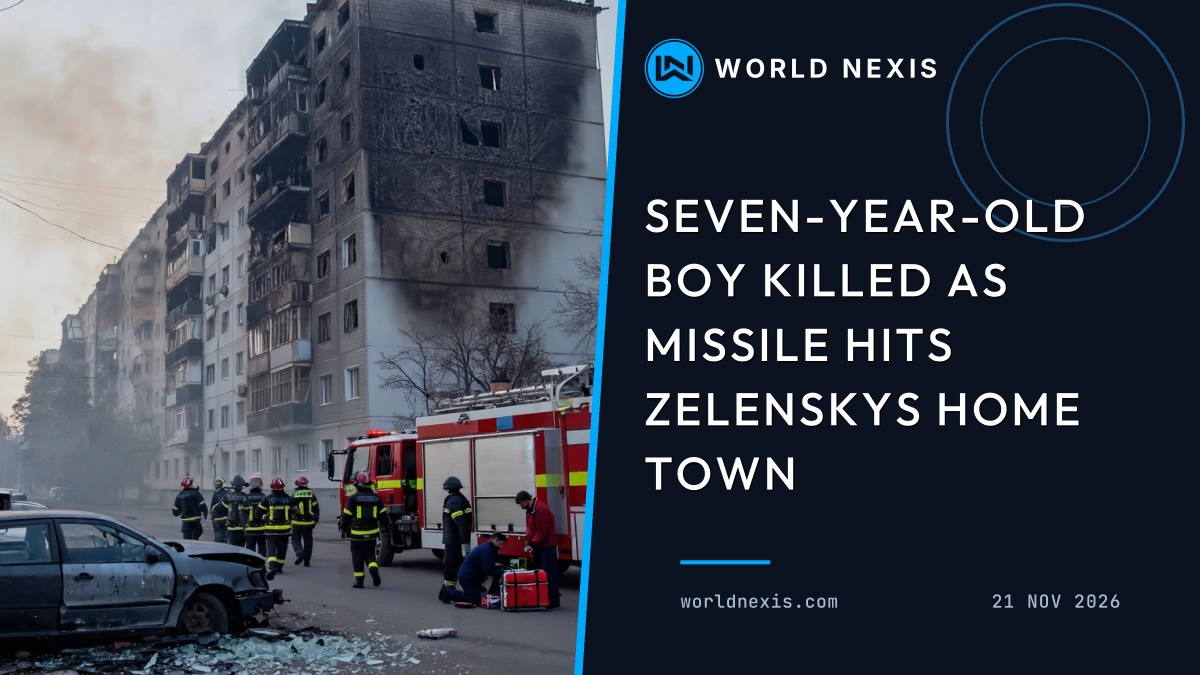
A Kryvyi Rih missile attack has killed a seven-year-old boy and a 20-year-old woman and wounded 60, as US-led peace talks struggle to gain momentum.
Updated 22 Nov 2026, 17:36 (UK time): Libya’s eastern-based government said an explosion aboard a Russian ship docked at Benghazi was caused by a suspected drone attack, with no deaths reported and no claim of responsibility.
An explosion aboard a Russian ship docked at the port in Benghazi was caused by a suspected drone attack, Libya’s eastern-based Government of National Stability said, in what would be one of the farthest-reaching strikes of the war so far. The blast came at dawn on Sunday while the vessel was refuelling and resupplying on its way back to Russia under a maritime cooperation agreement, the administration said.
The eastern government reported no deaths and said the site had been secured, with normal operations due to resume once the fire was out; accounts differed on whether anyone was injured. No one has claimed responsibility and Moscow has not commented. The authorities in Benghazi condemned the blast as a violation of Libyan sovereignty, saying the country is not a party to the war, while the internationally recognised government in Tripoli warned against foreign forces using Libyan ports and civilian facilities.
Nothing in the new reporting moves the tolls elsewhere: Dymer still stands at two killed and four injured, with 11 people believed trapped in the rubble of the five-storey building, and the Kryvyi Rih missile attack still stands at a seven-year-old boy and a 20-year-old woman killed and 60 wounded, six of them children.
Benghazi feels like the bigger shift of this weekend, because it drags the war’s reach into the Mediterranean and puts a Russian logistics node in Africa in the frame. But a suspected attack is not a confirmed one, and the authorities describing it are a party to Libya’s own division. I would want a second, independent account before treating it as a Ukrainian strike.
Updated 22 Nov 2026, 16:01 (UK time): A drone strike in the Gulf of Finland set fire to a Russian cargo ship bound for Kaliningrad hours before the exclave’s rare air-raid alert, while the Dymer death toll stayed at two with 11 still feared trapped.
New details have widened the picture around the weekend’s strikes. A drone strike in the Gulf of Finland set fire to a Russian cargo ship that was bound for Kaliningrad, the exclave that hosts much of Russia’s Baltic Fleet, and Finnish emergency services said they were still working to extinguish the blaze on Sunday. The attack came hours before air-raid sirens sounded in Kaliningrad late on Saturday.
In Dymer, north of Kyiv, the toll from Sunday morning’s strike has not moved: two people killed and four injured, with 11 still believed to be trapped beneath the rubble of the destroyed five-storey building, according to Ukraine’s State Emergency Service. Rescuers have evacuated nine residents, including a child, and a second child was taken to hospital.
Kaliningrad governor Alexei Bezprozvannykh has said a “suspicious object coming from the direction of Lithuania” triggered the alert in the Nemansky district. Regional authorities on Sunday denounced as fake a photograph said to show smoke over the naval base at Baltiysk, and Lithuanian foreign minister Kęstutis Budrys said Vilnius “categorically rejects false claims” of involvement, with Lithuanian authorities reporting no drones in their airspace overnight. Russian officials reported no casualties or damage in the region.
Two dead in a village outside Kyiv and a burning freighter in the Baltic now sit in the same weekend. I read the Kaliningrad alert less as a military turning point than as a reminder of how thin the margin becomes when drones cross borders after dark, and how fast unverified images fill the gap before anyone confirms a thing.
Updated 22 Nov 2026, 14:41 (UK time): A fresh Russian strike destroyed a five-storey apartment building in Dymer, north of Kyiv, killing at least two people and wounding four, with 11 feared trapped, days after the Kryvyi Rih missile attack.
A Russian strike destroyed a five-storey apartment building in the village of Dymer, north of Kyiv, on Sunday morning, killing at least two people and wounding four, according to Ukraine’s State Emergency Service. Rescuers evacuated nine residents, including a child, and a second child was taken to hospital. Emergency teams say 11 people are still believed to be trapped beneath the rubble.
The strike lands days after the Kryvyi Rih missile attack killed a seven-year-old boy and a 20-year-old woman and wounded 60 people in President Volodymyr Zelensky’s home town. Residents in Dymer described being woken by an explosion shortly before dawn; one relative of people trapped inside said his father-in-law was heard calling for help from the burning building.
Separately, the governor of Russia’s Kaliningrad exclave, Alexei Bezprozvannykh, said a “suspicious object coming from the direction of Lithuania” triggered a rare air-raid alert in the Nemansky district, and Lithuanian foreign minister Kęstutis Budrys rejected any suggestion that Vilnius was involved. Russian authorities reported no casualties or damage there.
Two mass-casualty strikes on civilian housing inside a single week tells me the tempo of this war has not eased while diplomats talk. Toll figures from a collapsed building are always provisional, and the number of dead in Dymer may well rise.
A Kryvyi Rih missile attack has killed a seven-year-old boy and a 20-year-old woman and wounded 60 other people, Ukrainian officials said, after a Russian ballistic missile struck the centre of President Volodymyr Zelensky’s home town on Friday night. Six of the wounded are children, according to the regional military administration. The city in central Ukraine has been hit repeatedly during a war that is now nearly five years old.
Key points
- Two people were killed in the strike: a seven-year-old boy and a 20-year-old woman.
- Officials said the Kryvyi Rih missile attack started four fires and damaged about 25 apartment buildings.
- A hospital, schools, an industrial facility, businesses and vehicles were also hit.
- 60 people were wounded, including six children, the regional military administration said.
What we know about the Kryvyi Rih missile attack
Oleksandr Vilkul, the head of the city administration, said on Telegram that the boy and the 20-year-old woman were killed in the attack on Friday night. Oleksandr Hanzha, who leads the regional military administration, said 60 people were wounded, including six children.
The strike caused four fires and damaged about 25 apartment buildings, a hospital, schools and an industrial facility, according to Vilkul. Businesses and vehicles were also damaged, he said.
Further attacks in Kharkiv, Kyiv and across the border
In the Kharkiv region, 11 people, including two children, were wounded when a Russian drone struck a five-storey apartment building, Ukraine’s State Emergency Service said on Saturday. One person was wounded in an attack on the capital, Kyiv, according to the same service.
Inside Russia, local officials said Ukrainian drone attacks wounded three people in the Bryansk and Belgorod border regions.
Poland, the Kerch Bridge and Moscow’s pattern of retaliation
The Kryvyi Rih missile attack fits the pattern of Moscow’s heavy responses to eye-catching Ukrainian attacks. Those include this week’s strikes on the Kerch Bridge, which links Russia to illegally annexed Crimea.
It came hours after two Russian missiles and a suspected drone came down in Poland. Poland’s prime minister said the incident was likely a provocation timed to coincide with European military exercises being held in his country.
On Friday, European troops were taking part in an unprecedented two-week exercise that began on November 9 in southeastern Poland. The forces are preparing for a possible post-war mission in Ukraine, aimed at helping to stabilise the country and rebuild its military. European countries have previously expressed alarm at what they regard as Russian attempts to destabilise the continent.
Trump, Putin and Zelensky’s warning on friendly words
At the same time, Washington is trying to add momentum to the Ukraine war talks it is mediating. President Donald Trump discussed the conflict with Vladimir Putin and Chinese leader Xi Jinping at a summit in China on Thursday, according to his envoy Steve Witkoff.
Trump called Putin his “friend” during the meeting. He returned to the relationship at a White House news conference on Friday.
Asked about those remarks in an interview, Zelensky said: “For us, he is an enemy. And of course, for us, he is a killer.” He warned that describing the Russian leader in friendly terms could mean “he doesn’t feel enough pressure”.
Why it matters
The Kryvyi Rih casualties — two dead, 60 wounded, six of them children — are a reminder that this war is still fought in ordinary streets, schools and hospitals, far from any negotiating table. Each strike adds to the load on emergency crews and medical staff in a conflict entering its fifth winter.
The diplomatic stakes are just as concrete. Two Russian missiles coming down on Polish soil show how quickly the consequences cross a border, and how little separates a battlefield in central Ukraine from the security of the rest of Europe.
Analysis
Having spent four years at World Nexis News tracking the diplomacy and the battlefield in this war, I look first at the gap between what is said in capitals and what lands on Ukrainian streets. The Kryvyi Rih missile attack tells me that this gap is now the most important fact about the peace effort. Warm words in a summit room do not stop a ballistic missile.
The evidence, in my view, backs Zelensky’s reading of the situation rather than Trump’s. Strikes on the Kerch Bridge have repeatedly been followed by heavy Russian retaliation against Ukrainian cities, and this weekend followed that script. The missiles that came down in Poland show how fast the war’s consequences cross a Nato border. Public friendliness towards Putin, before he has conceded anything, removes the pressure that diplomacy needs in order to work.
The strongest counter-argument is that Witkoff’s channel is the only one currently open, and that a president willing to call Putin a friend may be better placed to extract concessions than one who will not. That is a fair point. But warmth broadcast in public, at a press conference, before a single concession has been announced, is not a tactic. It is a concession, and I think Moscow reads it as one.
What happens next
The European exercise in southeastern Poland is scheduled to run for two weeks from November 9. The US-mediated talks on ending the war continue without an announced deadline.
Zelensky’s remarks put his position on record before any further contact between Washington and Moscow.
What we don’t know yet
- How many of the 60 wounded remain in hospital.
- Whether Poland’s government has taken further steps after the missiles came down on its territory.
- Whether the US-mediated talks have set a date for their next round.
Related coverage
- Russian missile crash in Poland: Tusk sees major provocation
- Kerch Bridge strike: third attack in 4 days halts trains
- Loch Leven glider crash kills two men on training flight
Further reading
- Young boy one of two killed in ballistic missile attack on Zelensky’s home town
- Missile attack on Zelenskiy’s hometown kills two
About the author: Marcus Ellington is the International Correspondent at World Nexis News (WNN), covering world affairs. The analysis section reflects the writer’s view.

Marcus Ellington
Marcus Ellington is International Correspondent at World Nexis News, reporting on diplomacy, conflict and the political forces reshaping Europe, the Middle East, Asia and the Americas. Based in London, he focuses on explaining why events unfold as they do, using official statements, diplomatic documents and…



