Kerch Bridge strike: third attack in 4 days halts trains
Third Kerch Bridge strike in four days halts rail traffic as Putin vows a 'far more painful' response and rules out ceasefire talks with Ukraine.
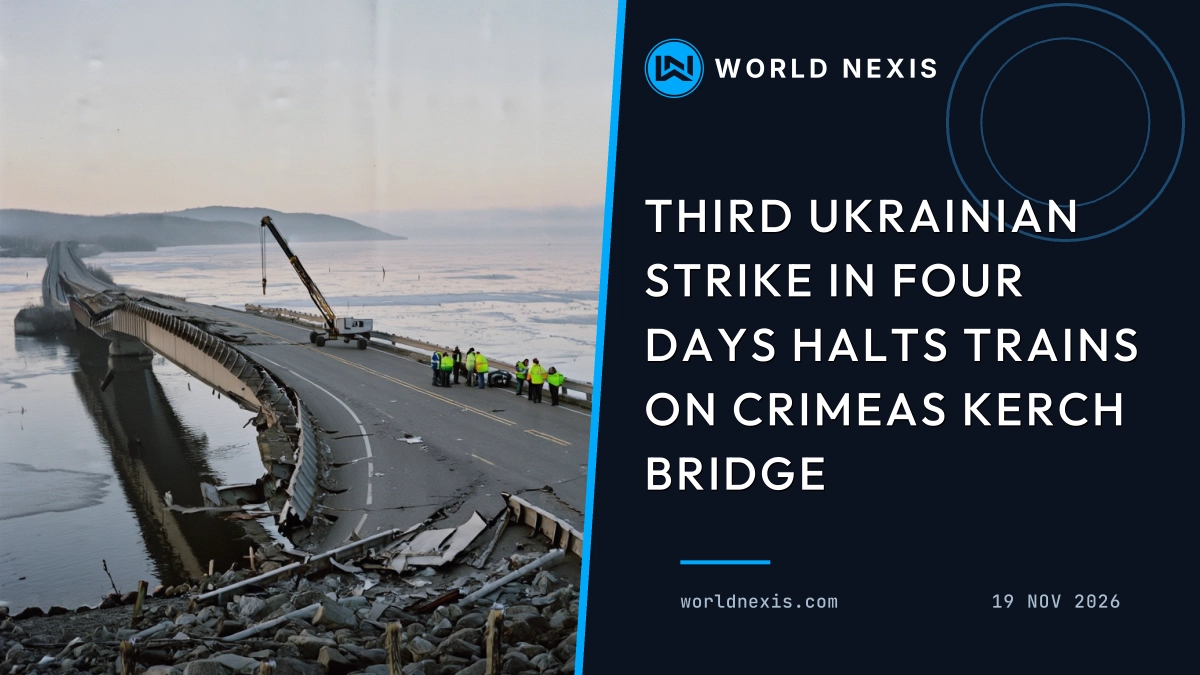
The third Kerch Bridge strike in four days has halted rail traffic across the 12-mile span linking mainland Russia to occupied Crimea. Vladimir Putin vowed a response “far more painful” than Ukraine’s attacks and ruled out a limited ceasefire. Thursday’s early-hours raid compounded damage from a combined missile and drone assault on Tuesday, which collapsed part of the road deck into the water.
Key points
- Ukraine’s third Kerch Bridge strike in four days halted trains across the crossing.
- The Crimean Bridge attack on Tuesday destroyed the central road section and closed the span to cars for the foreseeable future.
- Putin, speaking after talks with Donald Trump and Xi Jinping in Shenzhen, said Moscow would retaliate and would not negotiate.
- Moscow calls the bridge civilian infrastructure; Kyiv calls it the main military supply route into occupied Crimea.
What we know about the third Kerch Bridge strike
The Kerch Strait bridge carries road and rail traffic between the Russian mainland and the peninsula Moscow annexed in 2014. Putin opened the span himself in 2018, four years after the annexation, and it has stood as a symbol of Russian control ever since. Russia’s transport ministry said nobody was hurt in Thursday’s attack and that engineers were assessing the structure.
The Crimean Bridge attack on Tuesday did the heaviest damage in years. It destroyed the central road section and left the crossing unusable for cars. President Volodymyr Zelensky called that operation “unprecedented” and said it had taken weeks to prepare.
Since 2014 Moscow has used Crimea as a military base, with airfields, troop concentrations, training grounds and artillery depots. The peninsula has also served as a launchpad for strikes on the rest of Ukraine and a supply hub for Russian forces in the occupied south.
Putin freezes ceasefire talks after Kerch Bridge strike
Putin spoke to reporters in Shenzhen, China, after trilateral talks with Trump and Xi on the sidelines of the APEC summit. He said he had asked Russia’s Security Council to revisit ideas for a naval truce and a pause in strikes on energy facilities. Then he tied any deal to the bridge.
“But after the strikes on the Crimean Bridge, there will be no agreements,” Putin said. “We will respond to these strikes. And I want everyone to know this: I believe our response will be far more painful than what the Kyiv regime did to the bridge.”
He also played down the bridge’s military role, saying it carried civilians rather than troops or fuel. Ukraine rejects that account. Putin added that Russia would restore the crossing, and Kremlin spokesman Dmitry Peskov said the bridge “will be rebuilt, and it will be even better than before.”
Kyiv’s case and the talks in Berlin
Ukraine’s defense ministry described the bridge attacks as “time gained and lives saved.” It added: “The less that reaches the occupiers, the less hits our warriors.” Zelensky has called the crossing the “main military crossing from Russian territory into our Ukrainian Crimea.”
Zelensky said he had arrived in Berlin for talks with more than 40 partners on air defense, energy and financial support. In Germany, Jared Kushner and US special envoy Steve Witkoff met Chancellor Friedrich Merz, President Emmanuel Macron and other European leaders. Merz dismissed the China summit as a photo opportunity and said the trilateral format “will not bring peace” in Ukraine.
Why it matters
The Kerch Bridge strike matters because the crossing is the shortest land link between Russia and Crimea, and it moves fuel, food and military supplies south. Every day that trains stop adds cost and delay to Russian logistics and pushes Moscow back onto the land corridor through occupied southern Ukraine. That is why Kyiv keeps returning to the target.
At the same time, the promised Russian retaliation threatens Ukrainian cities and infrastructure. Russia hit two major bridge crossings in Kyiv on the same day as Tuesday’s attack. With ceasefire diplomacy frozen, Ukrainians should expect more disruption to power, transport and heating as winter sets in.
Analysis
Having covered conflict and European security for World Nexis News, I read the Kerch Bridge strike campaign as a textbook attempt to trade military effect for diplomatic leverage. Ukraine cannot break the land corridor outright or sweep Russia’s fleet from the Black Sea at will. It can, however, make the most visible symbol of the occupation expensive to hold open. That is a rational use of long-range drones and missiles, and the timing is no accident, coming days before European partners meet on money and air defense.
I think Putin’s own words settle the ceasefire question. He told reporters he had asked his Security Council to study a naval truce, then used the bridge as his reason to walk away. A leader who wanted a pause would not hand Kyiv a veto over one, and would not announce a “far more painful” response in the same breath. The strike gave him a convenient exit from a proposal he never seemed to want.
The strongest counter-argument is that hitting a bridge Moscow insists is civilian hands the Kremlin a propaganda gift and an argument for escalating against Ukrainian cities. That risk is real. It does not outweigh the supply losses, though, and Russia was already striking Ukrainian bridges and power plants before this week. I side with Kyiv’s calculus, with the caveat that the coming weeks of retaliation will test whether the gain was worth the price.
What happens next
Russia has promised to repair the span and to retaliate. Repair crews now face the prospect of working under renewed Ukrainian fire, which makes a quick reopening of the road deck unlikely. Zelensky’s meetings in Berlin are meant to lock in air defense and financing before winter.
What we don’t know yet
It is unclear how badly Thursday’s Kerch Bridge strike damaged the rail line, or when trains will run again. Nor is it clear what form or scale Russia’s promised response will take, or whether any ceasefire channel survives Putin’s refusal.
Related coverage
- Qeshm Island strike: US hits IRGC site after third attack
- Crimean Bridge attack: Putin vows ‘far more painful’ reply
- Stone of Destiny vandal admits £9,071 hammer attack
Further reading
About the author: Marcus Ellington is the International Correspondent at World Nexis News (WNN), covering world affairs. The analysis section reflects the writer’s view.

Marcus Ellington
Marcus Ellington is International Correspondent at World Nexis News, reporting on diplomacy, conflict and the political forces reshaping Europe, the Middle East, Asia and the Americas. Based in London, he focuses on explaining why events unfold as they do, using official statements, diplomatic documents and…