Qeshm Island strike: US hits IRGC site after third attack
US fighter jets launched a Qeshm Island strike on an IRGC missile site after Iran's third drone attack on Bahrain in five days, deepening Gulf tensions.
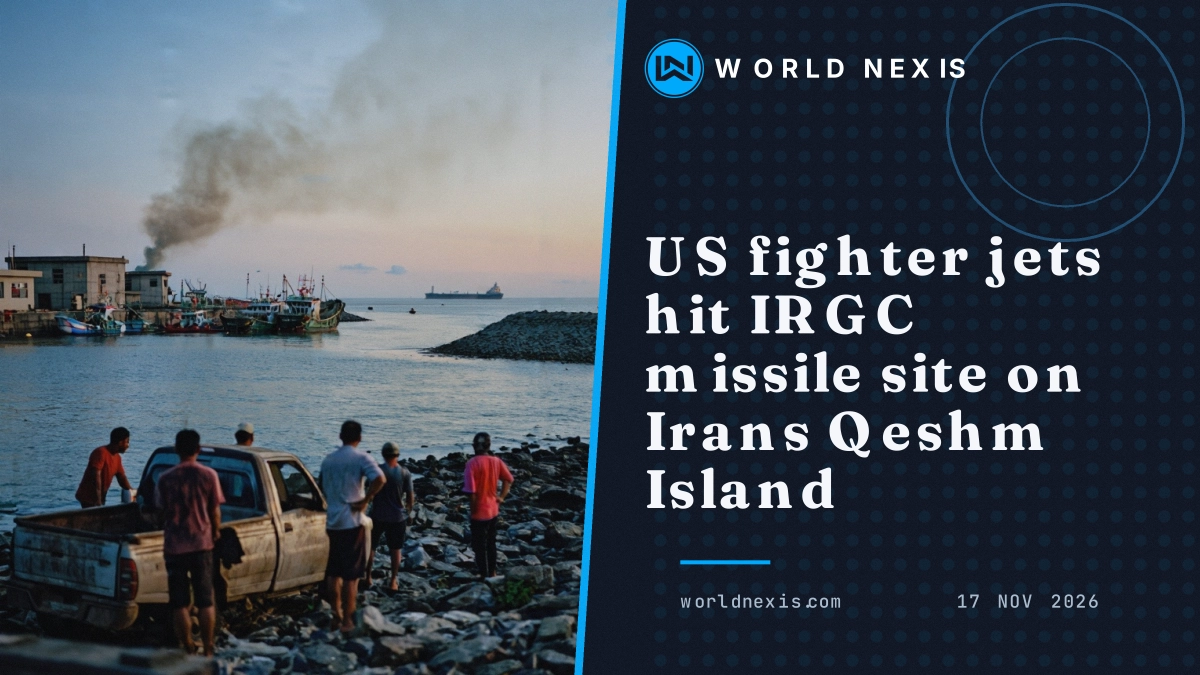
A Qeshm Island strike by US fighter jets on Tuesday hit an Islamic Revolutionary Guard Corps missile launch site near the Strait of Hormuz, a US military official said. The attack came hours after Iran fired drones at a US radar installation in Bahrain, its third assault on American military targets in the Gulf kingdom in five days. Bahrain said its air defenses intercepted the drones, and the US military said no equipment was damaged and no personnel were hurt.
Key points
- A Qeshm Island strike by US fighter aircraft hit an IRGC missile launch site in the Strait of Hormuz, according to a US official.
- Iran fired drones at a US radar site at Sheikh Isa Air Base in Bahrain earlier on Tuesday, its third attack there in five days.
- Iran’s IRNA news agency reported five or six explosions; a provincial official said homes, businesses and infrastructure were undamaged.
- Three US aircraft carriers and 53,000 troops are now operating in the Middle East, The Jerusalem Post reported.
Qeshm Island strike: what Washington says it hit
The US official, who spoke on condition of anonymity to discuss sensitive military operations, said the Qeshm Island strike used “precision munitions” and was a response to “aggression” toward US personnel. A US military official told The Jerusalem Post that American fighter aircraft struck the IRGC launch site “in self-defense.”
“The strike was in response to IRGC aggression targeting US personnel and assets,” the official said, adding that US Central Command “remains highly vigilant and fully postured to protect Americans across the region.” CENTCOM has not issued a public statement, but officials briefed reporters to make clear Washington will not sit idle while Iran attacks American assets, the paper reported. Army Radio reported the operation answered Iran’s drone attacks on US facilities in Bahrain.
Iranian accounts described several blasts. IRNA reported five or six explosions on the island, while the Fars agency reported blasts northwest of Qeshm city and smoke rising from the area. Iranian media said an air-defense missile launcher in the Nariman area was targeted, though the extent of damage to military sites was not immediately clear. Ahmad Nafisi, deputy governor of Hormozgan province, said the American strikes caused no damage to residential or commercial areas or critical infrastructure.
Third attack on Bahrain breaks a two-month lull
The Revolutionary Guard said it launched drones at a US radar installation at Sheikh Isa Air Base, framing the attack as a response to repeated violations of Iranian airspace by American military drones. Bahrain said its defenses intercepted “treacherous Iranian aerial attacks.” The exchange interrupted a roughly two-month pause in fighting and drew condemnations from across the region.
Bahrain hosts the US Navy’s 5th Fleet, which has already sustained damage in earlier Iranian attacks since the US and Israel struck Iran on February 28. The Qeshm Island strike was not the first this month either: on November 2, US forces carried out limited strikes on Iranian military targets there, which American officials described as defensive. Iranian forces claimed on Monday to have captured a US military drone south of Qeshm.
Blockade, carriers and pressure on Tehran
The Qeshm Island strike came as Iran suffers under a US naval blockade enforced for months in and around the Strait of Hormuz, the waterway that carries a large share of the world’s energy supplies and where Iran and its proxies have disrupted shipping since the war began. Oil tankers sailing under US military protection have helped return Gulf shipments to roughly prewar levels, while the blockade has curbed Iranian crude exports and damaged Tehran’s economy.
President Donald Trump has been circumspect about next steps in a war now in its eighth month, despite an initial promise it would last weeks. He has said new strikes are highly unlikely, yet he has sent a third aircraft carrier and thousands more troops to the region, and told Vice President JD Vance that talks are not needed at this time. The arrival of the USS Theodore Roosevelt in the Arabian Sea, sailing with the USS George Washington, brought three carriers and 53,000 troops into the Middle East.
Mostafa Najafi, a Tehran-based security analyst, told the Associated Press that Iran’s attacks could signal a shift in strategy after months in which it waited for a US attack and then retaliated against the operational capability of bases.
Analysis
Having covered conflict and sanctions for WNN, I look first at what a strike is meant to signal rather than what it destroys, and this Qeshm Island strike is a textbook calibrated response. One launch site, precision munitions and no announced Iranian casualties add up to a message about cost, not the opening move of a ground war.
In my view, the reporting supports Hamidreza Azizi of the International Crisis Group more than the White House framing. Azizi wrote on X that Iran’s leaders are weighing whether “breaking the blockade through escalation is less costly than accepting its continuation,” and that the risk of renewed war now depends as much on Tehran’s math as on Trump’s decisions. The blockade is the pressure point; the drones and the counter-strikes are bargaining moves around it. The strongest counter-argument is that the third carrier and repeated limited strikes on Qeshm this month give Tehran every reason to see Washington as the escalator, and readers should keep that possibility open.
What happens next
CENTCOM has not issued an official statement on the Qeshm Island strike, so the American account rests on briefings given to reporters. Trump has said further strikes are highly unlikely even as the carrier build-up continues, and he has told Vance that talks are not needed now. Azizi argues the next move depends on whether Tehran concludes that continued restraint costs more than escalation, the question that will shape the Gulf in the weeks ahead.
Related coverage
- Kerch bridge attack severs Crimea link in 7-stage raid
- Iran drone attack: Blinken warns of ‘absolute disaster’
- Parnell Square attack: life sentence for 3 child stabbings
Sources
- Iran launches a third round of strikes on Bahrain, host of U.S. Navy’s 5th Fleet (npr.org)
- US launches attack on Iran’s Qeshm Island in retaliation to regime’s ‘aggression’ (nypost.com)
- US strikes Iranian IRGC missile launch site on Qeshm Island | The Jerusalem Post (jpost.com)
- US fighter jets strike Iranian missile site on Qeshm Island after attack in Bahrain (ynetnews.com)
- US fighter jets strike missile launch site on Iran’s Qeshm Island (hindustantimes.com)
About the author: Marcus Ellington is World Nexis News’s International Correspondent, covering world affairs. The analysis section reflects the writer’s view.

Marcus Ellington
Marcus Ellington is International Correspondent at World Nexis News, reporting on diplomacy, conflict and the political forces reshaping Europe, the Middle East, Asia and the Americas. Based in London, he focuses on explaining why events unfold as they do, using official statements, diplomatic documents and…