Crimean Bridge attack: Putin vows ‘far more painful’ reply
Vladimir Putin vows a 'far more painful' response after the third Crimean Bridge attack in four days, as Tim Kaine forces a Senate vote on Trump's Russia…
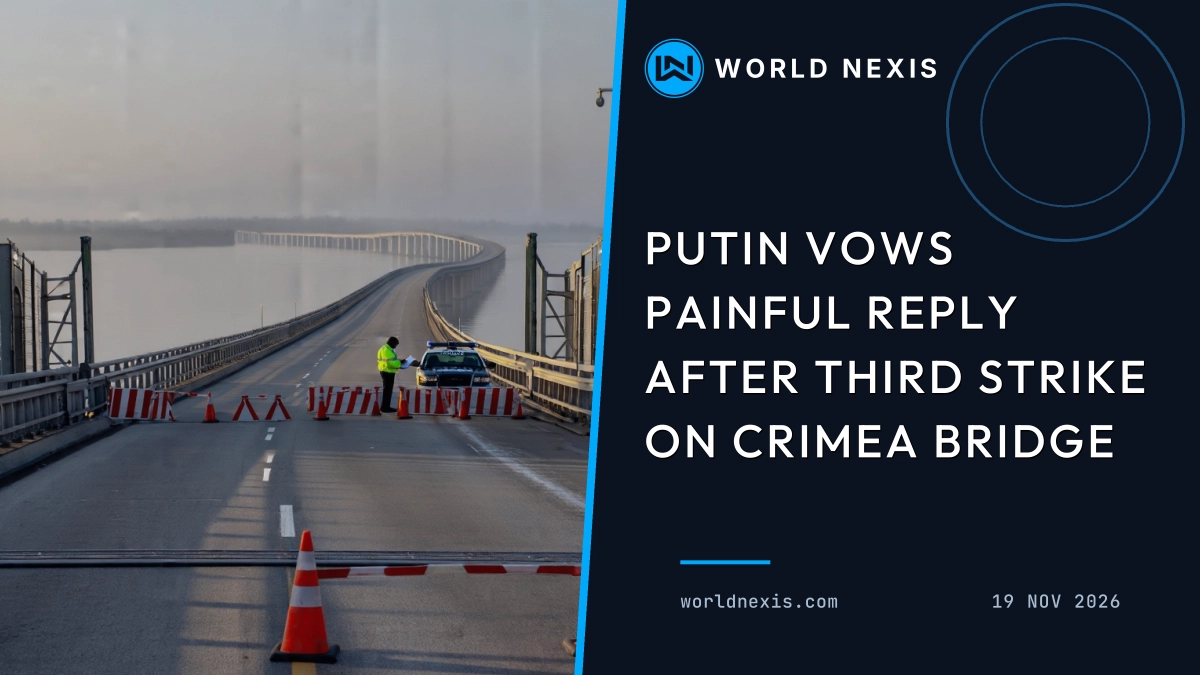
Vladimir Putin has vowed that Moscow’s response to the third Crimean Bridge attack in four days will be “far more painful” than the strikes themselves, a warning issued hours after trilateral talks with Donald Trump and Xi Jinping in Shenzhen. In Washington, Senator Tim Kaine of Virginia said he will force a Senate vote in the coming weeks on the human rights consequences of Trump’s Russia policy, including an October diesel deal that waived sanctions on Moscow.
Key points
- Third strike: Ukraine hit the 12-mile crossing to occupied Crimea again on Thursday in the latest Crimean Bridge attack, days after missiles and drones collapsed its central road span.
- Putin’s vow: He called the bridge civilian infrastructure, which Kyiv disputes, and promised a response on a larger scale.
- Traffic: Car use is barred for the foreseeable future, while rail service was suspended on Thursday and later resumed.
- Senate: Kaine’s resolution would require the State Department to report on how Trump’s Russia policies affect the war and human rights.
What the Crimean Bridge attack has done to the crossing
Tuesday’s strike, the first Crimean Bridge attack of the week, dragged a section of tarmac about 200m (660ft) long into the sea when missiles hit the bridge’s arch. It was the worst damage inflicted on the structure in several years. Ukraine said Thursday’s follow-up was carried out with Neptune cruise missiles, while Russia’s transport ministry said nobody had been hurt and that specialists were assessing the damage.
The bridge, also known as the Kerch Bridge, was built and unveiled in 2018, four years after Moscow illegally annexed Crimea. It carries road and rail traffic across the Kerch Strait and has long been in Ukraine’s sights, both because it embodies Moscow’s claim to Ukrainian land and because it supplies Russian troops in the occupied south.
Ukraine’s defense ministry described the operation in terms of Russian losses: “time gained and lives saved. The less that reaches the occupiers, the less hits our warriors.” Volodymyr Zelensky called the opening attack an “unprecedented operation” weeks in the making, in which Ukrainian forces first destroyed the air defenses, radars and electronic warfare assets protecting the span.
Putin promises a response “far more painful” than the strikes
At a press conference after the Shenzhen talks, Putin said the bridge was used exclusively for civilian purposes and not to move military equipment or petroleum products. Kyiv rejects that account and has described the Crimean Bridge attack as a strike on a legitimate military supply line. Since illegally annexing the peninsula in 2014, Moscow has used Crimea as a military base, with airbases, troop concentrations, training grounds and artillery stockpiles.
Kremlin spokesman Dmitry Peskov said the bridge “will be rebuilt, and it will be even better than before”. Russia has regularly targeted Ukrainian civilian infrastructure since its full-scale invasion in 2022, and this week, as the Crimean Bridge attack unfolded, it struck key bridge crossings over the Dnipro River in Kyiv.
Kaine turns the diesel deal into a Senate test
Kaine is introducing his resolution on Thursday under an arcane provision of a foreign policy law that lets any senator demand a vote on a report into a country’s human rights practices. Because the measure is privileged, it skips committees and reaches the floor within weeks.
The resolution asks the State Department to calculate how Trump’s policies have affected Russia’s ability to wage war in Ukraine and whether they have caused or worsened human rights abuses, and to update senators on negotiations to end the war. At its center is the deal Trump announced on October 9, under which Russia would supply more than 300,000 tons of diesel immediately, 500,000 tons in November and 1 million tons “immediately thereafter”, followed by 3 million tons more “within a short period of time”.
Trump presented the arrangement as a fuel-price measure: “Lower prices for Americans, especially our Great Farmers, Ranchers, and Truckers, is my Greatest Priority.” The resolution also points to Zelensky’s complaints that the Pentagon delayed deliveries of Patriot air defense interceptors and that US intelligence warning of incoming Russian attacks had been interrupted.
Kaine called the measure a “test of good faith” and said he hopes it can pass with bipartisan support. “If they were to give us a nonstarter human rights report that whitewashes Russia’s record, that will tell us a lot and that will tell the American public a lot,” he said. He has used the maneuver before, including war powers votes on Iran and a deportation resolution last year that Republicans blocked along party lines. “I want to make everybody here own what’s going on,” he said.
Why it matters
The Crimean Bridge attack is a military event with a direct civilian edge: the crossing is one of the main arteries for fuel and freight between Russia and the peninsula, and every week it is out of action forces longer land routes for supplies. For US households, the diesel deal is supposed to show up at the pump and on the farm. For Ukraine, the open question is whether the same policy has thinned the air defenses and warning intelligence that keep cities alive.
The Kaine vote also puts every senator on the record about Russia, at a moment when the White House is selling a fuel deal and pursuing peace talks at the same time. A report is not a sanction, but it is a document that can be quoted for years.
Analysis
Having covered congressional accountability fights for World Nexis News for five years, I look first at what a privileged resolution actually delivers. On the evidence here, Kaine has the stronger argument. A deal that waives sanctions under a Russia sanctions waiver and moves millions of tons of diesel deserves a public accounting of its consequences for the war, and the October announcement offered no such accounting. Zelensky’s own account of delayed Patriot interceptors and interrupted warning intelligence makes the demand for scrutiny hard to dismiss as partisan theater.
The strongest counter-argument is that this is a messaging vote which cannot survive a presidential veto, and that a State Department report can be written to say almost nothing. My answer is that a thin report is itself information, which is precisely Kaine’s point: a whitewash tells voters more than a stonewall does.
The Crimean Bridge attack sharpens that test. Each strike that lands makes the case that pressure is working, and makes any American gesture that eases Russia’s logistics harder to defend in public. I expect the resolution to pick up some Republican support; whether the report it demands ever arrives is a different question.
What happens next
Kaine introduces the resolution on Thursday, and a floor vote is expected within weeks. If it passes, the State Department would have to produce a report on the human rights and war-effort consequences of US policy toward Russia, including the diesel arrangement and any interruptions to military and intelligence support for Kyiv.
On the ground, Russian engineers face the job of repairing a bridge hit by a third Crimean Bridge attack in a week, with car traffic barred indefinitely and rail running again. Putin has promised a response “far more painful” than Ukraine’s strikes, and Moscow has already shown this week that it will answer by hitting Ukrainian transport links.
What we don’t know yet
Nobody has set out what Russia’s retaliation will look like, or when. It is also unclear whether Senate Republicans will allow a quick vote or try to block the measure, and how much of the bridge can be restored while it sits within range of Ukrainian missiles.
Related coverage
- Trump Xi Putin summit: 3 leaders vow peace in historic talks
- Trump Xi Putin meeting: first trilateral, major stakes
- Trump Xi summit: historic first three-way talks with Putin
Further reading
- Putin vows ‘far more painful’ response to Ukraine’s strikes on Crimean Bridge
- Sen. Tim Kaine says he will force votes on human rights consequences of US policies in Russia – AOL
About the author: Ayesha Rahman is the Senior Political Correspondent & Columnist at World Nexis News (WNN), covering politics & opinion. The analysis section reflects the writer’s view.

Ayesha Rahman
Ayesha Rahman covers politics and opinion for World Nexis News from London, focusing on elections, legislatures and the policy choices that shape everyday life in the US and UK. She writes analysis and columns that separate what is confirmed from what is claimed, working from…



