Heart transplant crisis: 125 organs for 420,000 patients
Alan Crawford, 76, thrives eight years after a heart transplant using 'heart in a box' tech, but Australia does only 125 a year despite 420,000 cases.
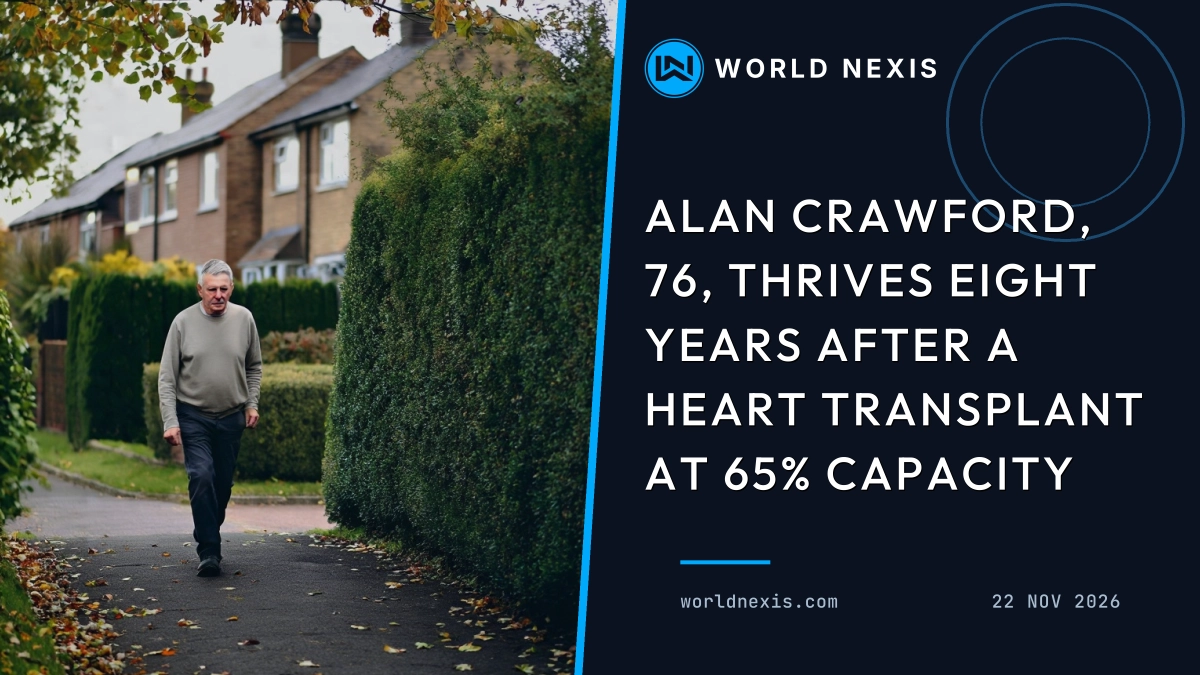
Alan Crawford’s heart transplant is still working eight years on. The donor organ that replaced tissue pumping at barely 10 per cent of capacity now runs at about 65 per cent efficiency, and the 76-year-old no longer needs the pacemaker or defibrillator that once ruled his days. His operation relied on a machine that keeps a donor heart beating outside the body, and his case has become the clearest illustration of what researchers hope to extend to the estimated 420,000 Australians living with heart failure.
Key points
- Alan Crawford, 76, received a donor heart in Sydney in 2018 that was kept beating on a perfusion machine instead of being packed on ice.
- His new heart is pumping at roughly 65 per cent efficiency, up from about 10 per cent before surgery, and he left hospital 13 days after the operation.
- Australia carried out just 125 heart transplants in 2025, against an estimated 420,000 people living with heart failure.
- Heart Research Institute scientist Nicholas Lam says Crawford is “one of the lucky ones”.
The heart transplant that began with a phone call
Crawford’s heart trouble started in his mid-40s with an irregular heartbeat. A stroke followed at 50, and he later developed dilated cardiomyopathy, which left his heart enlarged, weakened and increasingly unable to pump blood around his body.
An implanted defibrillator was supposed to protect him by restarting his heart when it slipped into potentially fatal rhythms. In practice the shocks were brutal and unpredictable, firing 26 times over the years and sometimes sending him crashing to the ground without warning.
“You’re walking in public and there’s a sniper or something there and all of a sudden you just get whacked,” Crawford said.
The attacks drove him out of the bronze foundry business he had built, which produced the castings used for the two First World War soldier statues on Sydney’s Anzac Bridge. Even crossing a road became a calculation. “If there’s three lanes, you’re always thinking, am I going to get to the middle and get spooked or something like that and just collapse?” he said.
By 2018 his doctors had run out of options. He was transferred from Royal Prince Alfred Hospital to St Vincent’s in Sydney, where he suffered another cardiac episode almost as soon as he arrived, and was told a heart transplant was his only chance of survival.
Within days, and before he had formally joined the heart transplant waiting list, he was offered a donor organ. It travelled using “heart in a box” technology, which keeps a donor heart beating and supplied with oxygenated blood outside the body rather than preserving it on ice. Crawford became the 26th person to receive a heart that way and, he says, the first whose donor organ had an angiogram while inside the machine. The donor’s family history of heart disease might otherwise have ruled the organ out; the examination confirmed it was healthy.
The anaesthetist’s verdict stuck with him. “The anaesthetist caught up with me about three days later and said, ‘You’re the most eager guy I’ve ever seen jumping on the operating table to have your heart cut out’,” Crawford recalled.
Heart transplant numbers: 125 operations against 420,000 patients
The recovery that followed has been close to a best case. Crawford walks 10,000 steps a day, mows his lawn, helps friends with their gardening and takes on hills he once went out of his way to avoid. He sums up the change in the language of his old trade: “It’s like having a V8 put in an old V-dub.”
The wider picture is far tighter. Just 125 heart transplants were carried out in Australia in 2025, while an estimated 420,000 people live with heart failure. Not all of them need a transplant, and for those who do, the shortage of donor organs is only one obstacle.
“He’s one of the lucky ones,” said Nicholas Lam, a scientist at the Heart Research Institute, where researchers are exploring technology that could help damaged hearts.
The transplant also gave Crawford something less measurable. It made him well enough to care for his wife Barbara after a fall left her seriously injured, and she spent her final two years being looked after at home by the husband whose health she had spent decades worrying about. She died in 2025, after 54 years of marriage.
Why it matters
For anyone on a waiting list, the significance is practical rather than symbolic. If a donor heart can be kept functioning and examined while it is in transit, organs that would once have been thrown out may become transplantable, which adds capacity without adding donors.
For everyone else, the numbers set the limits. Heart failure affects an estimated 420,000 Australians, and the heart transplant that saved Crawford remains available to only a fraction of them, which puts prevention, earlier diagnosis and donor registration at the centre of the debate.
Analysis
In my view the most consequential detail in Crawford’s story is not the V8 line, memorable as it is. It is the angiogram carried out while the donor heart was still on the machine. If an organ can be inspected in transit, hearts that would once have been rejected on family history alone become usable, and that is a supply problem being chipped away at with diagnostics. Having covered clinical research and patient safety for World Nexis News, I read cases like this for the evidence behind the enthusiasm, and I think the facts support the researchers here, even if that evidence is still thin.
The strongest counter-argument is obvious and fair: one 76-year-old thriving eight years later is an anecdote, not a trial, and transplant teams are right to be wary of enthusiasm outrunning the data. Yet the arithmetic pushes the same way. With 125 heart transplants against 420,000 people living with heart failure, the value of using a handful more marginal organs is immediate, and the cost of not doing so is paid on waiting lists.
What bothers me is which part of this story will travel. The car-engine simile will be repeated everywhere; the figure of 125 probably will not. Access to transplantation is rarely decided by one dramatic choice and far more often by distance, eligibility rules and organ supply, so I would judge any expansion of this technology by whether it reaches patients well beyond the big Sydney teaching hospitals.
What happens next
Scientists at the Heart Research Institute are continuing work on technology intended to help damaged hearts, and the transplant figures give that work a clear justification. No timetable has been announced for turning the research into routine treatment.
The number to watch is whether perfusion and in-machine imaging become common enough to push Australia’s annual heart transplant count beyond 125. Crawford, for his part, is eight years into a donated heart working at roughly 65 per cent efficiency, with no pacemaker and no defibrillator.
What we don’t know yet
It is unclear how many of the 420,000 people living with heart failure could ever be candidates, how many donor hearts would move from rejected to usable if in-machine angiography became standard, or whether the technology is offered outside Sydney’s main transplant centres.
Related coverage
- Titanic ring auction: rare diamond sells for £150,000
- Peter Murrell loan: SNP cancels £60,000 debt after jail
- Marine Band donation: Trump and White’s $500,000 Grammy boost
Further reading
- A new engine for Alan, new hope for failing hearts
- A new engine for Alan, new hope for failing hearts
About the author: Sofia Alvarez is the Health & Medicine Reporter at World Nexis News (WNN), covering health & medicine. The analysis section reflects the writer’s view.

Sofia Alvarez
Sofia Alvarez is Health & Medicine Reporter at World Nexis News, covering public health, clinical research, mental health and the policy decisions that shape care. Based in Manchester, she prioritises evidence over anecdote, checks claims against peer-reviewed research and official guidance, and explains uncertainty plainly…