Titanic ring auction: rare diamond sells for £150,000
Titanic ring auction: Lucy, Lady Duff Gordon's diamond ring sells for £150,000, with a rare viewing ticket making £40,000 at a Wiltshire saleroom.
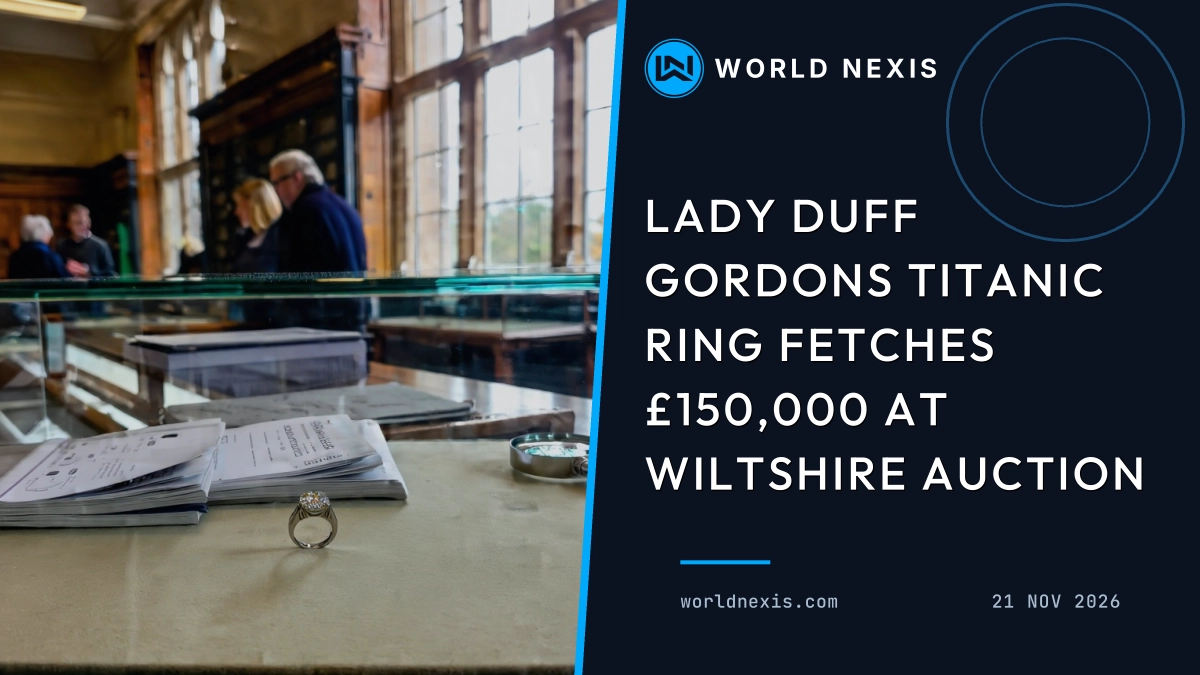
A Titanic ring auction at Henry Aldridge & Son in Devizes, Wiltshire, ended on Saturday with the diamond ring worn by Lucy, Lady Duff Gordon when the liner sank selling for £150,000. The solitaire was on her finger on 15 April 1912, when the ship went down on its maiden voyage with the loss of around 1,500 lives.
Two other objects from the same sale drew five-figure sums. A day ticket that let a passenger’s mother watch the Titanic leave Southampton made £40,000, while a postcard written by the ship’s senior wireless operator made £32,000.
Across the Atlantic, a framed lock of hair from George Washington, the first US president, sold for $4,000, or about £3,058.
Key points
- The Titanic ring auction was held at Henry Aldridge & Son in Devizes, Wiltshire, on Saturday.
- The £150,000 ring was the only significant piece of jewellery Lady Duff Gordon owned that survived the sinking.
- A viewing ticket for the ship at Southampton sold for £40,000; a postcard by wireless operator Jack Phillips made £32,000.
- A framed lock of George Washington’s hair sold in the United States for $4,000.
The ring that came through the sinking
Lucy, Lady Duff Gordon travelled to the United States with her husband, Sir Cosmo, as a first-class passenger. When the evacuation began, the couple and their secretary, Laura Mabel Francatelli, escaped in Lifeboat No 1.
That boat was built to carry 40 people, yet it was lowered with only 12 aboard, seven of them crew. Once the survivors were on the Carpathia, the Cunard liner that rescued them, Sir Cosmo handed each of the men from Lifeboat No 1 a cheque for £5.
The money was meant to help them after the White Star Line stopped their wages. Instead it fed gossip that the Duff Gordons had bribed the crew not to row back for swimmers, in case the boat was swamped.
The family called the piece The Titanic Ring and believed it was her engagement ring. It had belonged to her grandson John, the 3rd Earl of Halsbury, a crossbench peer and scientist, and it stayed with the family after his death before a direct descendant consigned it to the Titanic ring auction.
What the Titanic ring auction showed about demand
The Titanic ring auction also produced two paper lots with unusually detailed stories behind them. The day ticket bears the White Star burgee and is addressed to the officer in charge: “Please allow Mr Talbot and 2 friends to view the S.S. Titanic.”
A handwritten note on the reverse reads “Mrs Dibden plus two sisters”. Eliza Dibden, mother of 18-year-old second-class passenger William Dibden of the New Forest in Hampshire, carried it aboard, and her son died in the disaster. The lot also included his first communion certificate, dated Easter 1908.
Jack Phillips sent his postcard to his sister Elsie Phillips in Godalming, Surrey, on 6 April 1912, and it shows the Titanic at Southampton. It reads: “Thanks very much for your letter. Having glorious weather, went to Cowes yesterday. Will write later before we sail.”
Phillips was 25. Auctioneer Andrew Aldridge described him as “one of the true heroes of the disaster”.
A $4,000 lock of Washington’s hair
Richmond Auctions, a South Carolina-based house, sold the framed lock of George Washington’s hair for $4,000 (£3,058). Washington dined in 1799 with John Gadsby, a hotelkeeper in Alexandria, Virginia, shortly before his death that year.
Gadsby’s granddaughter, Julia Ten Eyck McBlair, set out the history in a 1928 affidavit offered with the lot. She said her grandfather came by the hair “in view of the friendship and association with his last days”, had it framed and hung it beneath Washington’s portrait, adding: “there I have seen it all my life”.
Washington led American forces to victory in the War of Independence and became the first US president in 1788, stepping down in 1797 after two terms. In July, a 1776 letter in which he asked for soldiers for the Continental Army sold for more than $109,000.
Why it matters
For anyone holding a family heirloom, the lesson is plain. Documented provenance sets the price, and the Titanic ring auction shows that a ring, a ticket or a scrap of card is worth what its story can prove.
For public collections, the sale is a reminder that the most personal objects from 1912 are passing into private hands, where new owners decide whether anyone else ever sees them.
Analysis
Having covered the memorabilia market for World Nexis News, I look first at provenance rather than at the stone. A solitaire of that size would not make £150,000 on its own merits. The price is for a ring that stayed on a named woman’s finger through a night that killed around 1,500 people, and for a family that kept the story straight for more than a century.
I think the buyers at this Titanic ring auction are right about the ring and probably wrong about the paper. The Lady Duff Gordon ring is unique, worn and easy to verify. The £40,000 viewing ticket, by contrast, was issued for “Mr Talbot and 2 friends”, and its link to the Dibden family, touching as it is, is second-hand. Sentiment is carrying that price.
The fairest counter-argument is that every Titanic sale is a sentiment market, and the ring is no less emotional a purchase than the ticket. Granted. Even so, when paper starts outpacing unique objects, it usually signals fashion rather than a durable market, and I would watch the next such sale for exactly that.
What happens next
The Titanic ring auction closed on Saturday. Neither house has announced a date for its next Titanic memorabilia auction, and the ring, the ticket and the postcard have passed into private ownership.
Richmond Auctions has not identified the buyer of the Washington lock.
What we don’t know yet
- Who bought the ring, the ticket, the postcard or the Washington lock. No buyer has been named.
- Whether any of the lots will be lent to museums or put on public display.
Related coverage
- MLK speech draft goes on rare display before $10m auction
- Peter Murrell loan: SNP cancels £60,000 debt after jail
- Marine Band donation: Trump and White’s $500,000 Grammy boost
Further reading
About the author: Emily Carver is the Culture & Entertainment Writer at World Nexis News (WNN), covering culture & entertainment. The analysis section reflects the writer’s view.

Emily Carver
Emily Carver is Culture & Entertainment Writer at World Nexis News, covering film, television, music, gaming, books and the creative industries from Los Angeles. She writes about the business and craft behind the work — streaming economics, production decisions, criticism and the way culture travels…