Advanced breast cancer: hidden scale of 10,000 cases a year
New analysis puts advanced breast cancer cases in England at about 10,000 a year, far above the 2,200 recorded at stage four, Macmillan warns.
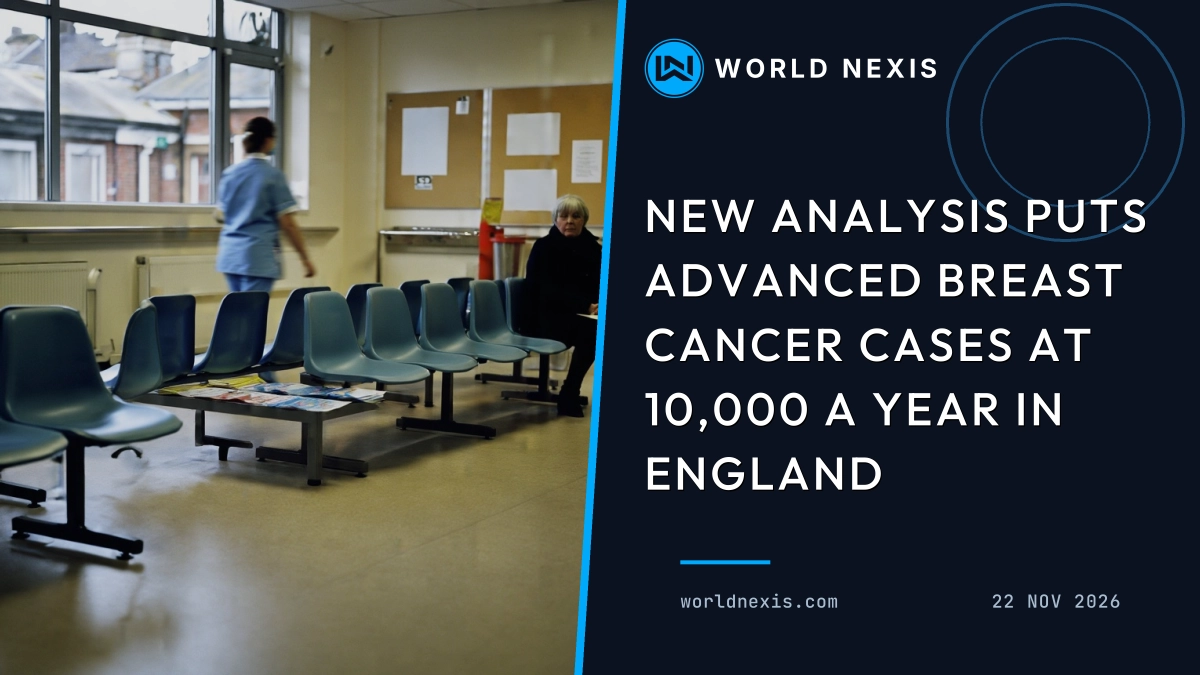
Roughly 10,000 women in England are diagnosed with advanced breast cancer every year, a new analysis has found. The figure suggests the true scale of the disease is far larger than official records show. The estimate comes from Macmillan Cancer Support and NHS England’s National Disease Registration Service. It was presented at the European Society of Medical Oncology conference in Madrid.
The analysis also puts the average age at which women are diagnosed with metastatic breast cancer, or go on to develop it, at just 61. Its authors told the conference that 52% of women with the disease live with it for two years or more.
Key points
- About 10,000 women a year in England are diagnosed with advanced breast cancer, according to the new estimate.
- Only around 2,200 a year are recorded as already having stage four breast cancer when they are first diagnosed.
- The average age at diagnosis, or at the point the cancer spreads, is 61, and 52% live with the disease for two years or more.
- Macmillan says women who develop metastatic cancer later are effectively “invisible in reporting”.
How the advanced breast cancer estimate was built
England’s routine picture of advanced breast cancer is built from women who are already at stage four when their disease is found. Around 2,200 women a year fall into that group. The measure captures one route into advanced illness and ignores another.
Thousands of women are first treated for earlier-stage breast cancer and later learn it has spread to other parts of the body. Because they entered the system at an earlier stage, they never appear in the late-stage tally. The result is a gap in understanding of how many people are living with incurable disease.
The Macmillan and National Disease Registration Service team linked NHS records and applied new analysis to close part of that gap. The resulting estimate of 10,000 cases of advanced breast cancer a year is far above the stage four count. Experts said the discrepancy means many women are “invisible in reporting”, and there is a “real risk” that health leaders cannot accommodate their needs.
What metastatic breast cancer means
Metastatic, or advanced, breast cancer is disease that has spread from the breast to other parts of the body. It is incurable. The new work suggests the patient group is more than four times the number captured by late-stage diagnosis alone.
Macmillan warns patients are ‘invisible in reporting’
Claire Taylor, chief nursing officer at Macmillan Cancer Support, said: “The new figures are another wake-up call for metastatic breast cancer.”
She said: “Behind these numbers are tens of thousands of women living with incurable cancer, which we know can impact every part of your life – not just your physical and mental health, but your job, finances, relationships with friends and family.”
Taylor added that the gap between the estimate and the number diagnosed at stage four “raises serious concerns that many people living with metastatic breast cancer are effectively invisible in reporting”.
She said: “When people are unseen in the data, there is a real risk that their needs are not fully recognised in service planning, research and policy development.”
Claire Rowney, chief executive at Breast Cancer Now, said the study offered insight into a group who, for decades, “have felt that they don’t count and that their needs remain hidden with no accurate national data available”. She added: “These findings are a further reminder of the urgent need for accurate data on metastatic breast cancer to be captured and published.”
Why it matters
For patients, the new advanced breast cancer estimate changes the arithmetic of care. Service planning, research funding and policy all depend on how many people have a condition and how long they live with it. A counted population less than a quarter the size of the real one distorts every decision built on it.
Taylor said better data is “essential to ensuring that services are planned around the reality of patients’ experiences”. She said it would help identify unmet need and reduce unwarranted variation in care, so that patients get the treatment and support they need wherever they live.
Analysis
I have spent my time at World Nexis News covering patient safety and health inequality. The first question I ask of any dataset is who has been left out. This one left out most of the people the disease affects, and that omission quietly shapes wards, waiting lists and research budgets for years.
In my view the evidence supports Macmillan’s case, and I side with Taylor and Rowney. The fairest counter-argument is that counting patients properly does not treat a single one, and the health service has little slack to act on what it learns. That is true, but it cannot justify staying ignorant.
You cannot commission specialist nurses, plan follow-up or design trials for a population nobody has measured. What also deserves attention is the age: an average of 61 cuts against the assumption that metastatic disease belongs to the very old. I would rather see this advanced breast cancer figure become a routinely published number than a one-off conference finding.
What happens next
The authors describe the work as an important step towards a more complete picture, while warning that much more remains to be done to understand and support this patient group. Their stated hope is that the insights inform future research, policy and service planning.
Breast Cancer Now is pressing for accurate figures on metastatic disease to be captured and published as routine. Rowney said: “Having this data is fundamental for ensuring the right treatment, care and support is provided”.
What we don’t know yet
It is not yet clear whether NHS England will refresh and publish an advanced breast cancer estimate every year. Nor is it settled how such a figure would feed into national cancer planning, treatment capacity or specialist staffing. Those decisions rest with the health service and with ministers, not with the charities behind the analysis.
Related coverage
- Heart transplant crisis: 125 organs for 420,000 patients
- Waukesha parade ceremony closes with final 5-year tribute
- Revenge porn law fails victims in Massachusetts, cases show
Further reading
- ‘Invisible’ advanced breast cancer cases revealed as study shows disease scale
- ‘Invisible’ advanced breast cancer cases revealed as study shows disease scale
About the author: Sofia Alvarez is the Health & Medicine Reporter at World Nexis News (WNN), covering health & medicine. The analysis section reflects the writer’s view.

Sofia Alvarez
Sofia Alvarez is Health & Medicine Reporter at World Nexis News, covering public health, clinical research, mental health and the policy decisions that shape care. Based in Manchester, she prioritises evidence over anecdote, checks claims against peer-reviewed research and official guidance, and explains uncertainty plainly…