Royal Mail delivery targets missed again with 82.5% on time
Royal Mail delivery targets were missed again in Q2, with 82.5% of first-class post arriving next day and the group warning its turnaround will take time.
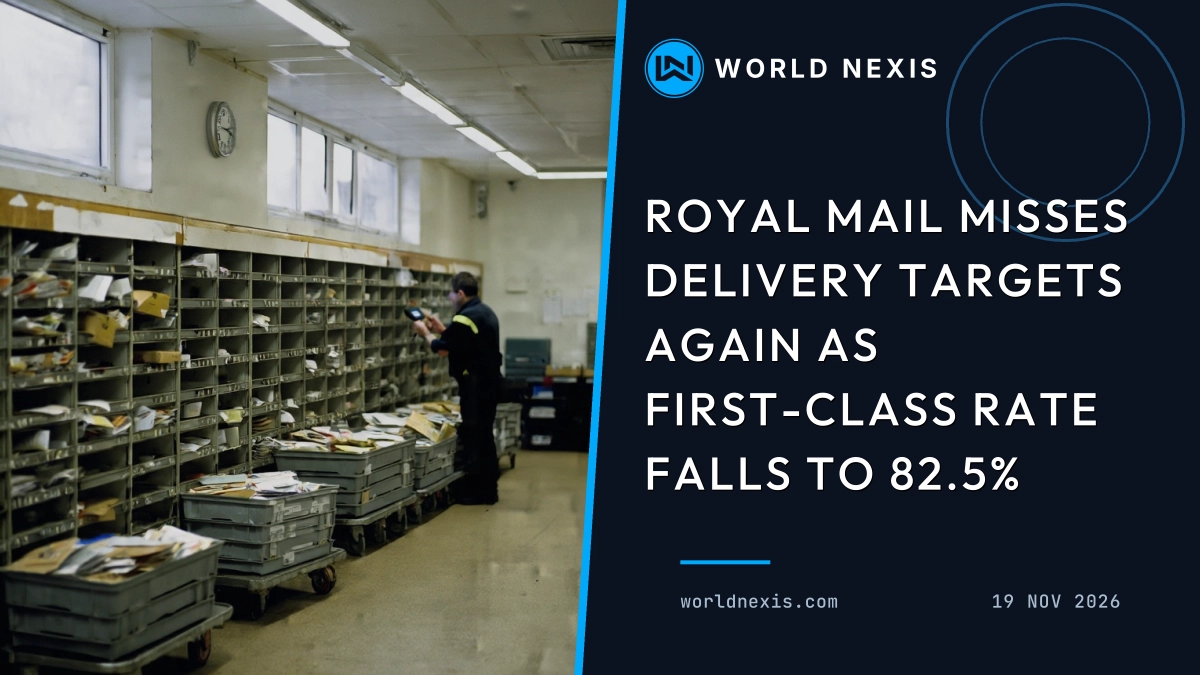
Royal Mail delivery targets have been missed again, with just 82.5% of first-class post arriving the next day between July and September and 87.2% of second-class mail delivered within three working days, both short of the standards regulator Ofcom requires.
The figures, released with the group’s half-year results on Thursday, are weaker than the previous quarter, when 85% of first-class and 91.4% of second-class mail arrived on time. Ofcom’s current requirement is 90% next-day delivery for first-class letters and 95% within three days for second-class, lowered from April as part of universal service reforms.
Key points
- First-class next-day delivery fell to 82.5% from 85% in the first quarter.
- Second-class delivery within three working days fell to 87.2% from 91.4%.
- Royal Mail says it is “broadly on track” with reforms but warns progress will not be linear.
- Citizens Advice says the company is on course to miss its first-class target for a tenth year in a row.
Royal Mail delivery targets slip further as overhaul bites
The company is midway through the biggest change to its network in decades. Second-class post is moving to an every-other-day service, Saturday deliveries are being phased out, and delivery offices are being reworked around new routes. Royal Mail last month paused the full rollout of the second-class overhaul until after Christmas so staff can concentrate on the festive peak.
Executives argue the disruption is the price of a service that must shrink to survive. “Given the scale and pace of the universal service change, we do not expect progress on quality of service to be linear,” the group said, adding that the new delivery model needs time for delivery offices to adapt to new processes.
Even so, the Royal Mail delivery targets published on Thursday point the wrong way for a company that says it is broadly on track. Royal Mail service performance has now fallen for a second consecutive quarter, months after the benchmarks were eased.
Change at the top and 2,500 jobs to go
The results came with a leadership change. Alistair Cochrane, the chief executive, will retire at the end of the year and be replaced by Paul Ablin, currently chief financial officer of both International Distribution Services (IDS) and Royal Mail.
The workforce is shrinking too. Up to 2,500 head office and support function roles will disappear by the end of 2027 to cut costs, a decision announced last month. IDS, the owner of Royal Mail, was bought last year by Czech billionaire Daniel Kretinsky.
What the accounts show
Royal Mail group revenues reached £4.1 billion for the six months to 30 September, up 3.9%. An 8% rise in parcel revenue offset a 0.8% fall in letters revenue, while letter volumes dropped 8% and parcel volumes climbed 8%.
Group-wide, IDS revenues rose 6.3%, helped by a 10.2% jump at its European parcels arm GLS. The company warned that Royal Mail’s second-half performance will be dented by the delay to price increases for access business mail: the marketing letters, household bills and medical appointment notices that make up a large share of the postbag.
Citizens Advice demands tougher Ofcom action
Consumer group Citizens Advice said the latest Royal Mail delivery targets leave the company on track to miss its first-class standard for the tenth year running and its second-class standard for the seventh.
“Putting a letter in a postbox shouldn’t be like rolling a dice to see if it arrives on time. But that’s the pot luck service consumers get with Royal Mail.”
Tom MacInnes, the charity’s director of policy, said Ofcom’s efforts to hold the company to account have made no impact on service so far. He called on the regulator to escalate its action and to stop Royal Mail raising stamp prices while annual delivery targets are missed.
Why it matters
Missing Royal Mail delivery targets is not an abstract regulatory failure. Households still depend on the post for medical appointment notices, bills and official paperwork, while small firms use it for invoices and orders where a day’s delay can cost a sale.
Customers also pay more for less. Letter volumes keep falling and stamp prices keep rising, so the value of the universal service — one price, one network, six days a week, a schedule now being cut back — rests entirely on whether Ofcom delivery targets are actually met.
Analysis
I have tracked Royal Mail service performance through several sets of results, and the pattern is now unmistakable: each quarter brings a fresh promise of a turning point and numbers that move the other way. The company’s argument that a network being rebuilt cannot improve in a straight line is reasonable in isolation. Operations do not run smoothly when routes are redrawn, staff are redeployed and a decades-old delivery model is dismantled.
But the defence wears thin when the same excuse accompanies a second consecutive decline against a target already relaxed in April. I side with Tom MacInnes at Citizens Advice here. If the regulator resets Royal Mail delivery targets and performance still falls, the reset has failed, and the next step should be enforcement rather than another concession. The strongest counter-argument is that hitting 90% next day while letter volumes drop 8% a year and 2,500 office roles go is genuinely hard, and a punitive fine would drain the operation that needs investment. That is a real risk, but it argues for sequencing, not for letting stamp prices rise unchecked while the postcode lottery persists.
What I am watching now is whether Royal Mail delivery targets steady through the Christmas peak. If the pause in the second-class overhaul holds service together in December, the regulator will have evidence that the model works when resources are concentrated. If it does not, the case for a much harder line becomes almost impossible to resist.
What happens next
The full second-class overhaul will not resume until after the Christmas peak, and no date has been set for the next stage. Alistair Cochrane steps down at the end of the year, with Paul Ablin taking over, while the 2,500 head office and support role reductions are due to be completed by the end of 2027.
Ofcom will judge annual performance against its reformed standards, and Citizens Advice wants the regulator to escalate its action and tie any further stamp price rises to delivery quality.
What we don’t know yet
Royal Mail has not said how much the delay to access business mail price increases will cost it over the full year. Ofcom has given no signal on whether it will escalate enforcement, and the extent of any further deterioration over the festive period will only become clear at the next quarterly update.
Related coverage
- GTA 6 launch day: 17m preorders and 9% surge in time off
- Sean Rooney inquest: 50-strong mob and fatal missed turn
- Van Gogh auction: record $190.4m sale ends Nazi-era row
Further reading
- Royal Mail insists turnaround will take time as it misses delivery targets again
- Royal Mail insists turnaround will take time as it misses delivery targets again
About the author: Daniel Whitmore is the Business & Markets Editor at World Nexis News (WNN), covering business & markets. The analysis section reflects the writer’s view.

Daniel Whitmore
Daniel Whitmore is Business & Markets Editor at World Nexis News, based in New York. He leads coverage of companies, economies, markets and the forces that move them, from central bank decisions to corporate earnings and the cost-of-living pressures facing households on both sides of…



