Paolo Bulgari dies at 89: Bulgari house hails ‘a true creative soul’
Paolo Bulgari dies at 89. The jeweler who turned a Rome family workshop into a global luxury brand, later sold to LVMH for over $5 billion, is mourned in…
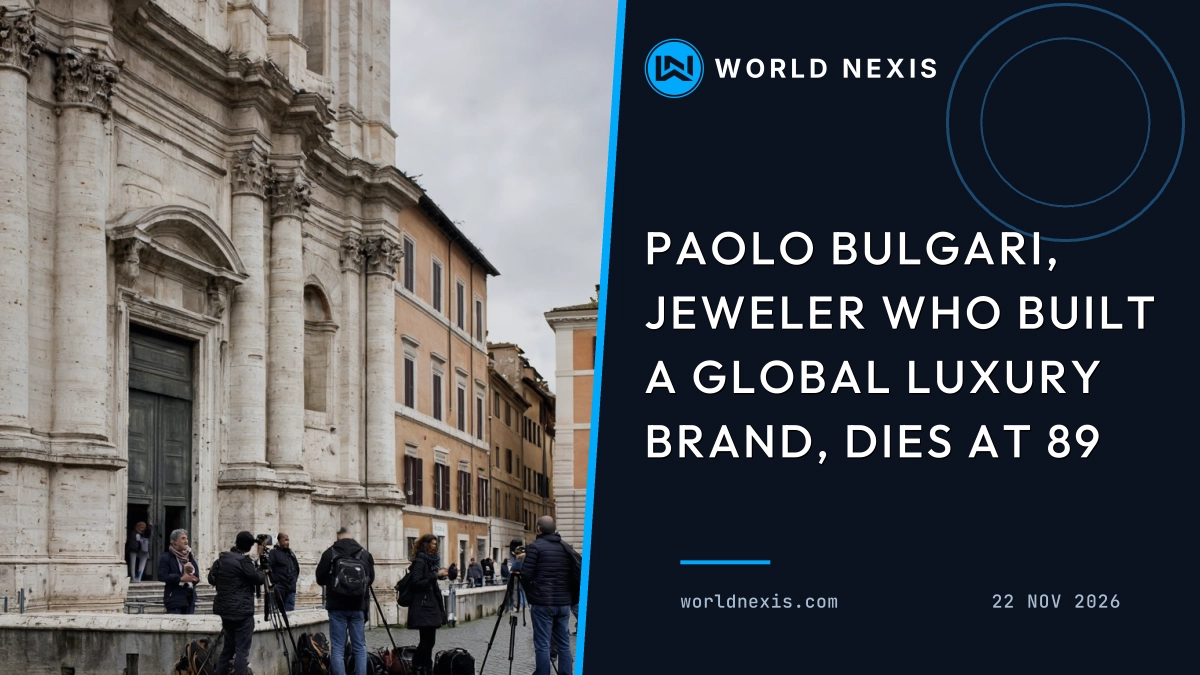
Updated 22 Nov 2026, 16:21 (UK time): LVMH chairman and chief executive Bernard Arnault has issued his own tribute crediting Paolo Bulgari with a pivotal role in the brand’s success, the first word from the owner rather than the house, while the Bulgari company confirmed the family’s announcement of the death.
Bernard Arnault, LVMH’s chairman and chief executive, has now spoken publicly about Paolo Bulgari, saying he played a pivotal role in the success of the Bulgari brand throughout his life while preserving and embodying its Italian spirit and deeply rooted Roman heritage. The tribute came on Saturday, and it is the first from the top of the parent group rather than from the jeweller itself or from the family.
The Bulgari company has also confirmed the family’s announcement of the death, which puts the corporate side on the record in a second way beyond its own social media post. Together the two statements close the loop: family, house and owner have all now said something on the record.
Other details have firmed up. He joined the family business in 1960 after initially studying law, and chaired the group from 1984 rather than the vaguer mid-1980s. Colleagues describe a reserved man of nearly two metres who still liked serving customers at the historic Via Condotti boutique, sometimes introducing himself simply as a salesman, and who kept sketching jewellery designs almost until the end of his life. The funeral is on Monday at the Basilica of Santa Croce in Gerusalemme in Rome.
The Arnault statement is warm but careful. It praises heritage and spirit, not the 2011 transaction that handed him the company — which is exactly what you would expect, and exactly why the family’s and the house’s words still carry more weight here.
Updated 22 Nov 2026, 05:01 (UK time): Bulgari, the jewelry house Paolo Bulgari built and which LVMH now owns, issued its own public tribute to him, the first statement from the company itself rather than from the family.
The house Paolo Bulgari built has now spoken for itself. Bulgari, the brand that has sat inside the LVMH group since 2011, posted a tribute describing him as “a true creative soul” who “poured his heart into his craft and into nurturing the talents of young designers,” and said he left an indelible mark on the world of jewelry.
That matters because the public record of his death, until now, came almost entirely from his family, which announced it on Saturday and called him “the greatest jeweler of our time.” A statement from the company puts the corporate side of the house on the record too, and places the emphasis on craft and on mentoring young designers rather than on the sale that ended family control.
Nothing in the essentials has moved. He was 89, born in Rome in 1937, the grandson of Greek silversmith Sotirios Voulgaris; he headed the group from the mid-1980s; the family sold a controlling stake to LVMH in 2011 in a deal valued at more than $5 billion; and the funeral is on Monday at the Basilica of Santa Croce in Rome.
The line about nurturing young designers is the one I would keep. It is warmer than most conglomerate language, and it points at the foundation he set up in 2019 rather than at the store network — which is probably where his legacy will be measured in twenty years. A tribute posted on Instagram is also a reputation document, so I read it as both. The family said who he was; the company said what it intends to keep.
Paolo Bulgari dies at 89, his family announced on Saturday, after a career that took a single jewelry workshop in Rome and turned it into one of the most recognizable luxury houses in the world. The family described him as “the greatest jeweler of our time,” praising his humanity and his entrepreneurial talent. His funeral will be held on Monday at the Basilica of Santa Croce in Rome.
For decades Bulgari presided over a brand celebrated by supermodels, Hollywood stars and collectors for its bold designs and distinctive use of color. He was born in Rome in 1937, the grandson of a Greek silversmith, and he never stopped reminding people how recent and how unlikely that family history was.
Key points
- Paolo Bulgari dies at 89; his family announced the death on Saturday and called him “the greatest jeweler of our time.”
- He was the grandson of Greek silversmith Sotirios Voulgaris and joined the family firm shortly after leaving school.
- He headed the group from the mid-1980s and drove its expansion into watches, perfumes, leather goods and hotels.
- The family sold a controlling stake to LVMH in 2011 for more than $5 billion; his funeral is on Monday.
Paolo Bulgari dies at 89 after decades at the head of the house
Bulgari joined the family business shortly after leaving school and worked alongside his father, Giorgio. His early focus was precious stones, and the expertise he built in gemstones shaped both his design instincts and his commercial judgment for the rest of his working life.
From the mid-1980s he headed the group through a period of significant international growth. Alongside his brother Nicola and his nephew Francesco Trapani, he opened stores in New York, Paris, Geneva and Monte Carlo, and pushed the business beyond jewelry into watches, perfumes, leather goods and, eventually, hotels.
Tall and silver-haired, he cut a characteristically reserved figure even as his creations appeared on red carpets and magazine covers. The house’s clients ranged from Elizabeth Taylor to Zendaya, a span of six decades in the public eye.
Bold color against the delicate Parisian style
The look was a deliberate break with the delicate aesthetic associated with Parisian jewelry houses. Bulgari embraced bold gemstones, rich yellow gold, generous proportions and unexpected combinations of color.
Ancient Rome and Italy’s artistic heritage supplied the references, and the mixture helped set the brand apart internationally. It also made the Bulgari jewelry brand instantly readable across a crowded room, which is exactly what a luxury client pays for.
The 2011 sale that ended family control
In 2011 the family sold a controlling stake in the company to the French luxury conglomerate LVMH in a deal valued at more than $5 billion, ending decades of direct family control.
Paolo Bulgari dies at 89 with the house he built sitting inside a conglomerate, and that ownership structure shapes how his career is being read this weekend. The Bulgari LVMH deal is the hinge on which most assessments turn: a family firm that had become a global name, handing over the wheel while keeping the name above the door.
The sale gave the brand capital and reach that one family could not have matched alone. It also meant the final say on design, expansion and pricing no longer sat with the Bulgari family, a trade-off every founder-led luxury business eventually faces.
A quieter legacy beyond the showroom
Bulgari traced the business to his grandfather, Sotirios Voulgaris, who came from Paramythia, a mountain village in the Epirus region of northwestern Greece known for its silver jewelry. Voulgaris fled Ottoman rule, settled in Naples and later opened a shop in Rome, adapting both his craft and the family name to his new home.
In 2019 Bulgari and his wife established the Paolo Bulgari Foundation, which supports young people through schooling and job training in disadvantaged neighborhoods on the outskirts of Rome. “Many people don’t know it,” he wrote in the foundation’s introduction, “but at the origin of my surname there is a story of migration.”
Why it matters
For anyone who buys, collects or simply walks past luxury goods, the story behind the news that Paolo Bulgari dies at 89 is a familiar template: a family craft business becomes a global brand, then becomes part of a conglomerate. The names survive on the storefront; the ownership usually does not.
That shift decides where design decisions, manufacturing jobs and profits sit, and it explains why the death of an Italian jeweler is read in New York and Paris as a corporate event as much as a family one.
Analysis
Having covered luxury consolidation for World Nexis News, I look first at what a founding family gives up and what it gets. In my view, the decision to sell control to LVMH in 2011 was the right call, and the evidence is the price the family secured and the reach that followed. One family cannot fund the store network, the advertising and the hotel expansion a brand of this scale demands, and holding on out of pride would have risked the business rather than saved it.
The strongest counter-argument is that independence was the whole point: that a house built on Roman color and Italian craft loses something once it answers to a French group’s balance sheet. I take that seriously, but the break is less clean than critics claim. The name on the door is still his family’s, and the foundation he set up in 2019 shows where he thought the returns should go.
So I do not read this weekend’s news as the end of an Italian company. I read it as the close of one family’s chapter inside a global one, and the schooling and job training he funded on Rome’s outskirts is the part of the legacy that will be hardest to replicate.
What happens next
The funeral will be held on Monday at the Basilica of Santa Croce in Rome. Tributes are expected to center on his design record and on the foundation’s work with young people on the city’s outskirts.
What we don’t know yet
No cause of death has been made public. There has also been no announced plan for how the Paolo Bulgari Foundation will mark his death, or who will direct its programs next.
Related coverage
- Peter Fluck dies at 85: Spitting Image creator’s legacy
- David McKittrick dies aged 77: landmark Lost Lives author
- Bruno Mars father Peter Hernandez dies at 74, family tribute
Further reading
- Paolo Bulgari, the Italian jeweler who turned a family business into global luxury brand, dies at 89 | Company Business News
- Paolo Bulgari, the Italian jeweler who turned a family business into global luxury brand, dies at 89
About the author: Daniel Whitmore is the Business & Markets Editor at World Nexis News (WNN), covering business & markets. The analysis section reflects the writer’s view.

Daniel Whitmore
Daniel Whitmore is Business & Markets Editor at World Nexis News, based in New York. He leads coverage of companies, economies, markets and the forces that move them, from central bank decisions to corporate earnings and the cost-of-living pressures facing households on both sides of…



