Peter Fluck dies at 85: Spitting Image creator’s legacy
Peter Fluck dies at 85: the Spitting Image co-creator's family confirmed he died at home in Cornwall, and his puppets left a legacy now held in Cambridge.
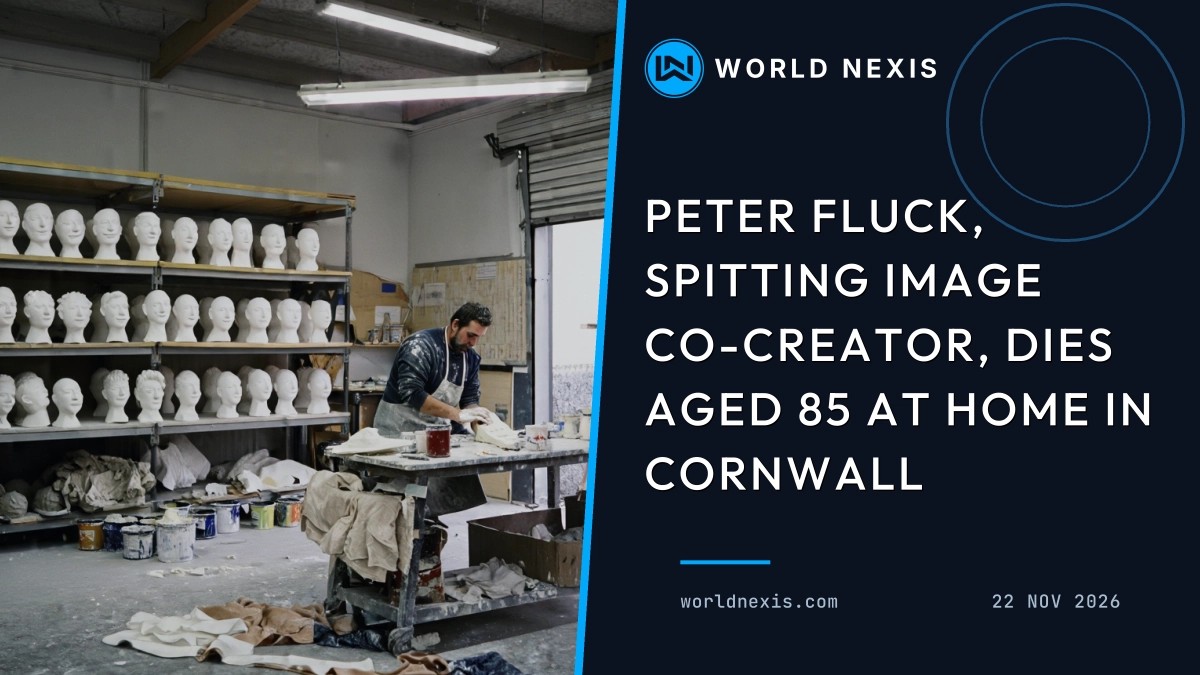
Peter Fluck dies at 85, his family has said, with the Spitting Image co-creator passing away in the early hours of Saturday at home in Cornwall following a recent illness. Tributes have focused on one claim — that he changed what Britain was allowed to laugh at — but the most durable legacy is more practical: the puppet moulds, scripts and drawings that now sit in a Cambridge library for anyone to study.
Key points
- Peter Fluck dies aged 85 at home in Cornwall in the early hours of Saturday, after a recent illness, his family said.
- He co-created Spitting Image with Roger Law; it ran on ITV from 1984 to 1996 across 18 seasons.
- Peak audience figures vary between accounts, put at between 15 million and 18 million.
- The show won Bafta and Emmy awards before ITV dropped it as ratings declined.
Peter Fluck dies at home in Cornwall after a recent illness
The family said he died in the early hours of Saturday at home in Cornwall following a recent illness, and they described the programme’s impact in sweeping terms. “The spirit that Spitting Image brought to the country was epoch-defining,” a family statement said.
They also credited the partnership at its centre. “With Roger Law (‘Luck and Flaw’), he brought a unique cutting edge to caricaturing that later evolved into a production company that created the TV series Spitting Image,” the statement said.
Fluck, they added, “was a private man who eschewed fame and attention”, and his creative life continued for years after the series from his studio in Cornwall, where he worked on ceramics, printmaking and mobiles.
From newspaper cartoons to Spitting Image puppets
Born in Cambridge in 1941, Fluck met Law while studying art in the city. Both later moved to London to work as freelance illustrators, and in 1976 they set up their partnership, Luck and Flaw, producing three-dimensional caricatures in clay and plasticine for publications.
Television came next. “You could say we took the traditional newspaper editorial cartoon and put it on the screen,” Fluck said in a 2006 interview. In a 2014 interview he recalled how the idea developed: “Fortunately, someone had the bright idea that the 2D work we’d been doing on the page could be made into puppets.”
Spitting Image ran on ITV from 1984 to 1996 across 18 seasons. Peak ratings figures vary between accounts, put at between 15 million and 18 million, and Fluck noted that it went out “at the difficult time of 10 o’clock on a Sunday night when all politicians should have been in bed”.
Peter Fluck dies: the puppets that fixed politicians in the public mind
The caricatures hardened into the images voters still carry. Margaret Thatcher was depicted as an aggressive iron-lady type, John Major became a dull, grey puppet with a penchant for peas, and Douglas Hurd was given “Mr Whippy ice cream” hair. Royal figures, including the Queen Mother, appeared regularly.
Politicians came to want the treatment. “We did get quite a lot of approaches from politicians for their puppet to be made, because if you didn’t appear as a puppet on Spitting Image you hadn’t made it as a politician,” Fluck said in 2011.
ITV said his “cutting edge puppetry and caricature skills, alongside the show’s sharp and always shrewdly observed humour, became a defining part of the cultural zeitgeist”. The broadcaster added that his creative contribution to television satire was “simply unrivalled”.
The programme collected Bafta and Emmy awards and was eventually axed by ITV because of declining audience numbers. In 2018 Law donated his archive of Spitting Image material to Cambridge University, including original scripts, puppet moulds, drawings and recordings, which were conserved and held in the library.
Why it matters
For anyone who watched it, the death is a reminder that a large share of British public life was once processed through one Sunday-night programme. It is also a reminder of the trades behind it: sculptors, moulders, model makers and puppeteers, whose skills now sit mostly in advertising, animation and effects work.
The archive changes what happens to that memory. Because the moulds, scripts and drawings were kept, the show can be examined rather than only quoted, and that collection is now the closest thing to a manual for how the puppets were built.
Analysis
Having covered the entertainment business for World Nexis News, I look first at the cost of the thing. Each puppet began as photographs, became a clay model, then a mould, then a foam-rubber skin, with studios in Birmingham, puppet-making in London and a lorry running up the M1 every week. That is slow, expensive work, and I think it explains why the jokes landed: the satire was unavoidable in a way a clip in a feed never is.
I side with Fluck’s own framing — that the team took the newspaper cartoon and put it on screen — over the idea that the show invented satire from nothing. His version is more useful, because it tells you what to protect now: craft, time and a mass audience. The strongest counter-argument is that the programme was often cruel, and that plenty of its material on women, race and the royals would not survive a modern commissioning meeting; it also reached far fewer people than a single viral post does today.
When Peter Fluck dies, the industry tends to write about a golden age and move on. I expect the more honest test of his influence to be whether the archive is actually used, and whether any commissioner is willing to pay for a team of makers again.
What happens next
ITV has issued its tribute and the family has made its statement; no further formal announcements have been made. The public record now rests with Law’s collection at Cambridge University, which remains the main account of how the puppets were designed and built.
What we don’t know yet
No funeral, memorial or tribute programme has been confirmed. It is also unclear whether Fluck’s later ceramics and printmaking, made in his Cornwall studio, will be collected or exhibited.
Related coverage
- Bruno Mars father Peter Hernandez dies at 74, family tribute
- Fiona the hippo dies days after swallowing a visitor’s hat
- David McKittrick dies aged 77: landmark Lost Lives author
Further reading
- Spitting Image co-creator Peter Fluck dies aged 85
- Peter Fluck, caricaturist and puppeteer who co-created Spitting Image, dies aged 85
About the author: Emily Carver is the Culture & Entertainment Writer at World Nexis News (WNN), covering culture & entertainment. The analysis section reflects the writer’s view.

Emily Carver
Emily Carver is Culture & Entertainment Writer at World Nexis News, covering film, television, music, gaming, books and the creative industries from Los Angeles. She writes about the business and craft behind the work — streaming economics, production decisions, criticism and the way culture travels…