Drax guidance upgrade lifts shares 8% as energy demand soars
Drax guidance upgrade sends shares up 8% as the generator says 2026 results will beat forecasts and targets underlying earnings above £1bn by 2031.
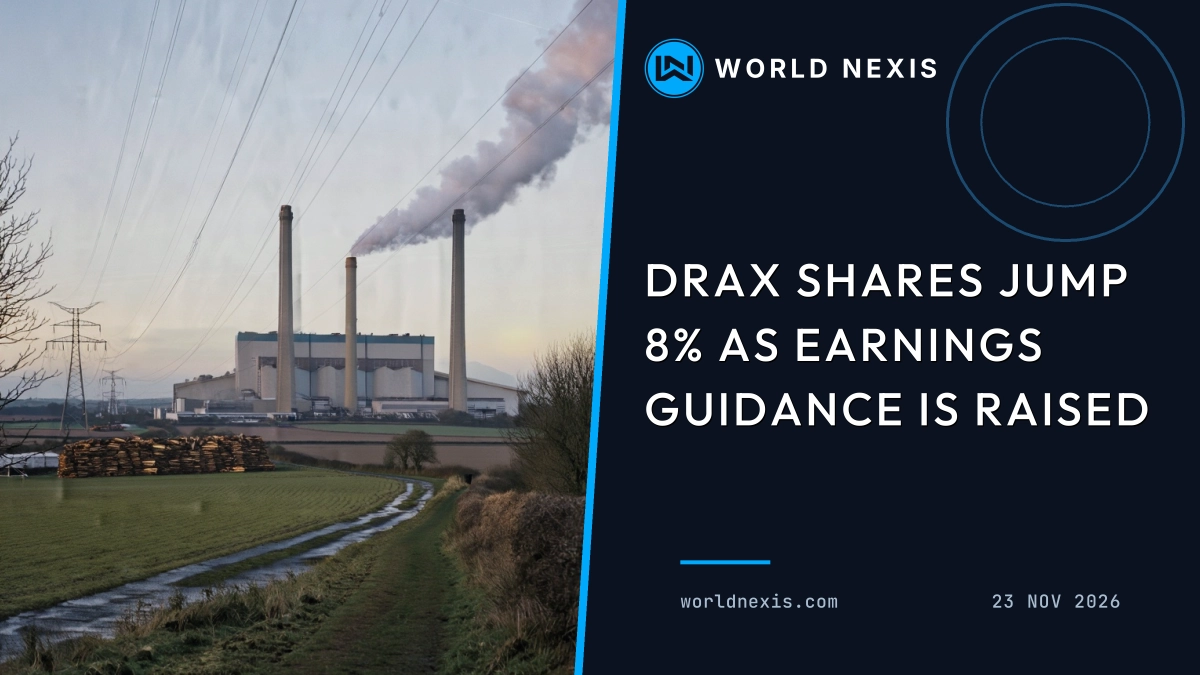
A Drax guidance upgrade lifted the power generator’s shares 8% in Monday morning trading, after the company said full-year results will land significantly above City forecasts and set out plans for underlying earnings to pass £1 billion by 2031.
The Selby-headquartered group runs the UK’s largest power station, in North Yorkshire. It said strong energy system support and power generation performance since September had changed its outlook for 2026. The market had pencilled in underlying earnings of £710 million to £736 million for the year.
Key points
- Drax said 2026 full-year results will be “significantly above” consensus forecasts.
- Shares rose 8% in Monday morning trading.
- Underlying earnings are targeted at £800 million to £900 million in 2029, then above £1 billion by 2031.
- Around £800 million is to be returned to shareholders in dividends between 2026 and 2031.
Five-year targets follow the Drax guidance upgrade
The Drax guidance upgrade does far more than raise one year of numbers. The company is now promising double-digit growth in both underlying earnings and dividend payouts across 2027 to 2031, a longer horizon than most British generators publish.
Under the plan, underlying earnings would reach £800 million to £900 million in 2029 before climbing above £1 billion two years later. Dividends would return around £800 million to shareholders across the six years from 2026.
That mix of rising earnings and steady cash returns gives investors a clear benchmark. It also shifts the argument to whether Drax can grow while the mix of British generation changes around it.
Power demand and the data centre bet
Chief executive Will Gardiner tied the outlook to the shape of the electricity system rather than to a single strong quarter. “Demand for power is expected to double by 2040 and as the share of gas generation reduces, there is an increased need for more generation across the board, including solar and wind, and the dispatchable flexible generation to support those and help keep the lights on when the wind isn’t blowing and the sun isn’t shining,” he said.
“The UK needs energy security and routes for decarbonisation which are affordable, whilst at the same time encouraging investment to support economic growth.”
Gardiner added that the group was building a portfolio of “flexible and renewable generating assets in the UK designed to benefit from the growth in renewable power and resulting need for flexible assets to support the system”.
Brookfield, Qai and Radiant
Earlier this month Drax struck a partnership with Brookfield and artificial intelligence business Radiant to develop a data centre at its North Yorkshire power station, a project that could be worth more than £20 billion. The Drax data centre plan is the second half of that growth story.
Brookfield said it will initially invest £2.5 billion through a joint venture with Qatar’s Qai, and that total investment could ultimately exceed £20 billion. The deal followed Drax proposals late last year to repurpose existing infrastructure at the site.
What the share price move shows
The Drax share price rose 8% in Monday morning trading, a strong reaction for a utility-scale generator. It reflects the size of the beat rather than a change in direction: a result “significantly above” a £710 million to £736 million range is a material change to this year’s numbers.
The Drax guidance upgrade also reveals how much of the investment case now rests on the company’s role as a supplier of flexibility. Its own language, from energy system support to dispatchable generation, describes a business paid for standing ready as well as for producing power.
Why it matters
Drax runs the kind of plant the grid leans on when renewable output falls short. Its commercial health therefore feeds into a question every household has a stake in: whether Britain can keep the lights on as older gas stations close.
The Drax guidance upgrade says nothing directly about bills. It does show where money is moving. A system that needs more flexible capacity will pay for it, and that cost sits somewhere inside the machinery that settles power prices.
Then there is the Drax data centre. The upgrade arrives alongside a plan that would put artificial intelligence demand at a Yorkshire power station, tying the region’s energy assets to one of the fastest-growing sources of electricity use anywhere.
Analysis
Having covered market structure and corporate strategy at World Nexis News, I look first at what a generator is actually being paid for. On this evidence, Drax is being paid for standing ready. The Drax guidance upgrade is a statement about scarcity: as the gas share falls, the plant that fills the gap becomes harder to replace.
In my view the facts support management’s reading that demand growth and flexibility needs underpin these numbers, and I side with that over the sceptics. The strongest counter-argument is that a few strong months since September are thin evidence for a five-year growth plan, and that the data centre is not yet a fixed sum. That is a fair objection, but it is about timing, not direction.
What I would watch is the split between system support income and ordinary generation. If the improvement leans on the former, Drax’s earnings rest on regulatory design as much as on the weather, and that is a different risk for anyone holding the shares.
What happens next
The Drax guidance upgrade now has to be confirmed in the company’s full-year results, and the 2027 to 2031 targets become the yardstick for every update that follows. The Drax share price will be tested when those numbers are published.
The partnership with Brookfield, Qai and Radiant moves into development, with Brookfield’s initial £2.5 billion commitment underwriting the first phase of the project at the North Yorkshire site.
What we don’t know yet
The company has not set out how much of the improvement comes from energy system support and how much from generation. Nor has it fixed the final scale and timing of the data centre investment, or the date of its full-year results.
Related coverage
- Civil Service pension: Capita boss quits as shares crash 70%
- Delta flight delays hit 3,500 flights as Atlanta hub stalls
- COP31 talks risk collapse on day 2 as fossil fuels omitted
Further reading
- Drax delivers guidance upgrade as energy demand soars
- Drax delivers guidance upgrade as energy demand soars
About the author: Daniel Whitmore is the Business & Markets Editor at World Nexis News (WNN), covering business & markets. The analysis section reflects the writer’s view.

Daniel Whitmore
Daniel Whitmore is Business & Markets Editor at World Nexis News, based in New York. He leads coverage of companies, economies, markets and the forces that move them, from central bank decisions to corporate earnings and the cost-of-living pressures facing households on both sides of…