Jet2 winter cuts: 240,000 seats slashed as fuel costs rise
Jet2 winter cuts remove 240,000 seats as Iran war fuel costs hit profits, with pre-tax earnings down 19% to £652.2m and no full-year guidance issued.
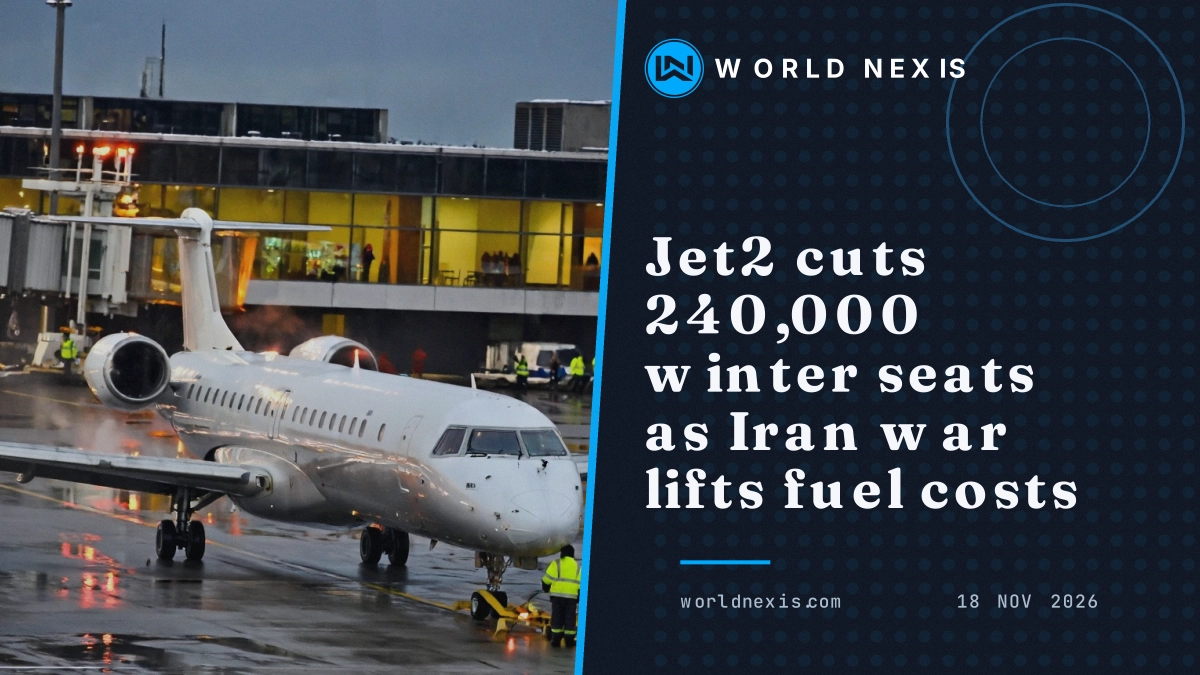
Jet2 winter cuts have removed 240,000 seats from the holiday group’s programme, the company said, as soaring fuel costs linked to the Iran war squeeze its margins. The package holiday firm, which is also the UK’s third-largest airline, said the reduction since early September equals a 3.6% fall year-on-year once its recent Gatwick expansion is stripped out.
Jet2 also held back from giving full-year profit guidance. It cited continued volatility in the price of the jet fuel it has not bought in advance.
Key points
- The Jet2 winter cuts reduce 2026-27 sale seat capacity by 240,000, a 3.6% year-on-year decline excluding Gatwick growth.
- Pre-tax profits fell 19% to £652.2 million in the six months to 30 September.
- Revenue rose 5% to a record £5.63 billion, with passengers up 9% to a record 15.4 million.
- The group gave no full-year profit guidance because of unhedged jet fuel price volatility.
Jet2 winter cuts: what the airline has changed
The Jet2 winter cuts amount to a modest slice of the programme rather than a retreat from it. The 240,000 seats represent a 3.6% reduction year-on-year, and only once the group’s recent Gatwick expansion is excluded.
The company was direct about the reason. “We have acted decisively to manage winter 2026-27 sale seat capacity in response to elevated unhedged jet fuel forward prices, reducing capacity by 240,000 seats since early September,” it said.
What the Jet2 winter cuts do show is a preference for trimming supply early, while the winter booking curve is still forming, rather than discounting seats later in the season.
No route-level detail was published. The group did not say which destinations lose seats, and it did not quantify the profit effect of the reduction.
Profits down 19% despite record revenue
The Jet2 half-year results, published on Wednesday, show a business selling more and keeping less. Revenue rose 5% to a record £5.63 billion, and passenger numbers climbed 9% to 15.4 million, the highest in its history.
Pre-tax profit nonetheless fell 19% to £652.2 million for the six months to 30 September. The gap between top-line growth and profit is the fuel bill.
Guidance withheld
Jet2 said it was “premature” to guide on full-year profitability. It pointed to the share of the winter season still to be booked and to continued volatility in jet fuel prices for its remaining unhedged requirement.
The group added that it would keep taking “responsible action” on seat capacity and operating costs in response to the external environment.
Why jet fuel hedging only partly shields Jet2
Jet2 buys much of its fuel in advance to fix costs. That is standard practice for airlines, and it protects the hedged share of the bill when prices jump.
The exposure sits in the unhedged remainder. As the conflict in the Middle East continues to disrupt global energy and oil markets, the cost of that uncovered portion rises sharply, and it lands on the winter season the group is selling now.
Demand is also arriving later. Jet2 said customers are continuing to book closer to departure, as they did in summer 2026, and argued that its flexible model is well placed to capture that demand.
A record summer, a cautious winter
The pattern across the results is consistent. Jet2 filled more seats than ever over the summer, then moved quickly to shrink the winter programme once the fuel curve turned against it.
Because the Jet2 winter cuts track unhedged fuel prices rather than booking trends, they are a cost decision rather than a demand signal. Nothing in the statement suggests holidaymakers are staying away.
Analysis
Having covered airline finances and fuel hedging for WNN, I look first at the hedge book, because it explains the timing of this decision better than the headline profit fall does. A carrier that has fixed most of its fuel costs but not all of them faces a moving price on the margin, and the winter programme is precisely where that margin is being priced today.
In my view the facts support Jet2’s side of this argument: the Jet2 winter cuts are a more defensible response than flying a full programme and hoping the fuel curve turns. A 3.6% trim is small enough to protect load factors and pricing without dismantling the network, and it stops record passenger growth turning into record losses. The strongest counter-argument is that shrinking supply pushes up unit costs and hands share to rivals just as demand grows, and that a company refusing to guide the market is asking investors to trust it through fog.
I still side with management on capacity. The case for defending every seat rests on fuel falling quickly and bookings holding up, and neither is guaranteed while the Middle East conflict runs. What I would watch is whether withheld guidance becomes a habit, because repeated silence on profitability is harder for shareholders to forgive than a trimmed winter schedule.
What happens next
Jet2 said it will keep taking responsible action on seat capacity and operating costs as conditions change. It will revisit full-year profitability guidance once more of the winter season is booked and the fuel outlook is clearer.
Customers should expect the same late booking pattern through the winter months, according to the company’s own account of demand.
Related coverage
- L&G job cuts: 1,000 roles go in sweeping overhaul
- Imperial Brands job cuts: major cull of 2,500 roles by 2030
- AAA Thanksgiving travel dips to 81.5 million on record fuel
Sources
- Jet2 cuts winter holiday programme in face of Iran war fuel pressures (oxfordmail.co.uk)
- Jet2 cuts winter holiday programme in face of Iran war fuel pressures (harwichandmanningtreestandard.co.uk)
- Jet2 cuts winter holiday programme in face of Iran war fuel pressures (thetelegraphandargus.co.uk)
- Jet2 cuts winter holiday programme in face of Iran war fuel pressures (midweekherald.co.uk)
- Jet2 cuts winter holiday programme in face of Iran war fuel pressures (heraldseries.co.uk)
About the author: Daniel Whitmore is World Nexis News’s Business & Markets Editor, covering business & markets. The analysis section reflects the writer’s view.

Daniel Whitmore
Daniel Whitmore is Business & Markets Editor at World Nexis News, based in New York. He leads coverage of companies, economies, markets and the forces that move them, from central bank decisions to corporate earnings and the cost-of-living pressures facing households on both sides of…



