California agave: 550 acres planted as wine sales slump 5%
California agave planting is spreading as wine sales fall 5%, with farmers betting on a domestic tequila-style spirit despite water limits and risk.
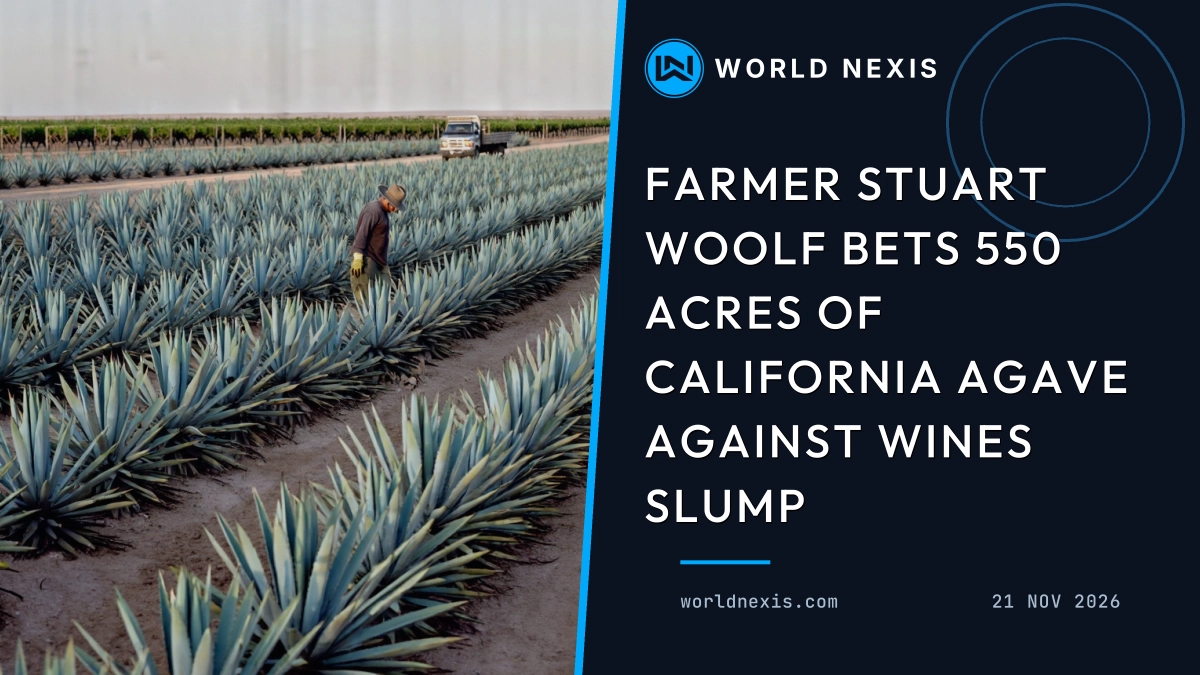
California agave planting is gathering pace as the state’s wine industry reels from a steep fall in consumption, with second-generation farmer Stuart Woolf putting about 550 acres of the succulent into the ground over four years at his farm in Huron. He plans to add another 150 acres, betting that an American agave spirit can win over drinkers who have turned away from wine.
Key points
- Stuart Woolf has planted roughly 550 acres of California agave in Huron over four years, with 150 more planned on a 30,000-acre farm facing strict water limits.
- California wine sales fell 5% last year, the sharpest decline of any alcoholic drinks category, in a market worth more than $15 billion a year through tracked US retail channels.
- Tequila has held up far better, with Mexican exports to the US up about 30% by volume between 2020 and 2025.
- Planting agave costs around $10,000 an acre, against up to $70,000 an acre to return land to grapes, yet California has very little distilling capacity.
Why California agave is spreading across the Central Valley
Woolf’s land sits in one of the most water-constrained parts of the state. Much of his 30,000 acres is subject to strict limits on water use, and agave needs less irrigation and maintenance than vines once it is established.
“This is a way that I could protect jobs, continue to farm our land, keep the land holdings within my family,” he said. “This is kind of our family’s legacy and I wanted to hang onto it and protect it.”
The crop is also cheaper to put in the ground. Soil scientist and consultant Steve Vierra, who has worked in California’s wine regions for nearly 30 years, puts the cost of planting agave at about $10,000 an acre, while converting land back to grapes can reach $70,000 an acre depending on the region. Mature agave can largely live on natural rainfall, whereas grapes need extra water.
Vierra said he has helped more than 20 wineries move part of their land from grapes into agave. The shift began with small boutique operations, he said, and larger commercial farms are now wading in.
Why the California agave bet still carries real risk
The demand case rests on demographics as much as price. Woolf points to a state of roughly 40 million people, about 40% of whom identify as Latino or Hispanic, as fertile ground for a new category of agave spirits.
“We’ve got 40 million people here, 40% of which identify as being Latino or Hispanic. This is a great place to try to introduce a new category of agave spirits.” — Stuart Woolf
Yet the obstacles are substantial. California has very little local distilling capacity and limited knowledge of how to process agave at scale. Plants are generally harvested five years or more after planting, leaving growers exposed to whatever the market looks like at the far end of that wait.
Agave prices in Mexico have also crashed after their own boom, mirroring the cycle that has hurt grape growers. On top of that, under denomination of origin rules, no drink made from California agave can be sold as tequila or mezcal.
Vierra called agave “a purely speculative crop” because distillers will not commit in advance. “There is no distillery handing out pre-plant contracts,” he said.
Spirit makers, though, argue that freedom from Mexican rules is an advantage rather than a weakness. “We’re not tied to any tradition, we’re not really tied to any way of making it,” said Gian Nelson, co-founder of Napa-based Jano Spirits.
Wine’s slump and tequila’s resilience
The fall in California wine sales has been steep. The category contracted 5% last year, the deepest drop among alcoholic beverages, according to Circana data, and brings in more than $15 billion a year through tracked retail channels without growing since at least 2022.
Dale Stratton, managing director of alcohol industry consultancy Azur Associates, said some growers are ripping out vines or letting their crops rot as demand falls. Higher labor and operating costs have compounded the squeeze, and growers are also working through an oversupply of grapes while state-imposed water restrictions bite.
Tequila has been far steadier. Growth was flat in the 52 weeks to 9 September, while vodka, whiskey and other spirits each shrank by at least 1.5%. Mexico’s exports to the US rose about 30% by volume from 2020 through 2025, despite a decline of about 1% last year, according to the country’s Tequila Regulatory Council.
Scale is starting to move. O’Neill Vintners & Distillers, which produces 8 million cases of wine a year, is taking a serious look at the possibilities. Even so, the California agave push remains tiny next to the size of the wine business it is meant to supplement.
Why it matters
For California’s farming counties, the switch is about holding onto land, jobs and water rights in a state where all three are contested. A viable agave sector would give growers a second cash crop and give rural communities a reason to keep investing.
For drinkers, it means a new and likely pricier category of spirit arriving without the protections of a Mexican appellation. The quality and consistency of the first commercial bottles will decide whether the California agave experiment becomes an industry or a footnote.
Analysis
Having covered agricultural commodity cycles for World Nexis News, I read this as a hedge dressed up as a spirit. The arithmetic on water and planting costs is genuinely compelling, but the return depends on a distillery network and a consumer habit that do not yet exist.
I side with Vierra’s caution. A grower with no pre-plant contract is carrying five years of price risk on a crop that already has a boom-and-bust record in Mexico, and a 5% fall in wine sales does not by itself guarantee that anyone will buy a California agave bottle. The strongest counter-argument is that $10,000 an acre is cheap optionality when the alternative is vines that cannot be sold, and for a family farm under water limits that is a fair point.
What I would watch is capacity, not acreage. If a few commercial distilleries sign multi-year supply deals, the California agave bet changes character and becomes a real supply chain. Until then, planted acres flatter the story more than they prove it.
What happens next
The first meaningful volumes will not arrive for years, because agave is typically harvested five or more years after planting. In the meantime, more wineries are expected to test small conversions of vineyard land, and larger producers are already studying the category.
What we don’t know yet
No distiller has publicly committed to buying California agave ahead of harvest, and it is unclear how quickly processing capacity can be built in the state. Whether drinkers will pay premium prices for an agave spirit that legally cannot be called tequila or mezcal remains the biggest open question.
Related coverage
- Nvidia subpoena: record 7-week slump as California probes
- UK retail sales rise 0.7% as clothing and stockpiling lift October
- GTA 6 sales hit record $3.79 billion on launch day
Further reading
- California’s wine slump is fueling a risky bet on agave
- California’s wine slump is fueling a risky bet on agave
About the author: Daniel Whitmore is the Business & Markets Editor at World Nexis News (WNN), covering business & markets. The analysis section reflects the writer’s view.

Daniel Whitmore
Daniel Whitmore is Business & Markets Editor at World Nexis News, based in New York. He leads coverage of companies, economies, markets and the forces that move them, from central bank decisions to corporate earnings and the cost-of-living pressures facing households on both sides of…



