Swiss diplomatic office shut as North Korea expels envoy
North Korea has shut the Swiss diplomatic office in Pyongyang and expelled its head within 48 hours, after Switzerland sanctioned a youth camp.
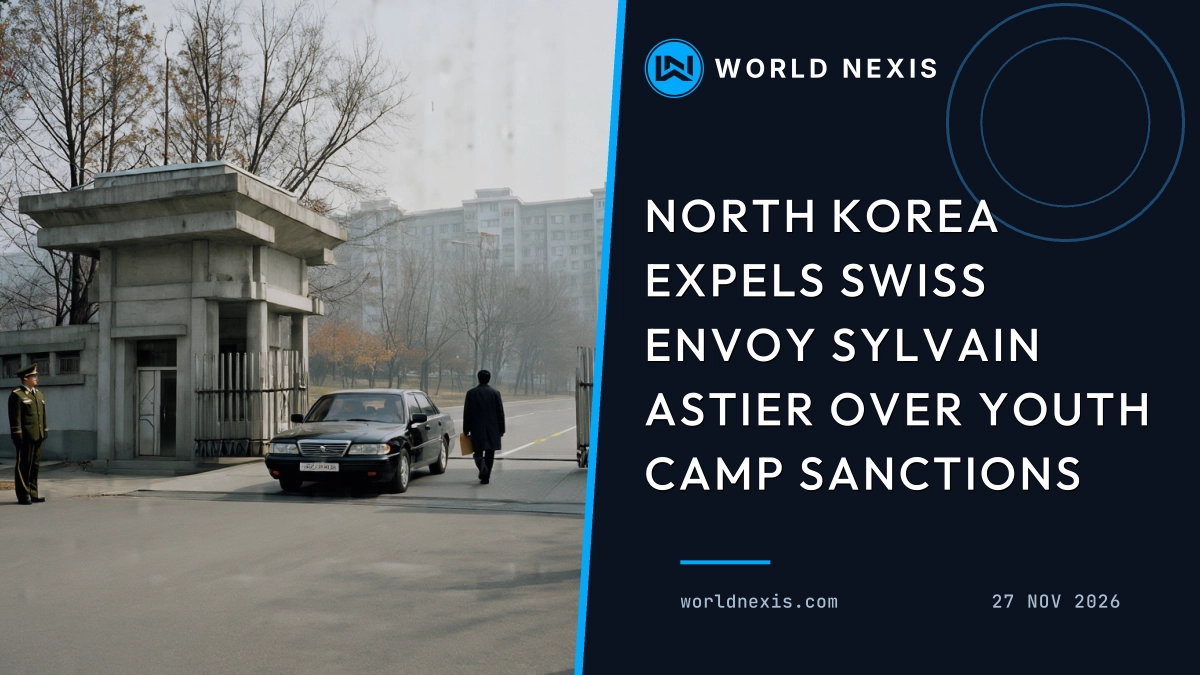
North Korea has shut down the Swiss diplomatic office in Pyongyang and expelled its head, giving him 48 hours to leave the country. The Foreign Ministry acted on Wednesday, days after Switzerland sanctioned a North Korean youth camp over its alleged role in moving children out of Russian-occupied areas of Ukraine.
The envoy, Sylvain Astier, was summoned and declared persona non grata. He had run the mission for barely a month. Switzerland’s Federal Department of Foreign Affairs said on Thursday that it regretted the decision and was arranging for him to return to the Swiss embassy in Beijing.
Key points
- North Korea declared the Swiss envoy, Sylvain Astier, persona non grata on Wednesday.
- The notice orders the Swiss diplomatic office in Pyongyang to close and Astier to leave within 48 hours.
- Switzerland sanctioned the Songdowon children’s camp at Wonsan over children transferred from Russian-occupied Ukraine.
- Bern says relations will continue through its embassy in Beijing and North Korea’s embassy in Bern.
Why the Swiss diplomatic office was shut down
The Swiss diplomatic office opened only last month, after a diplomatic push that peaked when Swiss Foreign Minister Ignazio Cassis met his North Korean counterpart, Choe Son Hui, in Pyongyang at the end of October. The mission was small and its mandate narrow. Even so, it gave Bern a rare direct channel into one of the world’s most closed states.
That channel closed over the camp. Switzerland imposed sanctions on the Songdowon International Children’s Camp at Wonsan, on North Korea’s east coast, over its alleged role in the transfer of children from Russian-occupied areas of Ukraine.
Kim Yo Jong, the North Korean leader’s sister, condemned the Swiss measures in advance. She called them an “open hostile act” that violated the North’s sovereignty. She did not directly address Western accusations that some Ukrainian children abducted by Russian forces were sent to the camp to be re-educated with pro-Russian propaganda.
The timing is instructive. Days earlier, Kim Jong Un had received credentials from 10 newly appointed ambassadors, among them envoys from Russia and Sweden. It was the first such ceremony of his 15-year rule. He used it to defend his nuclear arms buildup and to demand that the world respect North Korea’s sovereignty, a standard Pyongyang then accused Switzerland of failing to meet.
The Swiss diplomatic office closure and the 48-hour deadline
Bern has chosen to keep the dispute narrow. Its foreign ministry said it regrets the North Korean decision and is arranging Astier’s return to the Swiss embassy in Beijing. Diplomatic relations, it said, will be maintained through that embassy and through the North Korean embassy in Bern. Switzerland added that it will keep pursuing dialogue through these channels.
The North Korean notice was explicit. The ministry demanded the closure of the office and the envoy’s departure within 48 hours. That leaves little room for a negotiated exit, and no sign that Pyongyang will accept a replacement mission.
Why it matters
For Western capitals, losing the Swiss diplomatic office removes one of very few on-the-ground footholds in Pyongyang. European governments have used small missions to track humanitarian access, consular cases and security signals. Each closure narrows the picture.
For North Koreans, the cost runs the other way. Fewer foreign missions means fewer witnesses, less humanitarian contact and weaker channels for anyone seeking outside help.
The row also tests whether European governments will keep penalising North Korean cooperation with Russia over the transfer of Ukrainian children. North Korea is one of Russia’s allies and has sent thousands of troops to support Moscow’s war in Ukraine. Analysts say Pyongyang is warning other Western nations against widening sanctions while it leans harder on Russia and China. That strategy carries an obvious price: deeper isolation if Europe walks away.
The 48-hour notice matters as a precedent too. Any government that sanctions North Korean entities now knows the likely response, and smaller European states with limited presence in Asia will weigh whether a mission is worth the risk.
Analysis
Having covered sanctions and conflict for World Nexis News, I read this expulsion as a warning shot rather than a rupture. Kim Yo Jong’s language was designed to make an example of the smallest European mission on the ground. The message is aimed at capitals now drafting similar measures over the camp at Wonsan.
In my view the evidence supports Bern’s decision to sanction the camp, not Pyongyang’s claim of interference. The transfer of children from occupied Ukrainian territory is exactly the conduct sanctions exist to punish. A state that answers with an expulsion has shown that the measure landed, not that it was wrong.
The strongest counter-argument is that these small offices carry little leverage, and that Kim can afford to lose them while Russia and China supply diplomatic cover. That is fair, and it explains why the closure may not change his calculus. Even so, if the Swiss diplomatic office can be closed over a single sanctions package, the loss falls hardest on Pyongyang: each mission expelled makes the next partner more cautious.
What happens next
Sylvain Astier is expected to leave within the 48-hour window and join the Swiss embassy in Beijing. Switzerland says the relationship will stay alive through Beijing and through North Korea’s embassy in Bern. There is no indication that the Swiss diplomatic office will reopen.
European governments weighing their own measures over the Songdowon camp now have a precedent for how Pyongyang responds.
What we don’t know yet
It is unclear whether other European capitals will follow Bern with sanctions of their own, or whether their missions would also be expelled. Nor is it known whether Switzerland can keep any working channel beyond Beijing. The practical effect of the camp sanctions inside North Korea also remains an open question.
Related coverage
- North Korea nuclear: Kim Jong Un vows major arms expansion
- North Korea nuclear: Kim tours 2 plants, vows major buildup
- Thanksgiving hours 2026: 5 major chains shut as storms hit
Further reading
- What to know about North Korean move to shut down Swiss diplomatic office
- What to know about North Korean move to shut down Swiss diplomatic office
About the author: Marcus Ellington is the International Correspondent at World Nexis News (WNN), covering world affairs. The analysis section reflects the writer’s view.

Marcus Ellington
Marcus Ellington is International Correspondent at World Nexis News, reporting on diplomacy, conflict and the political forces reshaping Europe, the Middle East, Asia and the Americas. Based in London, he focuses on explaining why events unfold as they do, using official statements, diplomatic documents and…



