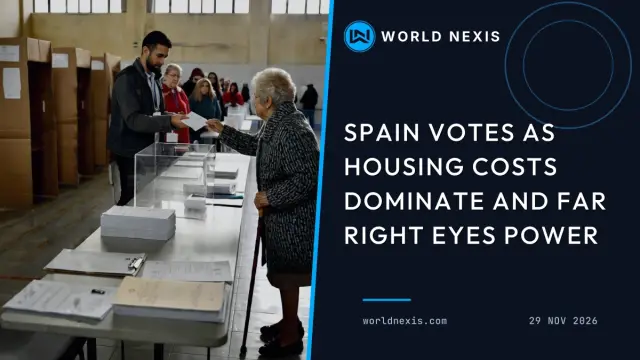
Spain election results: historic PP and Vox win 187 seats
Spain election results hand the People's Party and Vox 187 seats and end Pedro Sánchez's eight years in power. Housing and migration drove the swing.
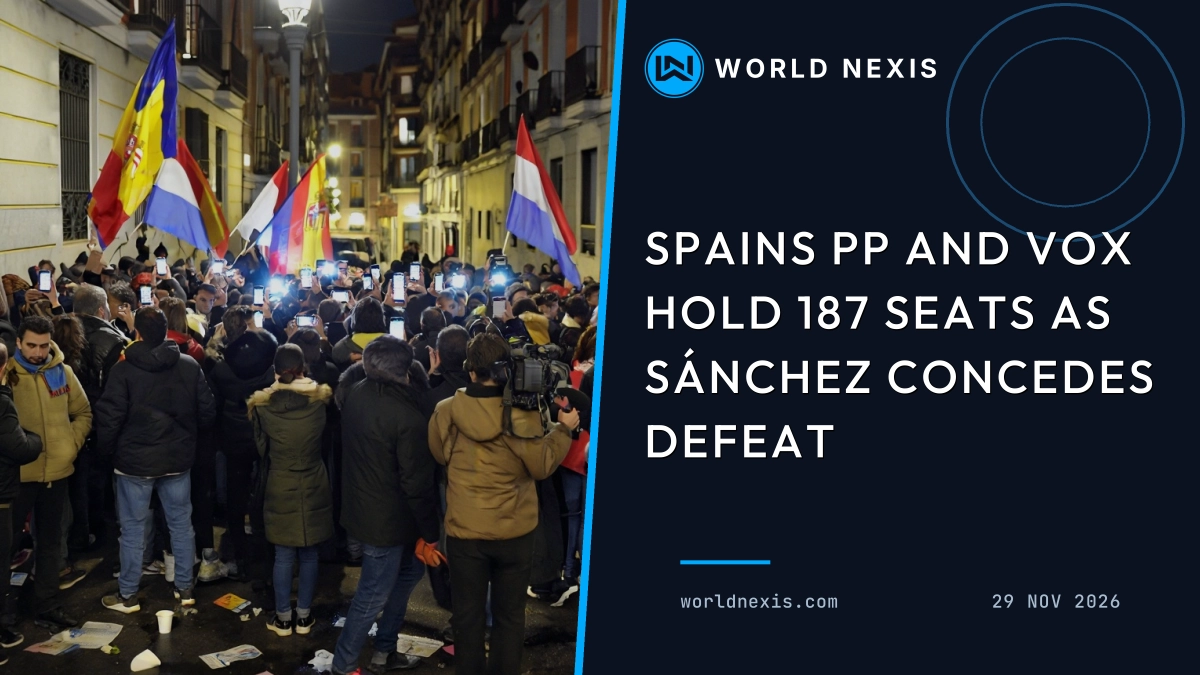
The Spain election results have ended eight years of Socialist-led government. The conservative People’s Party and the far-right Vox hold 187 seats between them in the 350-seat congress, eleven more than the 176 needed to govern. Pedro Sánchez conceded on Sunday night and telephoned Alberto Núñez Feijóo to congratulate him.
Turnout rose sharply on 2023, and the Spain election results put a far-right party into Spain’s cabinet for the first time since Francisco Franco’s death in 1975. Final figures vary slightly as counting concludes, with the PP on 134 to 135 seats, Vox on 52 to 53 and the Socialists on 115.
Key points
- The Spain election results give the PP and Vox 187 seats, a working majority above the 176-seat line.
- Sánchez accepted defeat and congratulated Feijóo; his Socialists fall to 115 seats.
- Vox would enter central government for the first time since Franco’s death in 1975.
- The new lower house meets on 23 December, with coalition talks on cabinet posts expected to be hard.
What the Spain election results change for voters
The Spain election results turned on housing, with soaring rents and property prices fuelling public anger across the country. Sánchez answered with emergency housing measures, but the anger outran him. He said he needed a fresh majority after parliament rejected the decrees he had proposed to tackle the crisis.
Immigration and corruption allegations around Sánchez’s circle fed the same demand for change. Both blocs campaigned on tighter border rules, and both promised to reset housing policy.
The policy shift will be felt fastest on rents and asylum paperwork. The PP says it would prohibit mass amnesties for migrants, allow returns to third countries and introduce a points system for legal immigration. Vox wants convicted foreigners deported, Spaniards given priority in the housing queue, lower taxes, and an end to climate policies and expanded LGBTQI rights.
A first for the far right since Franco
For decades Spain was relatively resistant to the far-right populism that spread across much of Europe. That resistance broke on Sunday. The Vox party’s leader, Santiago Abascal, told cheering supporters “Mission complete!” and “We have kicked them all out!”
Crowds gathered outside the People’s Party’s Madrid headquarters, waving party and national flags as the count came in. The PP declared victory on social media: “The PP is going to win the elections and Alberto Núñez Feijóo is going to be Prime Minister of Spain.”
Sánchez told his own supporters it was a sad day for the country. He said the Socialists had failed to keep a progressive government together and would not give way to passivity or despair.
Why it matters
The Spain election results matter well beyond Madrid. A PP-Vox government has promised to tighten immigration rules and rewrite housing policy, and those changes land first on migrants, landlords and young renters. Vox’s cabinet presence also puts LGBTQI rights and climate policy into the negotiating room.
Sánchez had clashed with Donald Trump over NATO defence spending and immigration. Trump welcomed the outcome as “a good thing”, saying Sánchez “did a terrible job” and “deserves to lose”.
Analysis
Having covered European politics and migration for World Nexis News, I look first at what voters were actually punishing. My reading of the Spain election results is that housing costs did most of the work here. Sánchez’s emergency measures arrived after the anger had set, and minority government meant he could not deliver at speed.
That matters because the Spain election results will be judged on delivery, not on the symbolism of Vox entering cabinet. If the new government brings rents down and builds faster, the far right’s arrival will look like a footnote a decade from now. If it spends its energy on deportation policy instead, the same anger will turn on it.
The strongest counter-argument is that Vox’s gains are real and not borrowed protest votes, so its cabinet power deserves to be taken seriously. I still think the decisive test is competence. Where I side with the government’s critics is on timing: the pledges on migration are far quicker to deliver than the pledges on rents.
What happens next
The new lower house meets on 23 December to elect a speaker. King Felipe then nominates a candidate for the premiership, usually the leader of the party with the most seats, and parliament votes on whether to confirm that candidate.
Spain coalition talks between the PP and Vox over the distribution of government posts are expected to be difficult. The two parties have run regional coalitions together in four Spanish regions, which gives them working habits but does not settle the division of ministries.
If no candidate wins parliament’s confidence within two months of the first attempt, fresh elections follow automatically.
What we don’t know yet
The final seat tally is still being confirmed, and the shape of the cabinet deal is unknown. It is also unclear how much of Vox’s programme on deportation and housing priority survives negotiation with the PP’s more cautious platform.
Related coverage
- Spain election: turnout up as Sánchez and Feijóo cast their votes
- Nehru Kashmir 1962: BJP MP alleges historic division deal
- Macy’s parade marks 100th run after historic postponement
Further reading
- Conservatives, far-right on track to oust incumbent Sanchez in Spain
- Spanish PM Pedro Sanchez concedes defeat as conservatives secure majority in parliamentary election
About the author: Marcus Ellington is the International Correspondent at World Nexis News (WNN), covering world affairs. The analysis section reflects the writer’s view.

Marcus Ellington
Marcus Ellington is International Correspondent at World Nexis News, reporting on diplomacy, conflict and the political forces reshaping Europe, the Middle East, Asia and the Americas. Based in London, he focuses on explaining why events unfold as they do, using official statements, diplomatic documents and…