Energy price cap: chancellor to warn of 26% January rise
The energy price cap rises 26% in January and Chancellor John Healey will write to millions of households suggesting they consider fixing energy bills.
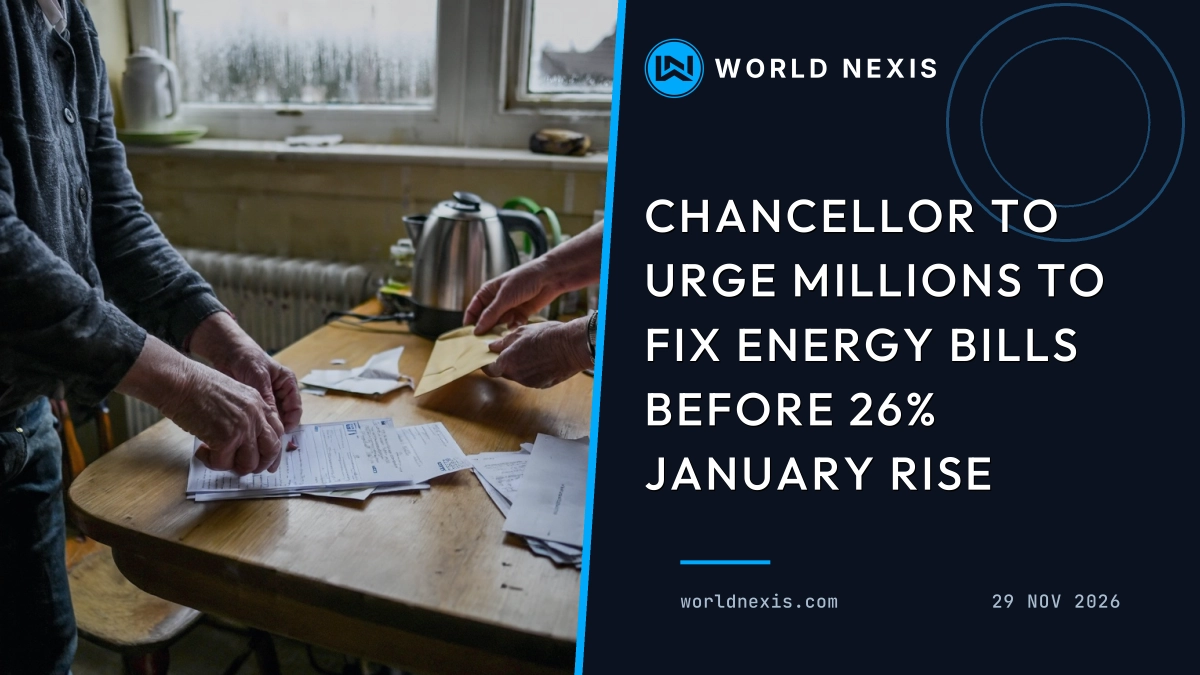
The energy price cap will rise by 26% in January, and Chancellor John Healey is expected to write to millions of households in the coming weeks advising them to consider fixing their energy bills before the increase arrives. The letter will go to the families eligible for the £100 payment he announced last month, and it will also urge them to pay council tax by direct debit so the money can be sent straight to their bank accounts.
Ofgem’s increase adds just under £37 a month to a typical household’s bill. Held at that level for a full year, it would add £443 to annual costs — more than four times the one-off support the Treasury has promised.
Key points
- The energy price cap rises 26% in January, or just under £37 a month for the average household.
- John Healey will write to millions of families suggesting a fixed-rate tariff could help with energy costs.
- About 20 million households in council tax bands A to D will receive £100 in January.
- The International Energy Agency warns a harsh European winter and the closure of the Strait of Hormuz could push prices higher still.
Energy price cap rise: what changes for households in January
The regulator’s decision sets the maximum a supplier can charge most households for each unit of gas and electricity, and for standing charges. From January, the energy price cap is 26% higher than it is now, so the average bill moves up by just under £37 a month.
About 20 million households in council tax bands A to D are due the £100 payment in January. The chancellor wants those same families on direct debit, because the money can then be transferred straight into accounts rather than chased through a claims process.
The comparison is uncomfortable for the Treasury. One payment of £100 against an increase worth £443 over a year leaves a gap that most households will feel in weekly budgeting rather than in a single bill.
Why the chancellor is urging households to consider fixed tariffs
A Treasury source said Healey would “make clear the importance of fixed tariffs” and suggest that fixing energy bills “could help with the energy costs facing families across the UK”. A fixed tariff sets the price per unit for a contract term, so a household is protected if the energy price cap rises again but does not benefit if it falls.
The advice lands at an awkward moment for global fuel markets. There is concern that the war in Iran could keep prices elevated throughout the next year, which would leave the January increase as a staging post rather than a peak.
On Sunday, Fatih Birol, head of the International Energy Agency, warned that a harsh winter in Europe, combined with the continued closure of the Strait of Hormuz, could push prices even higher than expected. Birol said he did not expect the winter to bring energy shortages, but he warned of “difficulties”.
Why it matters
For a household on a standard variable tariff, January is the month the numbers change. A 26% energy price cap rise arriving with the cold weather and the usual January squeeze on budgets leaves very little room to absorb another increase.
It also matters politically. The chancellor has chosen advice and a modest one-off payment over a larger universal subsidy, and households will judge that choice against the size of the bill in front of them. If prices stay high into spring, the argument that fixing early was the right call will be tested in public.
Analysis
Having spent my time at World Nexis News covering public services, I look first at the arithmetic of any support package rather than the announcement around it. On these figures, the £100 payment covers roughly two and a half months of the January increase for a typical household, while the energy price cap rise would cost £443 if it were held for a year. I think the chancellor should say that plainly, and I side with those who argue that advice alone cannot close a gap of that size.
That said, the advice on fixing tariffs is not wrong. With the Strait of Hormuz closed and the International Energy Agency warning of higher prices, a household that can lock in a rate now is buying certainty against a genuine risk. What worries me is who can act on it: the households with the least room to manoeuvre, including those already behind on bills, are the least able to take a risk on a fixed deal.
The strongest counter-argument is that fixing can backfire, because a household that locks in today’s elevated prices will not benefit if the energy price cap falls later in the year. That is a real risk. Even so, the balance of the evidence here favours those who say the £100 payment is too small to be described as help with soaring bills.
What happens next
The chancellor’s letter is expected in the coming weeks, ahead of the January energy price cap change. The £100 payments are due in January to households in council tax bands A to D, and the direct debit advice is intended to speed up delivery.
What we don’t know yet
The government has not set a date for the letter, and it is not clear which fixed tariffs will be available when it lands. Nor is it known whether the January increase will be the last, given the warning from the International Energy Agency that a harsh winter could push prices higher still.
Related coverage
- Energy prices: Chancellor to urge households to consider fixing bills
- Mandelson peerage row: No 10 insists removal pledge stands
- Mandelson peerage: No 10 shelves law despite Starmer vow
Further reading
- Chancellor to write to households suggesting they consider fixing energy bills
- Chancellor to write to households suggesting they consider fixing energy bills
About the author: Liam O’Connor is the UK Politics Reporter at World Nexis News (WNN), covering uk politics. The analysis section reflects the writer’s view.

Liam O'Connor
Liam O'Connor is UK Politics Reporter at World Nexis News, covering Westminster, devolved politics and the issues that matter to voters across England, Scotland, Wales and Northern Ireland. Based in London, he reports from primary sources — Hansard, official statements, published data — and explains…