OpenAI countersuit accuses Apple of major trade secret theft
OpenAI countersuit filed in California accuses Apple of stealing trade secrets and threatening suppliers, escalating a bitter fight over AI hardware.
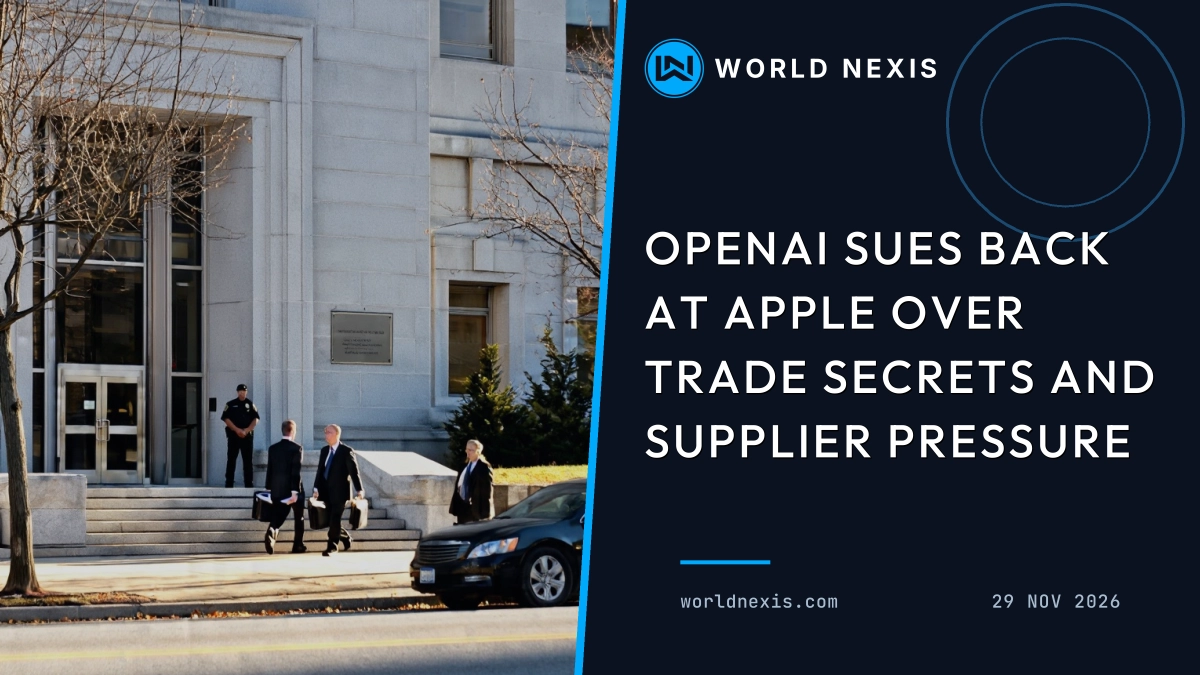
The OpenAI countersuit against Apple, filed in a California court on November 27, accuses the iPhone maker of stealing trade secrets, pressuring hardware suppliers and using its size and wealth to hold back competition. It answers Apple’s July lawsuit, which alleged that OpenAI and two former Apple employees carried out a “pattern of theft” of proprietary information. Apple says the counterclaims are a transparent attempt to distract from the substance of its own case.
Key points
- The OpenAI countersuit was filed in California on November 27, four months after Apple sued the AI company.
- The filing accuses Apple of “coercing and threatening” suppliers that also work with OpenAI.
- Apple denies the claims and says the dispute is about employees taking confidential information.
- The fight follows OpenAI’s purchase of io, Sir Jony Ive’s design startup, as it builds AI-enabled personal devices.
What the OpenAI countersuit alleges
The OpenAI countersuit claims Apple gained confidential information about OpenAI’s product plans by rehiring a former employee who had spent six months at the AI company. According to the filing, the worker had access to details of a new device and OpenAI’s roadmap for future physical products. It says he presented those plans to senior Apple staff “at Apple’s request”.
The filing also says the employee sent “dozens of OpenAI documents” to his personal phone numbers. OpenAI states in the complaint: “Given the timing, it now appears that stealing those documents may have been his reason for joining OpenAI in the first place.”
Central to the OpenAI countersuit is the claim that Apple went beyond ordinary supply-chain tactics by “coercing and threatening” manufacturers that also work with the ChatGPT maker. The company is preparing AI-enabled personal devices that it says could “outcompete Apple on what Apple views as its own turf”.
Apple has long used its purchasing power to lock in components and manufacturing capacity ahead of rivals. OpenAI argues that behavior has crossed into unlawful interference with its own supplier relationships.
Apple’s July lawsuit and the hiring dispute
Apple sued in July over what it described as a “pattern of theft”, naming OpenAI and two former Apple employees. Its complaint also targets io Products, the design startup founded by Sir Jony Ive, which OpenAI bought in May 2025 in a deal valued at about $6.5bn; figures reported for the price have differed slightly.
Ive’s studio sits at the heart of OpenAI’s hardware ambitions. The AI company is betting that a device designed by the man behind the iMac, iPod, iPhone and iPad can create a new category of consumer hardware.
The OpenAI Apple legal battle has been building since the summer, when Apple accused at least two long-serving workers of emailing themselves internal files before leaving for OpenAI. OpenAI has said it has “no interest in other companies’ trade secrets”.
The iCloud “trap” claim
The OpenAI countersuit also attacks how Apple handles employee files. It alleges Apple encourages staff to keep corporate documents on personal devices and personal iCloud accounts, which the filing says makes it easier to accuse departing employees of theft later. The complaint compares working at the company to the Eagles song Hotel California, adding: “Apple set quite a trap for employees.”
Apple’s response is blunt. A spokesperson said the case is about OpenAI employees deliberately taking confidential information on unreleased technologies, processes and products, and not about inadvertent retention of Apple information.
“This case is about OpenAI employees deliberately stealing, accessing, and using Apple’s secret and confidential information regarding our unreleased technologies, processes, and products – not about inadvertent retention of Apple information.”
Why it matters
For anyone who uses a smartphone, the OpenAI countersuit is about who controls the next generation of AI hardware, and how much leverage one supplier-heavy giant can exert over smaller firms building rivals. Workers should watch the iCloud argument too: if courts take it seriously, how big employers store and police staff files could come under scrutiny.
The wider Apple trade secrets lawsuit also signals how aggressively the largest technology companies will defend their roadmaps as AI moves from software into physical products. A ruling either way will shape hiring rules across the industry.
Analysis
Having covered AI policy and consumer hardware for World Nexis News, I read the OpenAI countersuit as less about documents and more about market access. The serious allegation in the filing is not the returning employee; it is the claim that a company with Apple’s purchasing power can lean on shared suppliers to slow a competitor. If that is proven, it is a competition problem, not a filing-cabinet one.
I think the facts as described favor OpenAI on the narrow point about the returning employee. On that account the documents went to Apple, and the plans were presented to Apple staff at Apple’s own request, which sits awkwardly with a story about theft flowing in one direction only. The strongest counter-argument is Apple’s, though: an employee who sends dozens of confidential files to a personal phone has done something serious, whatever the timing suggests.
Where I side more firmly with OpenAI is on the iCloud practice. A policy that blurs work and personal data, then becomes evidence against leavers, is a real risk to ordinary engineers who never intend to take anything. That deserves an answer in court, not just a press statement.
What happens next
The OpenAI countersuit now joins Apple’s July complaint in the federal courts in California, where both sides will exchange evidence and argue over which claims survive early motions. No trial date has been set. Apple’s original case continues against OpenAI, the two former employees and io Products.
What we don’t know yet
It is unclear whether the supplier allegations will be tested separately from the trade-secrets claims, or whether either side will seek a settlement. Apple has not said how it will respond in filings beyond rejecting the counterclaims.
Related coverage
- Dolly Parton tribute wins major praise from sister Stella
- Zomi Frankcom: families file major legal challenge in Israel
- Voting access poised to expand in three major states
Further reading
- OpenAI counter-sues Apple over alleged theft of trade secrets
- OpenAI-Apple legal battle escalates with trade secrets countersuit
About the author: Priya Nair is the Technology Correspondent at World Nexis News (WNN), covering technology. The analysis section reflects the writer’s view.

Priya Nair
Priya Nair is Technology Correspondent at World Nexis News, covering artificial intelligence, cybersecurity, consumer devices and the companies building them. Based in London, she explains how new technology works, who it affects and what the evidence actually shows, with attention to privacy, competition and the…