New Zealand election: Wong holds balance of power, 7 seats
New Zealand election final count leaves Luxon's National one seat short of a majority, giving Qiulae Wong's Opportunity party the balance of power.
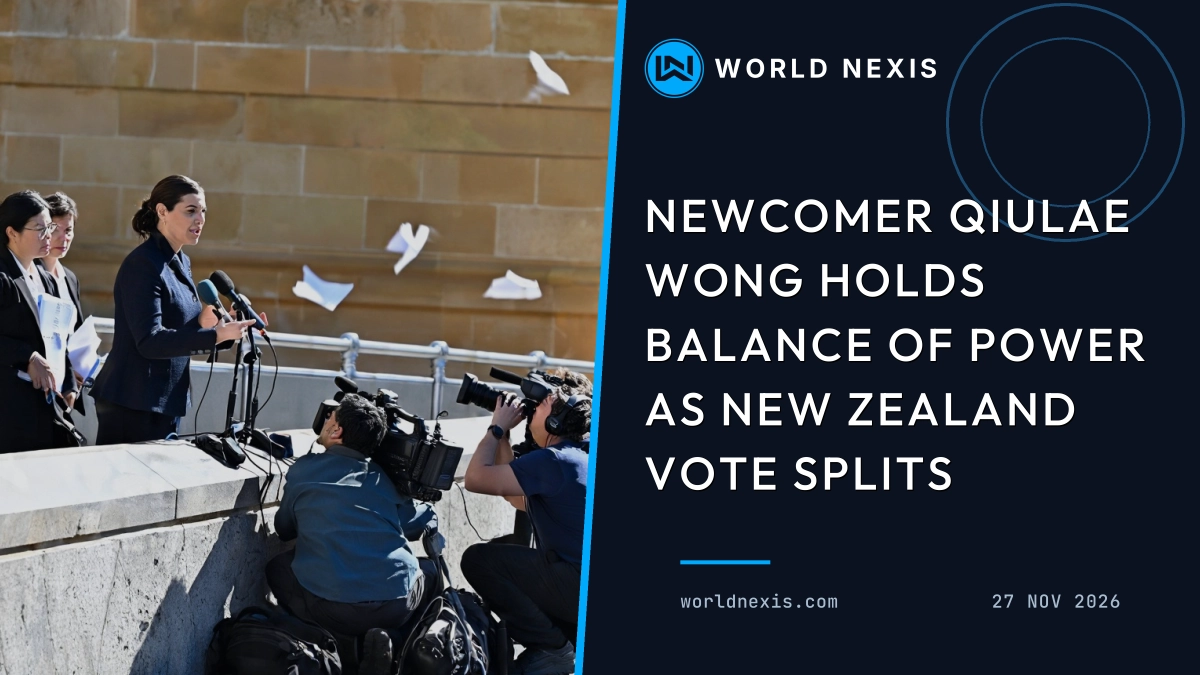
The New Zealand election final count, published on Friday, left neither the conservative incumbents nor the left-wing opposition with enough seats to govern, handing the balance of power to a centrist party entering parliament for the first time with seven seats. The Electoral Commission’s tally of roughly 400,000 special votes, including ballots cast by New Zealanders living abroad, removed two seats from Prime Minister Christopher Luxon’s National party, which finished on 40.
The right-wing bloc now holds 65 seats in a 130-seat parliament, one short of the 66 needed for a majority. The Labour-led opposition climbed to 58 seats, one more than on election night, with Labour itself taking 36 of them.
Key points
- The New Zealand election leaves no bloc with a majority: the right holds 65 seats, the left 58, and Opportunity seven.
- National lost two seats in the final count, finishing on 40 after 400,000 special votes were added.
- Qiulae Wong’s Opportunity party can decide who becomes prime minister.
- Wong says she will not serve in a government with Winston Peters as foreign minister.
What the New Zealand election final count changed
The November 7 ballot was the tightest in years. The conservative bloc ended election night with a wafer-thin majority, and the arrival of the special votes wiped it out. National’s two-seat loss and Labour’s one-seat gain left the chamber finely balanced, with no side able to command 66 votes alone.
Both Labour and National fell below 30 per cent of the preferred party vote. Analysts said the New Zealand election result reflected public malaise over high living costs and limited enthusiasm for either leader: Luxon, who survived two confidence votes among his own lawmakers this year, and Chris Hipkins, who led Labour to defeat at the 2023 election.
A newcomer with the deciding votes
Opportunity, an unaligned centrist group, is now the pivot of the result. Its seven MPs are led by Qiulae Wong, a 38-year-old business consultant and political newcomer whose promises of evidence-based centrism and an end to partisan bickering won support. Wong has said she could work with either side to form a government.
The arithmetic facing Christopher Luxon
Only Luxon has a viable path to a second term, and the Christopher Luxon coalition talks now carry the weight of the whole New Zealand election outcome. He said on Friday he was confident he could form a government with Opportunity, the libertarian ACT party and the populist NZ First. All three would have to endorse him, and each will seek deep policy concessions in return.
The difficulty is policy, not arithmetic. Opportunity’s five bottom-line policies include stronger measures on climate change and an end to bottom-trawling fisheries, both directly opposed by NZ First and ACT. Luxon also has to explain what his existing partners get for accepting terms written by a party with no governing record.
The Peters veto
Wong has repeated her position that she would not enter a government in which Winston Peters served as foreign minister, the role he held until the election. She pointed to remarks Peters has made in parliament about Asian people, which she said made him unsuitable to represent New Zealand abroad.
That condition is the sharpest obstacle in the talks. Luxon needs NZ First to govern, and foreign affairs sits at the centre of the dispute. Wong has restated the demand in public rather than leave it to the negotiating room, which makes it harder for either side to climb down quietly.
Why it matters
For households, the price of a deal is policy. The parties bargaining over support disagree sharply on climate measures and fisheries, so the concessions Wong extracts would shape rules that voters were never asked about directly. Until the numbers are settled, the country has a prime minister without a confirmed majority behind him.
Abroad, the question of who speaks for New Zealand carries real weight. The New Zealand election outcome turns partly on a portfolio rather than a spending promise, which is unusual in a negotiation dominated by cost-of-living politics.
Analysis
Having covered coalition building and foreign policy for World Nexis News, I look first at who can actually move the numbers. On this arithmetic, Wong’s position is stronger than Luxon’s confidence implies. With 65 seats against the 66 needed, National cannot govern without her, and her five bottom lines give her a public mandate she can defend point by point.
I side with Wong on the foreign minister question. A minister who has made remarks in parliament about Asian people is a liability in the job that carries the country’s voice abroad, and her objection is a judgement about the role, not a personal grudge. Luxon’s counter, that a three-party deal is there to be done, rests on thinner ground, because he has not said how ACT and NZ First would accept stronger climate measures and an end to bottom-trawling.
The strongest argument against me is that a seven-seat newcomer should not be choosing cabinet posts before talks begin, and that NZ First’s voters are entitled to representation too. That is fair as a point about process, but it does not answer the substance of her objection.
What happens next
Negotiations between Luxon’s team and the three minor parties follow the publication of the New Zealand election final count. Hipkins has effectively conceded that Opportunity’s support would not be enough to install a left-wing government. Luxon says he can close a deal with all three.
What we don’t know yet
Whether ACT and NZ First will accept Opportunity’s climate and fisheries conditions is unresolved. So is the timing of any agreement, and whether Wong would walk away if Peters is offered the foreign affairs portfolio.
Related coverage
- Power grid alert: Neso issues record fourth day of warnings
- Central Park rain record broken as 900,000 lose power
- Thanksgiving storm knocks out power to 900,000 on East Coast
Further reading
- Newcomer Wong holds balance of power as final count leaves vote split
- Newcomer Wong holds balance of power as final count leaves vote split
About the author: Marcus Ellington is the International Correspondent at World Nexis News (WNN), covering world affairs. The analysis section reflects the writer’s view.

Marcus Ellington
Marcus Ellington is International Correspondent at World Nexis News, reporting on diplomacy, conflict and the political forces reshaping Europe, the Middle East, Asia and the Americas. Based in London, he focuses on explaining why events unfold as they do, using official statements, diplomatic documents and…



