Iran attacks Gulf states in major escalation after Qeshm
Iran attacks on Gulf states widened as Bahrain intercepted a third assault in a week and Kuwait was struck, while Oman and Qatar push for talks.
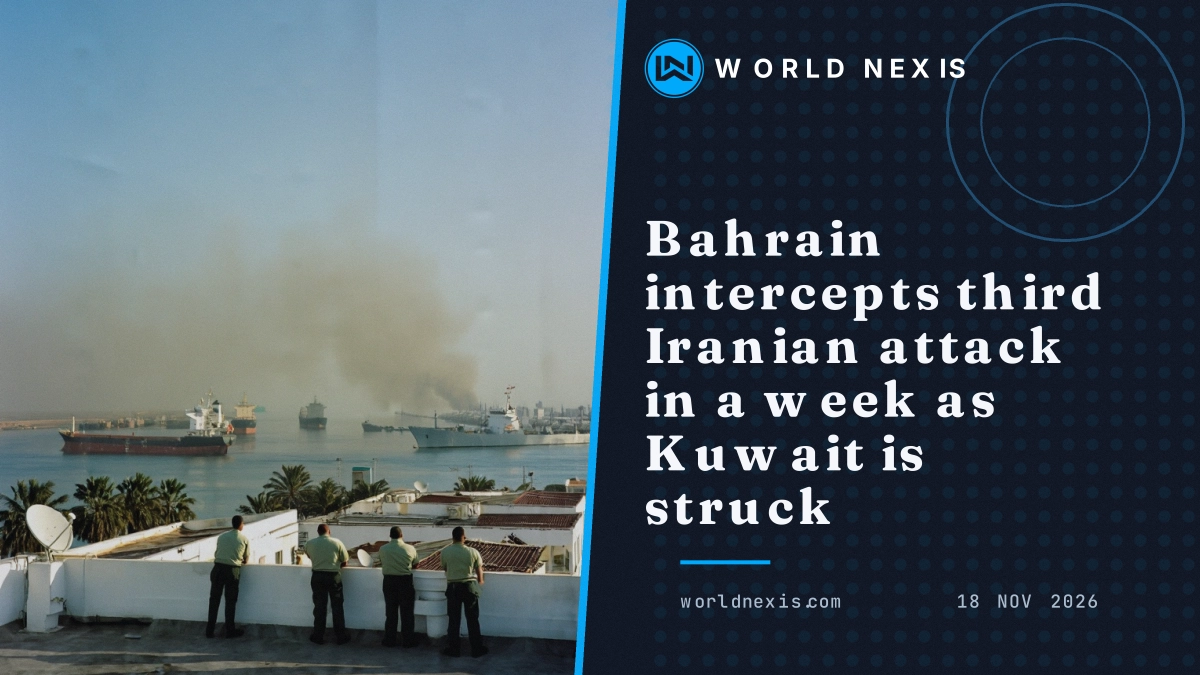
Iran attacks on Gulf states widened on Wednesday when Bahrain said it intercepted Iranian aerial attacks for a third time in a week, accusing Tehran of a “systematic hostile approach”. The escalation followed a US strike on Qeshm Island in the Strait of Hormuz and an Iranian claim that it hit US drone and missile sites in Kuwait overnight, Reuters reported.
Bahrain reported no casualties or damage. The Kuwait salvo was Tehran’s first attack on the US-allied Gulf state since September.
Key points
- US fighter jets struck a Revolutionary Guards missile launch site on Qeshm Island on Tuesday.
- Iran’s Revolutionary Guards said they targeted a US radar system at Bahrain’s Sheikh Isa base.
- Bahrain said it intercepted the Iran attacks, and Gulf states condemned the strikes on Kuwait.
- Qatar and Oman hosted Iranian diplomats as Brent crude rose 0.4% to $92.76 a barrel.
Iran attacks Gulf bases after Qeshm strike
A US military official, speaking on condition of anonymity, said American jets fired on the Qeshm launch site. He described the strike as a response to Iran’s “aggression targeting US personnel and assets”. Iranian media, citing an official, said the US attack did not damage infrastructure on the island.
Earlier on Tuesday, the Revolutionary Guards said they had targeted a US military radar system at Sheikh Isa base in Bahrain. They warned Bahrain over its alliance with Washington and its stance towards Shiite clergy, Middle East Online reported. Bahrain said it intercepted the assault.
The sentencing that came first
The Bahrain strike followed the kingdom’s sentencing of 64 people, most of them Shiite clerics, to life in prison. They were convicted of colluding with Iran to undermine the state. Bahrain is a Shiite-majority country ruled by a Sunni Muslim family, and it hosts the US Fifth Fleet.
Gulf governments condemned the Iran attacks on Bahrain and Kuwait, with The National reporting the joint language of “hostile” strikes. Overnight, Iran said it had hit US drone and missile sites in Kuwait, the first such attack since September.
Oman and Qatar push for de-escalation
Diplomacy has not stopped. Qatari and Iranian officials met on Tuesday for talks aimed at “bridging perspectives and narrowing the gap between proposals presented on the ground,” Qatari spokesperson Majed Al Ansari said. The session ran alongside a visit to Oman by Iranian Foreign Minister Abbas Araghchi.
Oman’s Foreign Ministry said Araghchi discussed safeguarding maritime corridors and keeping global shipping and trade moving with his Omani counterpart. They also covered preventing military escalation. Araghchi said on Telegram that he met Sultan Haitham bin Tariq and briefed him on Iran’s diplomatic initiative to end the war.
That war began with US and Israeli strikes on Iran on 28 February and has now run for nearly nine months. It has destabilised the Middle East, pushed up global energy prices and fuelled the voter anger that punished President Donald Trump’s Republican Party in November’s elections.
Hormuz, tankers and the cost of Iran attacks
Oman and Iran sit on opposite sides of the Strait of Hormuz. Before the war the waterway carried about one-fifth of global oil and liquefied natural gas supplies, but Iran now partly blocks it. Trump has said he will keep a naval blockade because Tehran keeps disrupting shipping.
Those Iran attacks on tankers have increased this month. The United Kingdom Maritime Trade Operations agency said the crew of a tanker was unaccounted for after it was attacked north of the Omani port city of Khasab. Iran’s Revolutionary Guards and navy said an LNG carrier and two oil tankers caught fire in the strait, a claim Reuters could not verify.
Brent crude futures traded up 0.4% at $92.76 a barrel on Tuesday, far above pre-war levels but well below April’s wartime peak of $126.41. An open-source analysis by Israel’s Institute for National Security Studies found US naval strength in the region now exceeds the force deployed at the peak of earlier hostilities.
Three carrier strike groups are in the region: the USS Theodore Roosevelt, USS George H.W. Bush and USS George Washington. Washington has also sent 12 destroyers to the Arabian Sea. Separately, Trump said the US was taking seriously a CNN report, citing intelligence assessments, that Iran could be planning a dirty bomb attack in Washington. Iran’s Foreign Ministry spokesperson called it “baseless allegations”.
Analysis
Covering conflict and foreign policy for WNN, I look first at what each side is trying to buy with its strikes, and here the answer is uncomfortable for the mediators. In my view the facts support the reading that Iran attacks Gulf neighbours because that is where Washington is most exposed. Bahrain hosts the Fifth Fleet and Kuwait hosts US drone and missile sites, so hitting them costs Tehran little and costs its neighbours a great deal.
That makes the diplomatic track harder, not easier. Oman and Qatar can offer corridors and confidence measures, but they cannot absorb the risk that American bases on their soil create. I side with the Gulf capitals pressing for de-escalation, because their infrastructure and shipping lanes are the collateral in a dispute they do not control.
The strongest counter-argument is that the Qatari and Omani channels are producing something real: Araghchi arrived with an initiative and briefed a head of state on it. That is more than theatre. Still, an initiative that runs alongside fresh Iran attacks on Bahrain and Kuwait looks more like leverage-building than a settlement.
What happens next
The Qatari and Iranian talks were aimed at narrowing the gap between the proposals each side has presented. Araghchi’s initiative remains live after his meetings in Muscat with Omani officials and Sultan Haitham bin Tariq.
Trump has said he may hold off attacking Iran if the US faces no provocations from Tehran or Yemen’s Houthis, who have seized ground along the Bab al-Mandab Strait. The US naval blockade of Iran stays in place for now.
Related coverage
- Apec summit: Xi and Putin hold major talks as Trump lands
- Iran dirty bomb plot: Trump warns of severe response
- Qeshm Island strike: US hits IRGC site after third attack
Sources
- Iran War Updates: Gulf states and tankers under fire as U.S. and Iran ramp back up tit-for-tat strikes (cbsnews.com)
- US, Iran trade blows while Gulf states push for de-escalation | MEO (middle-east-online.com)
- Iran fires at Kuwait after US strike on Iranian island (al-monitor.com)
- Iran Attacks US Bases in Gulf Countries Despite Diplomatic Efforts (chronicle.lu)
- Bahrain Intercepts Iranian Attacks as Gulf Mediation Continues | EconoTimes (econotimes.com)
About the author: Marcus Ellington is World Nexis News’s International Correspondent, covering world affairs. The analysis section reflects the writer’s view.

Marcus Ellington
Marcus Ellington is International Correspondent at World Nexis News, reporting on diplomacy, conflict and the political forces reshaping Europe, the Middle East, Asia and the Americas. Based in London, he focuses on explaining why events unfold as they do, using official statements, diplomatic documents and…