Indonesia mine flood: 16 dead, rescuers race to reach 10
Indonesia mine flood: 16 bodies recovered and at least 10 miners still trapped in an illegal gold shaft in Bogor, West Java, as rescuers enter day four.
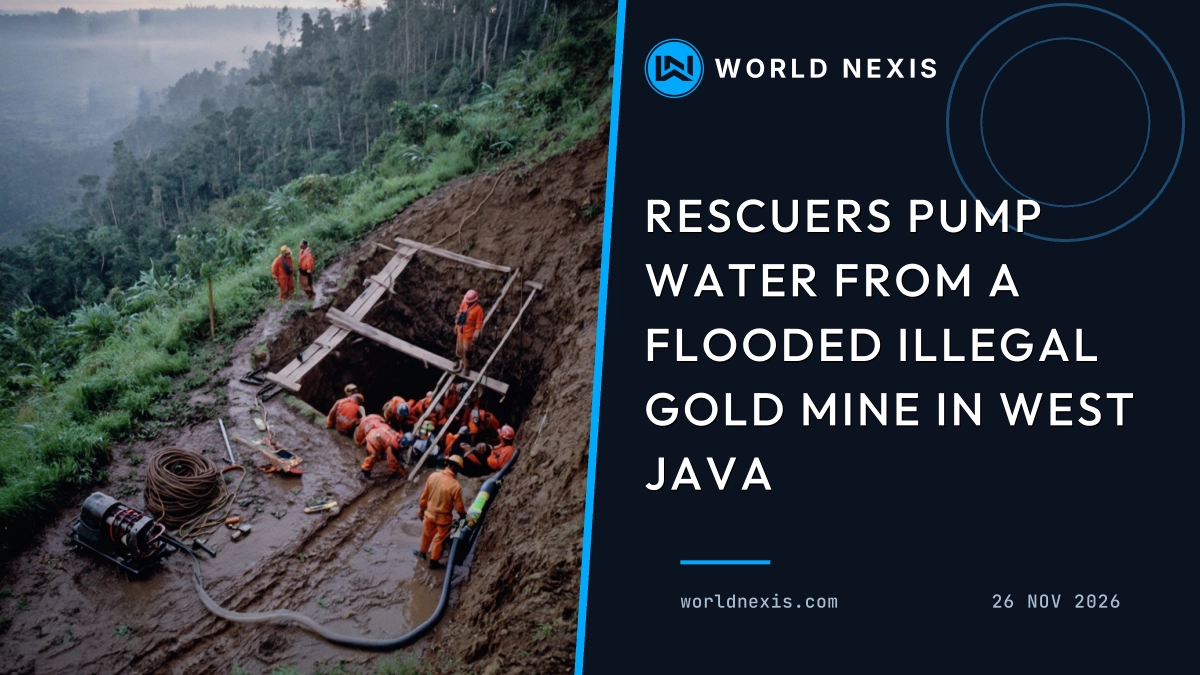
Rescuers fighting the Indonesia mine flood are still searching for at least 10 workers believed trapped underground, after water poured into an illegal gold mine in West Java and left 16 people dead. The miners were digging for grains of gold late on Monday when heavy rain caused the Ciseureuh River to overflow into a shaft in Bogor regency, in a mountainous area south of Jakarta.
The shaft is estimated to be about 330ft deep. Several people escaped from one section of the excavation before the floodwater filled it. By Thursday, the fourth day of the operation, teams were still battling high water, darkness and slippery, narrow terrain.
Key points
The Indonesia mine flood has left a growing death toll and a shrinking window for survivors.
- 16 bodies have been recovered from the flooded shaft in Bogor regency, West Java.
- Police believe at least 10 miners remain trapped underground.
- Officers were not told for about 16 hours because the mine was operating illegally.
- 325 personnel are working two adjacent shafts with submersible pumps and rope access.
How the Indonesia mine flood unfolded
Heavy rain on Monday night sent the Ciseureuh River over its banks and into the shaft. Because the miners were working illegally, the authorities were not notified, and local diggers and residents first tried to pump the water out themselves. That effort failed as the water kept rising.
Police first received reports of trapped miners about 16 hours after the flooding. Shortly after midnight on Wednesday, the nearby state-owned mining company PT Antam forwarded a formal report to the Jakarta Search and Rescue Agency, and a full-scale operation began.
The flooded shaft sits close to facilities run by PT Antam’s Pongkor gold mining unit. The company said the incident was unrelated to its operations.
Inside the Indonesia mine flood rescue effort
Working at the West Java gold mine, teams have used submersible water pumps to suck water from the hole and have tried to close off openings where groundwater seeps in. The work is slow because the shafts are narrow and the ground is slippery.
Thursday’s operation involved 325 personnel and focused on two adjacent shafts. Crews used rope-access techniques to reach victims, and 16 bodies had been recovered as of Thursday.
Hendra Rochmawan, a West Java police spokesperson, said the odds for the missing were lengthening.
“On the fourth day, the chances of finding survivors have become increasingly slim,” he said. “But we will continue the search. At this point, it would be a miracle if anyone were still alive.”
Why illegal gold mining remains so dangerous
Informal mining is common across Indonesia, where thousands of people work in dangerous conditions. Diggers face landslides, flooding and tunnel collapses. Gold processing often involves toxic mercury and cyanide, with little protective equipment.
The illegal status of such sites also shapes how quickly help arrives, as this Indonesia mine flood has shown. With no registered operator on site, the alarm was raised by local people, hours after the water came.
Why it matters
For the families waiting at the mine in Bogor regency, the practical question is whether anyone can still be pulled out alive, and the police spokesperson’s own assessment suggests that is unlikely. Beyond the rescue, the deaths raise harder questions about illegal gold mining, work that happens largely beyond the reach of regulation.
The Indonesia mine flood will be remembered for its toll, but its real lesson is about who carries the risk. Those risks land squarely on the diggers, and on the families now waiting at the shaft.
Analysis
Covering international response for World Nexis News, I read official timelines as arguments rather than neutral records. In this Indonesia mine flood, the timeline runs: the water came late on Monday, police heard 16 hours later, and the search agency only mobilised after a state mining company passed on a formal report. That gap is the story, and the word “illegal” is being used to explain it away.
In my view, the evidence supports a harsher reading. The miners were failed by the absence of the state long before the Ciseureuh River broke its banks. A shaft 330ft deep is not dug overnight, and it is hard to accept that its existence was unknown to anyone with authority over that hillside.
The strongest counter-argument is that police cannot guard every shaft in a country where informal mining is a livelihood, and that formalising small operations is slow and politically thankless. That is fair, but it explains a gap in policy, not a 16-hour silence.
The distinction decides who is accountable. If these deaths are a natural disaster that happened to strike an illegal site, the inquiry stops with the weather. If they are the product of a tolerated informal economy, the question becomes why that tolerance existed. I side with the second reading, because the rescue showed the state could reach the site fast once it chose to.
What happens next
Rescue teams will keep working the two adjacent shafts, with Rochmawan insisting the search will continue despite the shrinking odds. Officials have not said how long the operation will run.
The Indonesia mine flood response will also keep attention on PT Antam’s Pongkor unit, which has distanced itself from the flooding. Its statement does not explain how an unlicensed shaft came to be sunk so close to a major gold operation.
What we don’t know yet
- The exact number of people who were underground when the water hit; police say at least 10 remain trapped.
- Whether any of the missing miners is still alive.
- Who organised and ran the illegal operation, and whether anyone will face action.
Related coverage
- Senate leadership race: six freshmen force a Dec 1 showdown
- North Korea nuclear: Kim tours 2 plants, vows major buildup
- Cairo fire kills 31 as fuel tanker overturns on major road
Further reading
- Rescuers battle to reach trapped miners after deadly flood
- Rescuers battle to reach trapped miners after deadly flood
About the author: Marcus Ellington is the International Correspondent at World Nexis News (WNN), covering world affairs. The analysis section reflects the writer’s view.

Marcus Ellington
Marcus Ellington is International Correspondent at World Nexis News, reporting on diplomacy, conflict and the political forces reshaping Europe, the Middle East, Asia and the Americas. Based in London, he focuses on explaining why events unfold as they do, using official statements, diplomatic documents and…



