Hegseth Venezuela trip extends to Colombia with C-130 handover
Hegseth Venezuela visit ends with a signed deal on joint training and intelligence sharing, deepening the US military role in Caracas for years.
Updated 20 Nov 2026, 05:21 (UK time): Hegseth’s Venezuela-centred Latin America tour moved on to Ecuador on Thursday, a third stop after the Caracas signing and the C-130 handover in Colombia.
Pete Hegseth landed in Ecuador on Thursday, extending a trip that began with the Venezuela military agreement in Caracas and continued with a C-130 Hercules handover in Colombia. The US defence secretary is touring a region where Washington has spent the past year refocusing on drug networks, and Ecuador’s President Daniel Noboa has moved closely in line with the administration, expanding the military’s role in the country’s cities as other conservative leaders in the region have done.
What changes is the shape of the visit. A signing in Caracas followed by a delivery in Bogotá now reads as a three-country anti-narcotics circuit, with Quito as the newest stop. That matters because the boat-strike campaign the US has run since September 2025, which officials say has killed at least 240 people, is no longer being sold only as a bilateral arrangement with Venezuela but as a regional posture.
The substance still lags the itinerary. Neither the Venezuela framework nor the Colombia talks produced a published text, cost figure or timetable, and the Pentagon has not set out what the Ecuador leg involves beyond the tour itself.
I read the widening map as evidence of momentum rather than depth: each new capital makes the Caracas agreement look more like a system and less like a promise, without adding a single paragraph of written terms. Breadth is easier to photograph than detail.
Updated 19 Nov 2026, 18:46 (UK time): Hours after signing the Venezuela military agreement in Caracas, Hegseth flew to Colombia to hand over a C-130 Hercules transport, where Bogotá denied reports it had refused a US plan for joint anti-drug operations, saying foreign forces on Colombian soil need legislative approval.
The Hegseth Venezuela trip did not end in Caracas. After signing the military cooperation agreement with acting President Delcy Rodríguez, the US defense secretary flew to Colombia the same day, where Colombian officials said he handed over a Lockheed Martin C-130 Hercules transport aircraft and held talks on security cooperation as Bogotá battles drug trafficking groups and other illegal armed actors. The delivery turns the visit from a single signing into a regional equipment-and-training tour.
In Bogotá, the Colombian government pushed back on reports that President Abelardo De La Espriella had rejected a US proposal for joint anti-drug operations on Colombian soil. A source at Colombia’s defense ministry said the government supports deeper military cooperation and intelligence sharing against cartels and designated terrorist organizations, but cannot approve operations involving foreign forces on the ground without legislative authorization. A US official said Washington was aware of Colombian concerns about support in Congress but did not confirm the plan had been refused outright.
That distinction matters for the framework announced in Caracas. The Venezuela agreement commits the two militaries to training, intelligence sharing and equipment without a published text, cost or timetable; Colombia, a far older security partner, is now demonstrating where the legal limits sit. What Washington calls a partnership looks different depending on whether the host government can authorize foreign boots on its territory at all.
I read the Colombian denial as the more instructive half of the day. Caracas signed quickly because its government answers to few constraints; Bogotá is negotiating with a legislature that must be won. Until the Venezuela terms are written down, the deal remains a promise whose durability no parliament has tested.
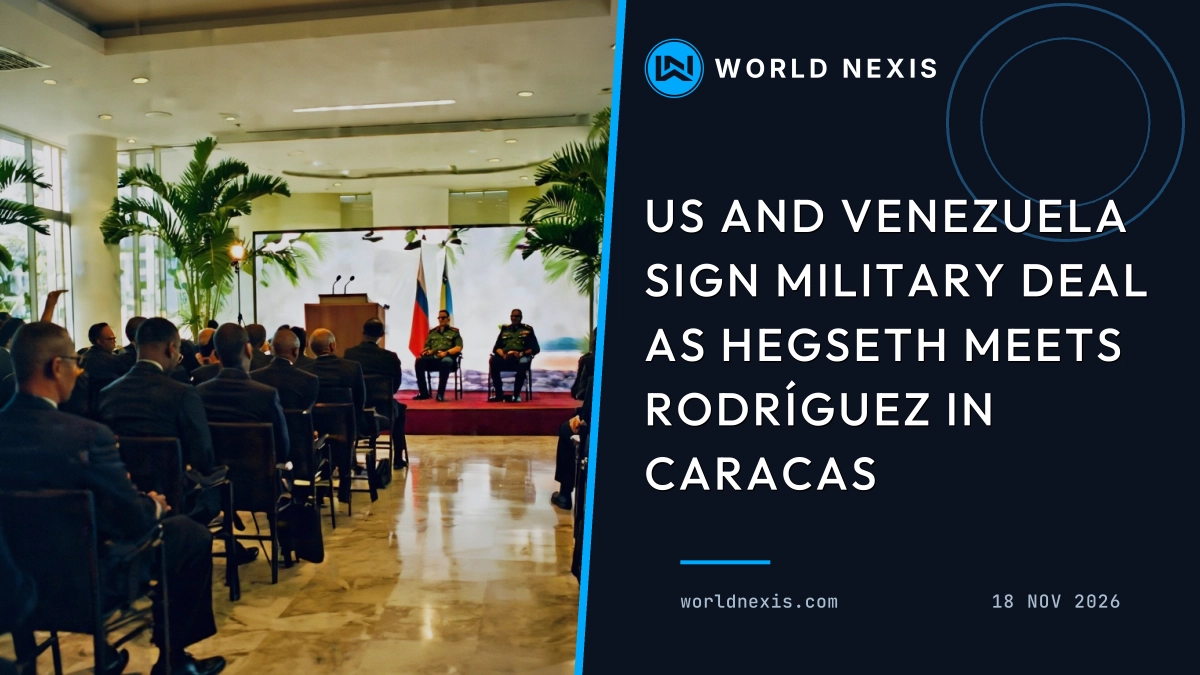
The first Hegseth Venezuela visit since US forces seized Nicolás Maduro ended on Wednesday with a signed agreement to rebuild military ties between Washington and Caracas, covering joint training, intelligence sharing and future defense equipment. The US defense secretary announced the deal at the US embassy in the Venezuelan capital, hours after he was received at the presidential palace by acting President Delcy Rodríguez. He told diplomats and military officers from both countries that Venezuela had gone “from our most aggressive regional threat to a compliant security partner”.
Key points
- Washington and Caracas signed a military agreement covering joint training, intelligence sharing and defense equipment, Hegseth said on Wednesday.
- Hegseth met acting President Delcy Rodríguez at the presidential palace before speaking at the US embassy.
- Neither government published terms, cost or a timetable, and the Pentagon did not immediately give further detail.
- The Hegseth Venezuela trip is the latest in a series of cabinet visits this year, after the Interior and Energy secretaries.
What the Hegseth Venezuela deal covers
Hegseth gave only a broad outline. The two militaries would be “training together, partnering together, sharing intelligence, more defense equipment and capabilities together,” he said. They would also work, in his words, “to recover its territory from narco-terrorist networks”.
Rodríguez, speaking at the palace, said she hoped military cooperation “can be brought to its highest possible level” so the two countries could “address common threats”. She framed the relationship as a decisive break with the recent past.
Beyond the statements, the US Venezuela military deal is a framework rather than a contract. No text was published, and the Pentagon did not immediately set out what the partnership means for deployments, budgets or the chain of command. Hegseth also praised what he called “close cooperation” that had allowed officials “to stabilize Venezuela and rid it of narco-terrorists once and for all”.
Oil, the Strait of Hormuz and the wider bargain
The military agreement sits on top of an economic one. President Donald Trump said in August that Hegseth had helped broker a sweeping deal for the US to take control of some Venezuelan oil reserves. On Wednesday, Hegseth tied the strands together, saying the oil arrangement “makes the Strait of Hormuz a non-factor for the Western Hemisphere”.
That remark referred to the Gulf waterway where the administration’s conflict with Iran has disrupted energy supplies. The Venezuela oil deal Trump described in August gives the new security partnership an economic floor, and Caracas has presented it as mutual gain rather than concession.
The Hegseth Venezuela trip is the third by a senior member of Trump’s cabinet this year, following the Interior and Energy secretaries, who concentrated on oil and critical minerals. The administration has spent the past year pulling American military attention back to the Western Hemisphere and to Latin American drug networks.
Since September 2025, US forces have attacked boats in the Caribbean Sea and the eastern Pacific Ocean that the administration says are smuggling narcotics. At least 240 people have been killed, and officials have released little public evidence for the individual claims or for any effect on the availability of drugs in the US.
Why it matters
For American readers, the Hegseth Venezuela agreement turns a temporary military presence into an institutional one. Trainers, intelligence officers and equipment are now committed to a country where, ten months ago, US forces were removing its president. It also gives the drug-interdiction campaign a government on the ground that names the same enemy.
For Venezuela, the deal formalizes a realignment that began with Maduro’s capture and is being pushed forward by energy. Rodríguez said the arrangement enabled “the energy development of our nations” and “benefits both the people of the United States and the people of Venezuela”.
Analysis
Having covered US military posture in the Americas for World Nexis News, I look first at what a signed partnership actually commits, and the honest answer is: not much yet. There is no text, no cost, no basing arrangement and no timetable. A defense secretary can sign a framework in an afternoon; the obligations that matter, from who trains whom to which equipment is transferred, take months and normally a congressional notification.
In my view this is a genuine strategic gain for Washington, and a fragile one. The administration has converted a captured president into a compliant security partner faster than any sanctions regime managed in a decade, and the oil arrangement gives that partnership somewhere to stand. But the Hegseth Venezuela deal is being sold faster than it is being defined, and a partnership whose terms nobody can read is hard to defend when politics in Caracas shifts.
The strongest counter-argument is that ambiguity is deliberate: a published text would inflame hardliners on both sides and hand critics a target, while quiet military-to-military work survives longer. I accept that logic for the first few months. I do not accept it as a permanent substitute for scrutiny, and Congress should demand the terms before the first joint exercise rather than after it.
What happens next
The immediate next step is definition. The Pentagon said nothing further on Wednesday about the scope of the agreement, so military-to-military talks on training schedules and intelligence-sharing arrangements are the thing to watch. Hegseth said the two sides would look at “more defense equipment and capabilities together”, without naming any systems.
Rodríguez has said she wants cooperation lifted to its “highest possible level”, which suggests Caracas will push for equipment and training commitments rather than symbolic visits. The energy track continues in parallel, with the oil arrangement brokered earlier this year still being implemented.
What we don’t know yet
Neither government has confirmed whether US troops will be stationed in Venezuela on a long-term basis. It is also unclear how much the partnership will cost, whether Congress will be formally notified, or whether any written text will be released. Those three questions decide whether Wednesday’s signing was a policy or a photograph.
Related coverage
- Iran attacks Gulf states in major escalation after Qeshm
- Apec summit: Xi and Putin hold major talks as Trump lands
- Muslims outnumber Christians by 2035 in major global shift
Further reading
- Hegseth uses Venezuela visit to boast of Maduro’s capture by US military
- US and Venezuela sign a deal to reestablish military ties, Hegseth says in visit to Caracas
About the author: Marcus Ellington is the International Correspondent at World Nexis News (WNN), covering world affairs. The analysis section reflects the writer’s view.

Marcus Ellington
Marcus Ellington is International Correspondent at World Nexis News, reporting on diplomacy, conflict and the political forces reshaping Europe, the Middle East, Asia and the Americas. Based in London, he focuses on explaining why events unfold as they do, using official statements, diplomatic documents and…



