Muslims outnumber Christians by 2035 as India’s Hindu share slips to 76%
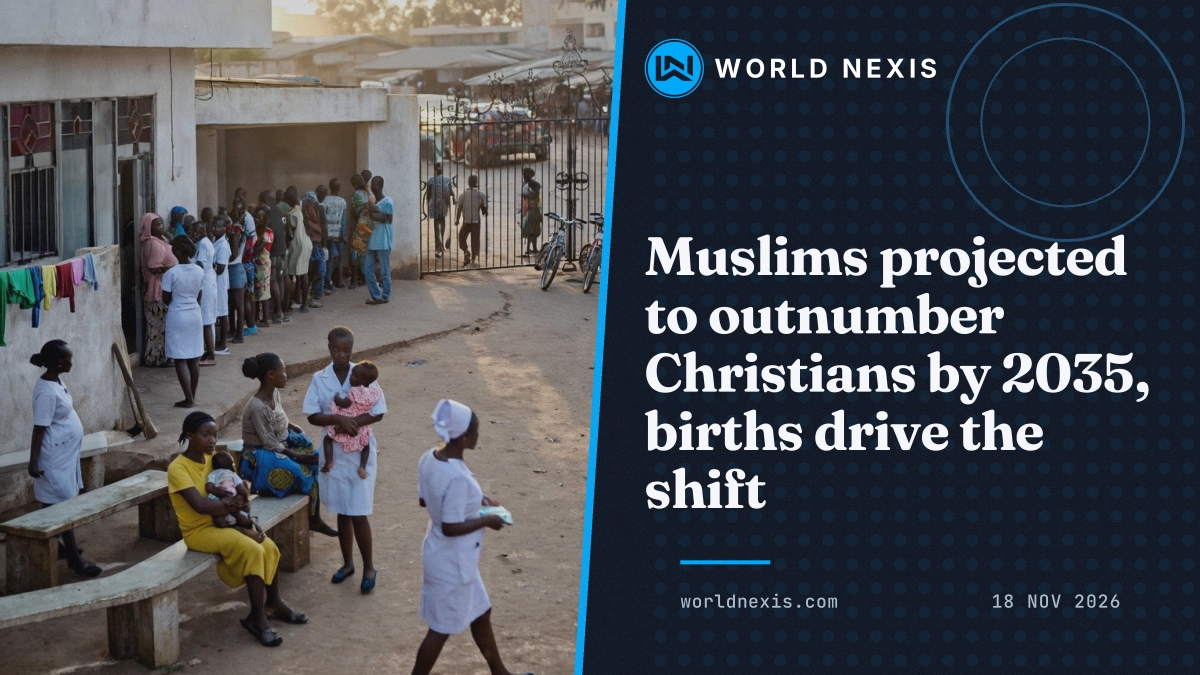
Muslims outnumber Christians: Muslims are projected to outnumber Christians by 2035 in a major study, as higher fertility rates drive an 80% rise in the…
Updated 19 Nov 2026, 07:57 (UK time): Pew’s 2070 projections now carry country-level detail our first story lacked: India’s Hindu share slips from 79% to 76% while its Muslim population reaches 334 million, second only to Pakistan’s projected 461 million.
Pew Research Center’s projections, released Wednesday, put country-level numbers behind the 2035 crossover headline. India remains overwhelmingly Hindu in the modelling: Pew estimates the Hindu share falls from 79% of the population in 2020 to 76% by 2070, while the Muslim share rises from 15% to 20%. The Hindu population still grows by about 176 million across the same period, keeping it above three-quarters of the country.
Pew puts India’s Muslim population at 334 million by 2070, up from roughly 213 million, second only to Pakistan, which is projected to overtake Indonesia as the country with the largest Muslim population at about 461 million. The driver is demographic rather than conversion: Indian Muslims had a median age of 24 in 2020 against 29 for Hindus, and Pew estimates Muslim women in India will average 2.3 children in 2025-2030 against 1.8 for Hindu women.
Other new detail fills in the global picture. Pew estimates Muslim mothers worldwide gave birth to about 252 million babies between 2020 and 2025, against 208 million for Christian mothers. In the United States, Muslims are projected at nearly 4% of the population by 2070, the third-largest group behind Christians and the unaffiliated and ahead of the Jewish population, and 62% of the world’s Jews are projected to live in Israel by then, up from 46%.
This changes the scale of our earlier reporting, not its direction. Stephanie Kramer of Pew Research Center said the Hindu-Muslim fertility gap in India has already narrowed from more than one child per woman in 1992 to about half a child in recent years, and KS James, a demographer at Princeton University, said the two rates will ultimately converge. I think that is the number to keep watching: the projections run on a gap that is closing even as it is being counted, so a three-point shift over 50 years reads as slow demography rather than a takeover.
Muslims outnumber Christians by 2035 under detailed projections released Wednesday by the Pew Research Center, a demographic shift that would rearrange the world’s religious map. Pew estimates there were 2.27 billion Christians and 2.02 billion Muslims worldwide in 2020. By 2035, its projections put Muslims at 2.57 billion and Christians at 2.52 billion.
The findings were reported by the Associated Press. They project that Muslims outnumber Christians by 2035 and chart how major religious groups could change between 2020 and 2070. Pew has published religious demography reports for 25 years, and the AP described them as authoritative.
Key points
- Pew projects that Muslims outnumber Christians by 2035, at 2.57 billion against 2.52 billion.
- Muslim fertility averaged 3.1 children per woman in 2020-2025, against 2.5 for Christians and 1.6 for other women.
- By 2070, Pew projects more than 3.6 billion Muslims and just under 3 billion Christians.
- The United States is projected to lose its Christian majority by 2065, with the unaffiliated reaching 41% of the population by 2070.
What the world religion projections show through 2070
The headline finding — that Muslims outnumber Christians by 2035 — is not a story of Christian shrinkage. Both faiths are growing, but Islam is growing far faster. Pew’s projection would make Islam the world’s largest religion within a decade.
Global population is projected to rise 29% between 2020 and 2070. Of the groups Pew analyzed, only Muslims and Christians are expected to keep pace. Christians grow by 30% across that period, while Muslims grow by 80%.
Other faiths fare less well in relative terms. Hindus and Jews are growing in absolute numbers but are projected to decline as a share of the world’s population. Pew forecasts that Buddhists shrink both in number and in share, partly because of expected population declines in China, South Korea and Japan.
The report’s window runs to 2070, so the 2035 milestone is a midpoint rather than an endpoint. Pew’s country-level detail matters as much as the global total, because it shows where the two faiths will live.
Why Muslims outnumber Christians by 2035
Fertility does most of the work. During 2020-2025, Pew puts the fertility rate for Muslims at 3.1 children per woman and for Christians at 2.5. The average for all other women was 1.6, well below the 2.1 considered necessary for each generation to replace itself.
“It’s the babies,” said Pew senior demographer Conrad Hackett, explaining that conversion and other ways of changing religious identity are much smaller factors than fertility rates.
The Times of India headlined the study “It’s the babies”, while other outlets led on the global ranking. Either way, geography reinforces the gap. Most future population growth is expected in Africa, particularly south of the Sahara, where most people are Christian or Muslim.
Age profiles compound the effect. Pew’s models weigh how each group’s population is spread across ages, not only its birth rate. High fertility and rising life expectancy across Africa therefore lift the global totals of both faiths, and explain why Muslims outnumber Christians by 2035 rather than decades later.
A Christian-majority America ends by 2065
The projections carry sharp consequences for North America. Pew projects that the United States will no longer have a Christian majority within 40 years. Christians account for 62% of U.S. adults now and are projected to fall below 50% by 2065.
Rising numbers of people with no religious affiliation drive much of that change. By 2070, Pew projects the unaffiliated will make up 41% of the U.S. population and will outnumber Christians in Canada, where the Christian share drops below 50% by 2030.
Europe moves the other way. Pew projects the continent’s population will shrink by 17% by 2070, and its Christian population will fall by a third, from 505 million to 324 million.
Africa becomes the center of gravity for Christianity. By 2070, more than half of the world’s Christians will live in sub-Saharan Africa. Congo is projected to overtake the United States as the country with the most Christians, with its ranks rising more than threefold.
Analysis
Having spent two years checking numbers and public data for WNN, I look first at what a projection can and cannot tell us. The projection that Muslims outnumber Christians by 2035 is arithmetic, not a scoreboard. A gap of 3.1 against 2.5 children per woman, repeated across hundreds of millions of people, compounds quickly.
I side with Pew’s emphasis on births over conversion, because the fertility gap is large, measurable and stable across the years it models. The strongest counter-argument is that fertility tends to fall as incomes and education rise, so today’s African birth rates may not hold for another two decades. That is a fair objection, and Pew’s condition — that recent trends continue — carries much of the weight.
For readers in Britain and the United States, the affiliation figure matters more than the global ranking. A country losing a Christian majority is not becoming a nation of converts; it is becoming a nation of the unaffiliated. In my view that is the number to watch at every census, because it changes charities, schools and public services long before any global ranking moves.
What happens next
Pew frames these as projections rather than predictions, and its timeline sets out clear markers. Canada’s Christian share falls below half by 2030, Muslims outnumber Christians by 2035, and the United States drops below 50% by 2065.
Every date rests on assumptions holding steady. Pew says the estimates account for recent differences in age profiles, fertility, religious switching and migration. Those four levers will decide whether the 2035 milestone arrives on time.
Related coverage
- FAA ground stop: 4-hour halt and major United delays
- United Airlines outage delays flights after major FAA halt
- Iran attacks Gulf states in major escalation after Qeshm
Sources
- Muslims are projected to outnumber Christians by 2035 as the world (winknews.com)
- Muslims are projected to outnumber Christians by 2035 as the world’s largest religion (wral.com)
- Muslims are projected to outnumber Christians by 2035 as the world’s largest religion (winnipegfreepress.com)
About the author: Rohan Mehta is World Nexis News’s Data & Fact-Check Journalist, covering data & fact check. The analysis section reflects the writer’s view.

Rohan Mehta
Rohan Mehta is a Data & Fact-Check Journalist at World Nexis News. Based in London, he tests public claims against primary evidence — datasets, court records, official statistics and original documents — and turns complex numbers into readable stories. He labels verdicts plainly, explains methodology…