Trump Asia trip: 3 leaders hold historic first summit
Trump Asia trip: the president meets Xi Jinping and Vladimir Putin in Shenzhen on Nov 19 for the first trilateral summit, amid Nvidia and midterm fallout.
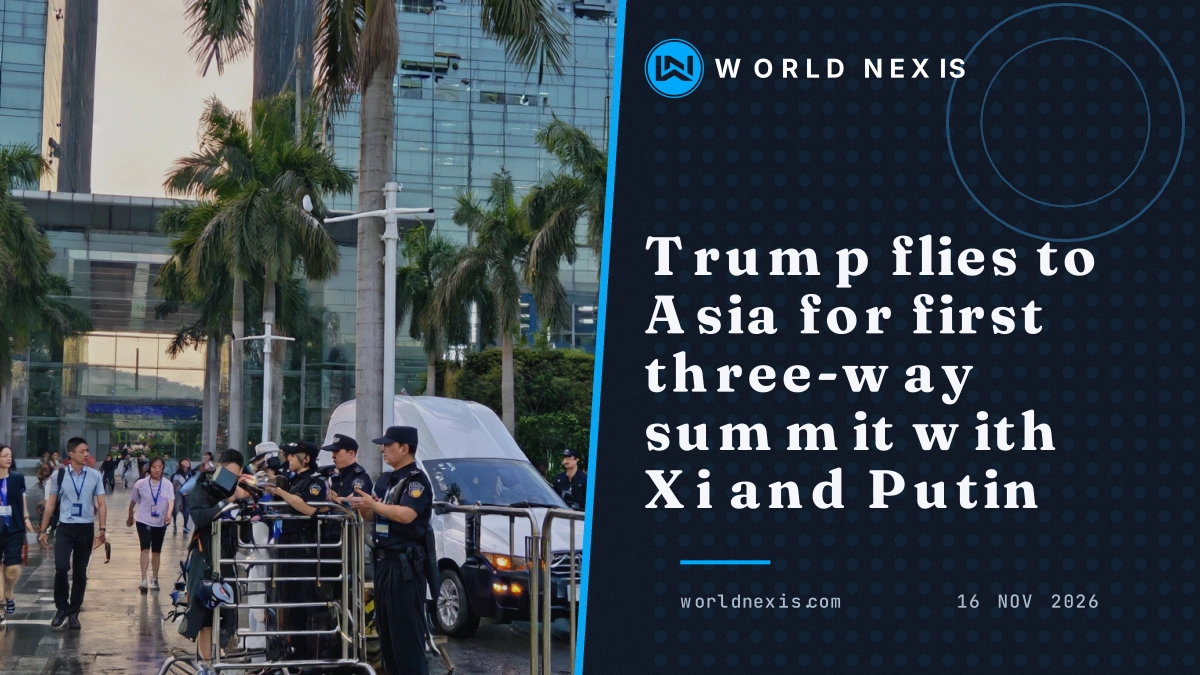
Donald Trump’s Asia trip opens in Manila this weekend before he flies to Shenzhen for APEC and a first-ever trilateral meeting with Xi Jinping and Vladimir Putin on 19 November. The White House confirmed the three-way session on Friday, and US officials say denuclearisation will be the headline subject.
The journey is his second to China this year and his first foreign trip since midterm elections that went badly for his party, according to the Guardian. It also coincides with intense scrutiny of the administration’s handling of the resignation of Nvidia chief executive Jensen Huang.
Key points
- Trump attends the ASEAN summit in Manila before flying to Shenzhen for APEC, spending about three days in the region.
- The trilateral with Xi and Putin on 19 November is the first meeting of its kind, US officials say.
- Denuclearisation is the stated focus, although the White House expects no agreement.
- The Trump Asia trip follows midterm losses and the Nvidia security row over former chief executive Jensen Huang.
Trump Asia trip: Manila first, then Shenzhen
Trump begins at the Association of Southeast Asian Nations summit in Manila, which started on Sunday. While he is in the Philippine capital, US officials will hold a sidelines meeting of the Quad group — Australia, India, Japan and the United States — the Guardian reported.
He then moves to Shenzhen for the Asia-Pacific Economic Cooperation leaders’ meeting, which begins on Wednesday. Apec economies account for more than 60% of global GDP, and the grouping has traditionally promoted free trade and multilateralism. Beijing holds the home advantage this year, with the summit staged in its southern technology hub.
The wider itinerary is crowded. A Francophone summit runs concurrently in Cambodia with the Canadian prime minister, Mark Carney, and the French president, Emmanuel Macron. Taiwan, which China does not recognise, is sending the founder of the hardware company Acer as its envoy.
Regional flashpoints will compete for attention: the South China Sea, where Beijing has built military outposts in disputed waters; the forest fire haze drifting from Indonesia; and the long-running crisis in Myanmar.
Nvidia fallout and midterms shadow the summit
Huang resigned after admitting an extramarital affair with a woman US intelligence officials believe was recruited by China’s top spy agency, according to The New York Times. NPR reported the claim and said it had not independently confirmed it.
The White House and Commerce Secretary Howard Lutnick are also under scrutiny over what they knew, NPR reported. Huang had travelled to China with Trump earlier this year; this time the tech billionaire Elon Musk is joining the president in Shenzhen.
Pressure on the company has not eased. The Guardian reported that more than 165,000 people, including Musk, signed an open letter calling for Nvidia to bring Huang back.
Domestically, the midterm results have weakened the president’s bargaining position across the Pacific, according to NPR. Even so, the imagery of the trilateral summit is expected to make waves whatever the outcomes.
What each leader wants from the trilateral
Trump has said for weeks that he wants to discuss the war in Iran and denuclearisation with Xi and Putin, ABC News reported. The White House confirmed the joint session and characterised it as an “entry point” for talks on reducing nuclear stockpiles.
“We do not expect to get to any kind of agreement,” a White House official said, according to NPR. A second official, speaking not for attribution, said it was time for China to “step up to the adult table”.
Beijing is reluctant. Edgard Kagan, a former US ambassador to Malaysia now at the Center for Strategic and International Studies, said: “The Chinese strongly disagree with the idea that they should be involved in any kind of trilateral discussions with the United States and Russia on nuclear weapons.” He added that China fears being locked into a “subservient position” and does not want to set a precedent.
Xiaoyu Pu, an associate professor at the University of Nevada, argued the meeting “might be more symbolic than substantive, although symbolism itself matters in great-power diplomacy”. He said Trump is focused on arms control, Xi on a stable relationship with Washington while keeping Russia close, and Putin on leverage over Ukraine.
Ukraine is not intended to be on the agenda, a White House official said, and there is no plan for a separate Trump-Putin meeting. Russia’s war is nearing its five-year mark, and Trump has made friendlier moves towards Moscow in recent months, including a deal to release more Russian oil into the market ahead of the midterms.
Trump said last month that he was comfortable with Volodymyr Zelensky not being present at any meeting with Putin about the war: “Anything I can do to end the war, whether somebody’s there or not.”
Analysis
Having spent five years on accountability reporting around this White House, I read a summit like this through what it does for the leaders in the photograph rather than what it produces in writing. On the evidence available, the symbolic reading is the stronger one. The administration itself says it does not expect an agreement, and China has spent years resisting precisely this format. As Xiaoyu Pu puts it, the meeting may be more symbolic than substantive.
I side with Edgard Kagan’s analysis that Beijing will give little away and that the format mainly serves Moscow. Putin gets a seat beside the two presidents whose economies dwarf his, while Ukraine is deliberately excluded and nothing is committed to paper. The strongest counter-argument is that symbolism genuinely matters in great-power diplomacy, and a single image of three nuclear-armed leaders at one table could, over time, build a habit of consultation that no communiqué could manufacture.
Still, the sequencing matters for readers in Britain and America. Trump arrives having lost the midterms and while his commerce department is answering questions about an alleged Chinese spy close to a strategic chipmaker. A president who needs a win on denuclearisation cannot easily walk away from a table the other two set. In my view, the risk this week is not a bad deal but normalisation: a three-power arrangement discussed over the heads of Kyiv and Taipei, presented as peacemaking.
What happens next
ASEAN continues in Manila, where Trump is expected to meet allied leaders before the APEC summit Shenzhen programme opens on Wednesday. The three-way session is scheduled for 19 November, with officials saying they expect no concrete agreement and no separate Trump-Putin bilateral.
The president is expected to remain in the region for about three days. Officials have framed the meeting as an opening conversation on reducing nuclear stockpiles rather than a negotiating round.
Related coverage
- Nvidia chip scandal: Trump faces calls to fire Lutnick
- FAA ground stop: Trump team seeks $50 billion for air traffic control
- Regional picture theatres: 4 historic Australian cinemas
Sources
- World leaders head to Asia for back-to-back diplomatic summits (theguardian.com)
- Trump heads to Asia to meet with Xi and Putin amid Nvidia fallout (npr.org)
- Trump heads to Asia for 2nd high-stakes meeting with Chinese President Xi amid Nvidia CEO scandal (abcnews.com)
- China says Xi, Trump, Putin to discuss ‘world peace’ (indiatimes.com)
- Trump, Xi, Putin to hold trilateral meeting on Nov 19 – Peoples’ Review (peoplesreview.com.np)
About the author: Ayesha Rahman is World Nexis News’s Senior Political Correspondent & Columnist, covering politics & opinion. The analysis section reflects the writer’s view.

Ayesha Rahman
Ayesha Rahman covers politics and opinion for World Nexis News from London, focusing on elections, legislatures and the policy choices that shape everyday life in the US and UK. She writes analysis and columns that separate what is confirmed from what is claimed, working from…



