Nvidia chip scandal: Trump faces calls to fire Lutnick
The Nvidia chip scandal deepens as a New York Post column urges Trump to fire Commerce Secretary Howard Lutnick over stalled Megaspeed blacklisting.
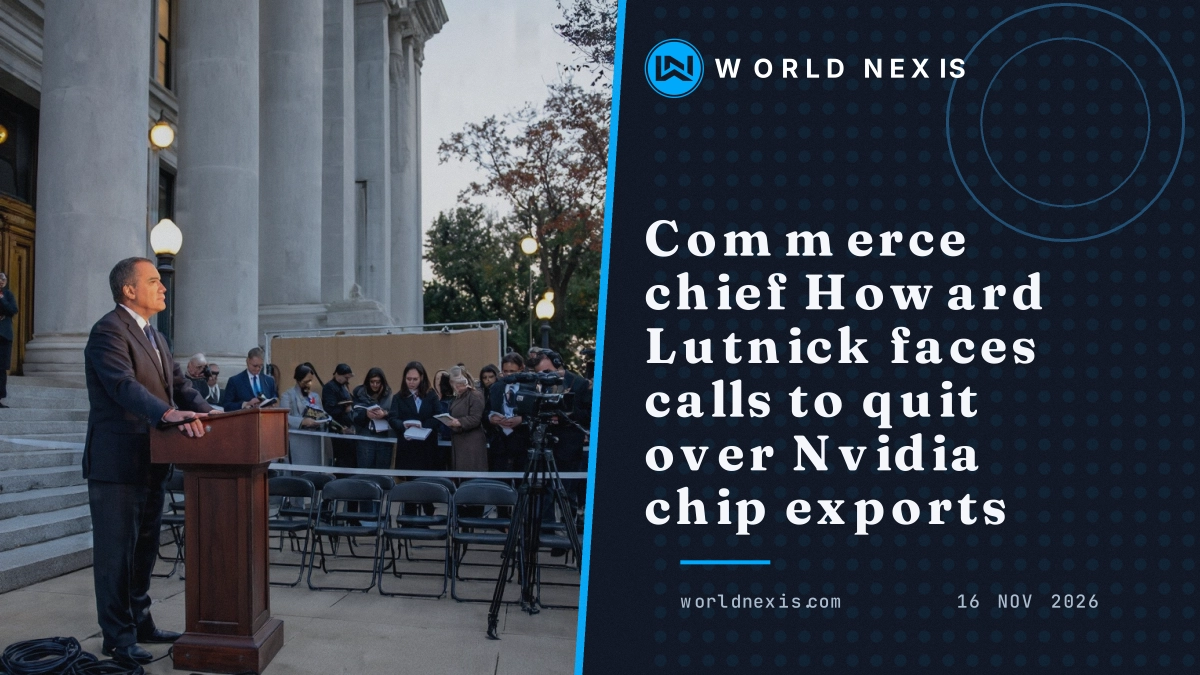
The Nvidia chip scandal has pulled Commerce Secretary Howard Lutnick into the sharpest fight of his tenure, after the New York Post published a column on 16 November urging Donald Trump to fire him over allegations that he slowed a blacklisting tied to advanced AI chips sold to China. The column landed hours before the president left for a week of Asian summits and as lawmakers returned to Washington with questions about Nvidia’s leadership.
Here is what the Nvidia chip scandal involves, and why it now reaches from Singapore to Shenzhen.
Key points
- Columnist Miranda Devine called Lutnick “embarrassing” and said Trump, who once loved firing people on The Apprentice, should do it again.
- Nvidia founder Jensen Huang was forced out last week after revelations about extramarital affairs, including one with Alice Huang, a businesswoman US intelligence suspected of being a Chinese spy.
- Treasury Secretary Scott Bessent said Commerce “had the pen” to add Alice Huang’s firm Megaspeed to the Entity List, but did not act for months.
- Huang and Lutnick have agreed to testify to congressional committees, which must also reach a spending deal to avoid a shutdown.
Inside the Nvidia chip scandal
At the center of the Nvidia chip scandal is export control. The New York Post reported that Lutnick is accused of softening restrictions on sales of advanced Nvidia chips to China while his former firm, Cantor Fitzgerald — now run by his two sons — profited. If proven, the column argued, that could have compromised his office and jeopardized national security.
Devine’s column catalogued earlier embarrassments, citing tariffs on Australian islands inhabited only by penguins and a $5 million gold card debacle. It also accused Lutnick of misleading her on his podcast about the extent of his relationship with his former Upper East Side neighbor Jeffrey Epstein. Other Washington coverage this week noted that Lutnick pushed for narrower chip curbs while critics warned China could gain ground in AI.
The row escalated after Jensen Huang left the company he founded. The Post reported that Huang was forced out last week following disclosures about multiple extramarital affairs, including an approximately two-year relationship with Alice Huang, a Chinese state television journalist turned businesswoman. Administration officials have denied suggestions that she handed Nvidia’s intellectual property to Beijing.
Alice Huang ran Megaspeed, a Singapore-based company suspected of diverting advanced Nvidia chips to China in breach of a crackdown ordered by Trump. Singapore police detained her in June last year and held her passport for eight months over potential false declarations about servers containing the chips, according to the Post. Late last year the CIA warned administration officials and lawmakers that she was suspected of being a Chinese honeypot.
Singapore’s government said US agencies offered little help. A statement quoted by the Post read: “Despite these repeated requests, Singapore has to date received limited information or assistance in respect of the company.”
Megaspeed blacklist stalled at Commerce
The Megaspeed blacklist sits at the heart of the Nvidia chip scandal. Officials pressed for months to place the company on the Entity List, which restricts suspect firms from receiving sensitive American technology. The Post, citing Axios, reported that Lutnick slow-walked those demands because of “concerns it would escalate the trade war with China”.
Bessent broke ranks on Fox’s Sunday Morning Futures. Asked by Larry Kudlow why Commerce had not added Megaspeed to what he called the “enemy list”, the treasury secretary said: “I’ll leave the internal workings of the Commerce Department to the Commerce Department.”
He went further on Nvidia itself. Bessent said the chipmaker needs a “drastic shakeup” and criticized a “culture of noncompliance” that he said went beyond Huang’s personal failings. “If this were a bank and they hadn’t complied like this … a lot of the executives would be removed,” he said.
Trump flies to Asia as the Nvidia chip scandal festers
Trump leaves Washington this week for the Apec and Asean summits, Gray DC reported in its Week Ahead round-up. The Apec leaders’ meeting opens in Shenzhen, China, on Wednesday, according to the Guardian, two weeks after the president lost the midterm elections.
A confirmed trilateral meeting with Xi Jinping and Vladimir Putin is the centerpiece. Gray DC reported that Iran and nuclear proliferation are on the agenda, and that Russia’s war in Ukraine is not expected to come up. The Guardian reported that Apec economies account for more than 60% of global GDP.
The Guardian said the three-way format has been likened to a modern-day Yalta, though analysts doubt a “Yalta 2.0” that issues edicts on Ukraine and Taiwan without their involvement. Xiaoyu Pu, an associate professor at the University of Nevada, told the paper that a three-way meeting “might be more symbolic than substantive, although symbolism itself matters in great-power diplomacy”.
Back on Capitol Hill, lawmakers returning ahead of Thanksgiving will question Nvidia’s leadership and the department’s handling of export controls. Both Huang and Lutnick have agreed to testify, Gray DC reported, and the same lawmakers must negotiate a deal to keep the government open.
Analysis
Having spent five years covering accountability reporting and the machinery of Congress, I look first at who held the legal power and when. On the public record, Commerce had the pen on the Entity List, and the treasury secretary — a cabinet colleague — says his department sought a blacklisting for months. That is not a policy disagreement to be settled by memo; it is a process failure Congress is entitled to test under oath.
In my view the evidence currently supports the case that Lutnick owes a sworn, public explanation, and that Trump’s instinct to shield an old friend is the weaker argument. The strongest counter-argument is that blacklisting Megaspeed risked inflaming trade talks with Beijing at a delicate moment, and no public document yet shows Lutnick personally profiting. That may justify caution; it does not justify months of silence while an ally’s police force asked Washington for help.
For readers, the Nvidia chip scandal matters because the rules under scrutiny are the ones meant to keep the most powerful AI hardware out of the wrong hands. Devine’s column ran the morning before the president left for a summit where AI supply chains sit on the table. Voters who backed Trump’s China crackdown will notice if the official selling it is also the one accused of slow-walking it.
What happens next
Lutnick and Huang will appear before congressional committees, where the timeline of the Megaspeed decision is likely to dominate. Congress must also pass a spending agreement to avoid a shutdown. The Nvidia chip scandal will follow the president to Shenzhen, where AI supply chains and export controls sit on an agenda he would rather have framed on his own terms.
Related coverage
- Nvidia scandal: Megaspeed denies smuggling 240,000 AI chips
- FAA ground stop: Trump team seeks $50 billion for air traffic control
- Isaac the cat found alive 4 days after Brooklyn collapse
Sources
- World leaders head to Asia for back-to-back diplomatic summits (theguardian.com)
- Miranda Devine: Remember what you used to love President Trump and fire the embarrassing Howard Lutnick (nypost.com)
- Week Ahead in Washington: November 15 (wbko.com)
- The Hindu Morning Digest: November 16, 2026 (thehindu.com)
- Lutnick pushed narrower chip curbs as critics warned China could gain ground in AI (foxbaltimore.com)
About the author: Ayesha Rahman is World Nexis News’s Senior Political Correspondent & Columnist, covering politics & opinion. The analysis section reflects the writer’s view.

Ayesha Rahman
Ayesha Rahman covers politics and opinion for World Nexis News from London, focusing on elections, legislatures and the policy choices that shape everyday life in the US and UK. She writes analysis and columns that separate what is confirmed from what is claimed, working from…



