FAA ground stop: Trump team seeks $50 billion for air traffic control
A nationwide FAA ground stop halted US flights for more than four hours after a router failure, canceling thousands of flights and stranding travelers.
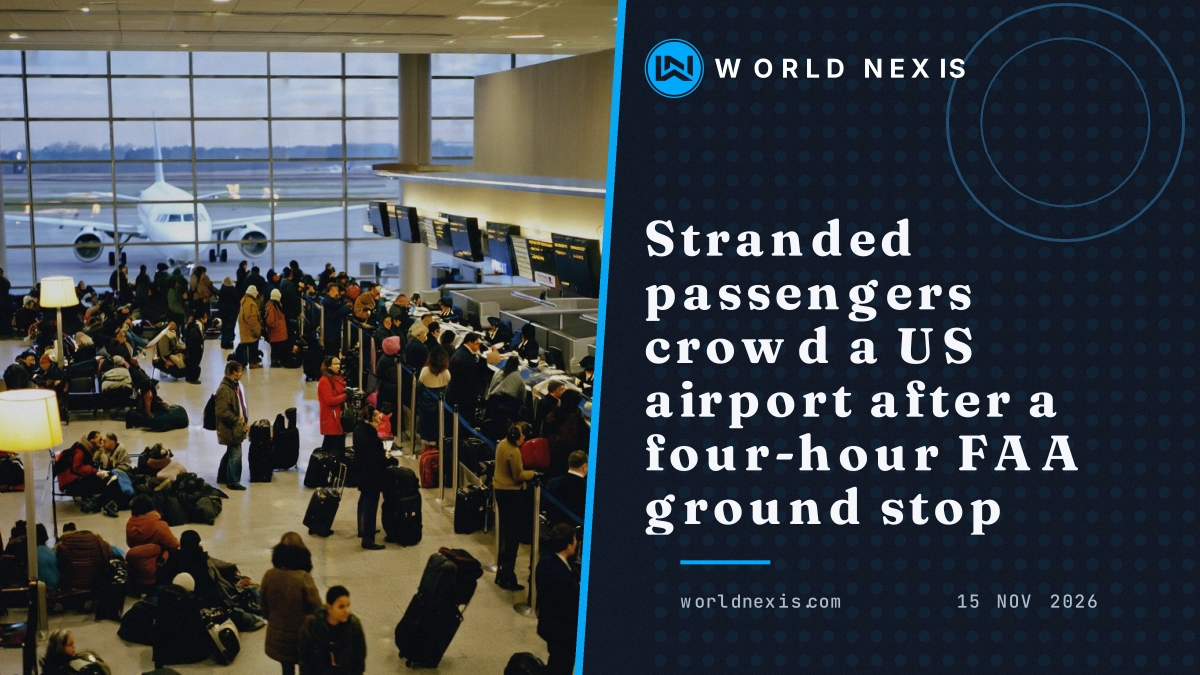
Updated 16 Nov 2026, 02:51 (UK time): Trump officials put a $50 billion figure on their air traffic control funding request and the transportation secretary said airlines would be back at full capacity heading into Monday, while several college football games were rescheduled.
The funding argument now has a number attached to it. CBS News reported that Trump officials asked Congress for $50 billion for air traffic control in the wake of Friday’s FAA ground stop. Until now the administration’s push had been described only as a request for additional money.
Transportation Secretary Sean Duffy told CBS’ Face the Nation on Sunday that travelers should still expect delays but that operations should be running at full capacity heading into Monday. FlightAware data cited in the same reporting showed more than 1,400 flights canceled for Sunday and around 2,200 delayed.
The blame game sharpened over the weekend. The Guardian reported that Duffy pointed at prior presidents and Congress for the state of the system, while Democratic Senator Chris Van Hollen countered that the administration had not properly invested the funds it already had.
NPR reported the sporting cost in detail: Mississippi’s game at Oklahoma was pushed to Sunday at 1 p.m. ET, Utah’s trip to Arizona was delayed three hours, Auburn against Mississippi State moved back more than four hours, and Florida Atlantic’s game at Tulsa shifted to 6:15 p.m. Oklahoma announced free student entry and cut-price concessions for the rescheduled game. My take: a dollar figure is progress, but it is still a promise, and the public accounting of how one router took down the network has not arrived.
The FAA ground stop ordered on Friday afternoon halted departures across the United States for just over four hours. According to the Guardian, it was the longest nationwide shutdown and only the second blanket halt of departures since the September 11 attacks. About 3,500 flights were already in the air when the restriction took effect, CBS News reported.
Transportation Secretary Sean Duffy said at 4:16 p.m. ET that the halt was needed because of “a communication issue impacting all Air Route Traffic Control Centers.” He added that FAA technicians were investigating. Medical flights were allowed to continue, and US flight cancellations mounted through the weekend.
Key points
- The FAA ground stop halted departures nationwide on Friday, with roughly 3,500 aircraft already airborne.
- Officials blame overloaded routers tied to maintenance work by contractor L3Harris Technologies.
- About 9,159 flights were canceled and 7,190 delayed on Friday, according to FlightAware.
- ABC News reported more than 14,000 cancellations across Friday and Saturday, with disruption running into Monday.
How the FAA ground stop unfolded
CBS News reported that the agency announced all planes would be grounded at 3:36 p.m. ET. Fox News put the halt to departures at 3:54 p.m., after controllers detected instability in radar and communications feeds. Those feeds guide aircraft approaching airports and traveling between them.
Within minutes, the FBI, the director of national intelligence, the Department of Homeland Security, the Transportation and Justice departments, the Defense Department, the Joint Chiefs of Staff, US Cyber Command, the FAA and the Federal Emergency Management Agency were looping each other in, CBS News reported. The White House then led an interagency call chaired by chief of staff Stephen Miller.
The intelligence community preliminarily ruled out hostile activity after searching its channels for chatter and finding nothing, according to CBS News. By the fourth hour of the FAA ground stop, technicians had identified the fault and the order was lifted. President Trump, who was in an economic policy meeting when the halt began, was briefed within 30 minutes and later met Duffy and Homeland Security Secretary Markwayne Mullin.
The router failure behind the FAA ground stop
FAA Administrator Bryan Bedford told a Saturday news conference that the air traffic control failure stemmed from faulty equipment. “We see zero evidence of anything nefarious, and zero evidence of anything AI-related,” he said.
Duffy said the trouble apparently began as L3Harris Technologies carried out maintenance updates at a remote facility, replacing aging copper communications lines with fiber optic connections. During that work, a router began generating more than 1,000 connection attempts every four to five seconds. That traffic overwhelmed routers across the entire FAA network.
Mullin sought to reassure travelers outside the White House on Friday. “There’s no reason for the public to be afraid or scared for your loved ones,” he said. Even so, CBS News reported that key questions remain about the underlying cause of the systemwide failure.
The FAA ground stop also disrupted college football travel. Texas had boarded its plane for Baton Rouge to face LSU when departures stopped, and Tennessee’s 4 p.m. flight to College Station was halted, Fox News reported. Ole Miss, Tennessee and Baylor returned to their athletic facilities, and some teams sat aboard charter aircraft for up to two hours.
Political reaction follows the FAA ground stop
Behind the scenes, the administration moved to contain the fallout. White House communications director Steven Cheung wrote on X that the ground stop was lifted “after just a few hours,” describing the response as “A Herculean effort, only made possible by President Trump’s leadership.”
Trump also began calling congressional leaders on Friday to press for more FAA funding, CBS News reported. The White House congressional team contacted key members about modernizing air traffic control. Separately, the Homeland Security Council invited key officials and outside stakeholders to a meeting on Monday to discuss preventing a recurrence.
Analysis
Having covered accountability reporting at WNN for five years, I look first at who knew what and when, not at who issued the fastest press release. The record here is unusually clear. A contractor was swapping copper for fiber. A single router began firing more than 1,000 connection attempts every few seconds, and a network built for a slower era had no answer.
On that evidence, I side with the view that the FAA ground stop was a predictable modernization failure and that the funding argument now attached to it is the more serious one. Grounding traffic within minutes of an unreliable radar and communications feed, with 3,500 aircraft airborne, was the conservative call. Lifting the order once the fault was found kept a bad day from becoming a worse one. To be fair to the administration, the response was genuinely fast and coordinated, and Steven Cheung’s claim about speed is not wrong on the facts. But speed after a failure is not the same as preventing one, and the money Trump is now seeking from Congress will matter far more than the spin.
The test now is transparency. If Monday’s Homeland Security Council meeting produces a public account of how one router could take down the whole network, travelers gain something real. If it produces only reassurance, another FAA ground stop becomes a question of when rather than if.
What happens next
The Homeland Security Council meets on Monday with key government members and outside stakeholders to discuss next steps. The FAA has said it expects air travel to return to normal on Sunday, according to Fox News. ABC News, however, reported that US flight cancellations were still continuing into Monday.
Trump’s push for additional FAA funding and air traffic control modernization now moves to Congress, where leaders were contacted on Friday. Bedford said investigators had found no sign of hostile or AI-related activity, but officials have not yet explained the root cause of the outage.
Related coverage
- Peoria bomb evacuation: 5,000 residents return after FBI search
- New Orleans port lawsuit seeks $1m after tanker hits cruise ship
Sources
- Rare nationwide ground stop halts US air traffic – video (theguardian.com)
- A timeline of Trump administration (cbsnews.com)
- FAA ground stop timeline: Weekend chaos grounds planes and postpones games (foxnews.com)
- FAA ground stop live updates: Flight cancellations continue into Monday (abcnews.com)
- US flight disruptions to linger for another day (maitlandmercury.com.au)
About the author: Ayesha Rahman is World Nexis News’s Senior Political Correspondent & Columnist, covering politics & opinion. The analysis section reflects the writer’s view.

Ayesha Rahman
Ayesha Rahman covers politics and opinion for World Nexis News from London, focusing on elections, legislatures and the policy choices that shape everyday life in the US and UK. She writes analysis and columns that separate what is confirmed from what is claimed, working from…



