Midterms poll finds only 52% of Republicans trust vote count
Midterms poll finds only 52% of Republicans trust the vote count, while 66% of Americans call the races fair, as Trump waves away the Iran war excuse.
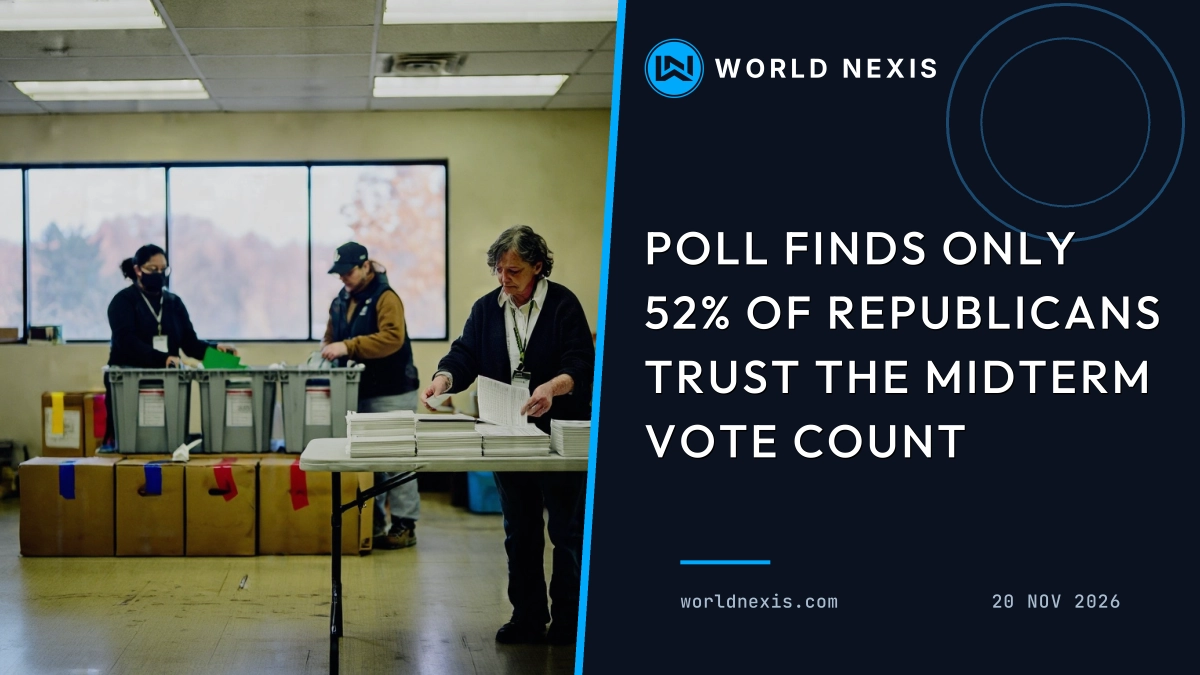
A new midterms poll from the University of California San Diego shows that only 52% of Republican voters trusted ballots were counted accurately this month, a collapse in confidence that has outlasted the party’s own concessions. The survey landed on Friday, hours before President Donald Trump told reporters at the White House that JD Vance’s explanation for the Republican wipeout was “fine.”
Key points
- Only 52% of Republicans said they trusted the midterm vote count, down from more than 80% after the 2024 election.
- Overall, 66% of Americans called the midterms free and fair, up from less than half before Election Day.
- Just 15% of Republicans said politicians discuss voter fraud “too much”.
- Trump called Vance’s claim that the Iran war cost Republicans the midterms “a very accurate statement”.
What the midterms poll found
Fewer than half of Republicans nationwide judged the midterms “free and fair,” the midterms poll found. Only 52% trusted that votes were counted accurately. After the 2024 election, which Trump won, more than 80% of Republicans said they had confidence in the count.
That fall is far steeper than the usual sulk of a losing party. Thad Kousser, a co-director of UC San Diego’s Center for Transparent and Trusted Elections, said a healthy oscillation would run about 10 percentage points either way. The Republican swing between 2024 and 2026 was nearer 30 points.
“It’s sort of like asking people after an overtime basketball game, do you trust the referees?” Kousser said.
Nationally the mood has improved. Two-thirds of Americans, 66%, said the midterms were fair, better than the weeks before the vote, when less than half expected free and fair contests. Democrats and independents drove the rise, many relieved that feared federal interference at polling places never materialized.
Lauren Prather, another co-director of the center, warned against reading the 66% as a verdict on the whole country.
“It would be a mistake to [look at the 66%] and think, ‘Oh, everyone has a pretty good view of the election,'” she said. “It really buries the lede a little bit about the partisan gap.”
The midterms poll also measured appetite for the fraud argument itself. Only 15% of Republicans said politicians talk about voter fraud “too much,” which suggests the base is not tiring of the subject. In similar polling before the January 6 attack on the Capitol, just 22% of Republicans trusted the national vote count.
Trump calls Vance’s Iran war explanation accurate
Trump’s own position has shifted. On election night, as Democrats retook the House and Senate, he told Fox News’ Bret Baier: “Sure, I’ll accept [the results].” He added: “Why wouldn’t I?” Days later he posted: “Does anybody really believe that this ‘Election’ was honest”.
The midterms poll suggests those posts still find a receptive audience. At Friday’s press conference Trump said he was not unhappy with Vance’s analysis, which blamed the Iran war for Republican losses. “Actually, it was a very accurate statement,” Trump said. “The war drove up prices, fuel prices, far less than I thought.”
He said he would have added one question of his own to Vance’s statement: would you do it again? “Absolutely, the answer is yes, because we cannot allow Iran to have a nuclear weapon,” Trump said.
He also argued Republicans lost because he was not on the ballot, promised to fight for datacenters and praised his relationship with China’s Xi Jinping.
Why it matters
American elections are run county by county, by clerks, volunteers and part-time staff on modest budgets. For anyone who works an election day shift, the midterms poll is a warning about the season ahead. When half of one party stops trusting the count, those offices absorb the cost: records demands, lawsuits, pressure on poll workers and endless argument over rules.
The collapse in Republican trust in elections also changes what is politically possible. A base that believes the result was rigged gives state legislators an incentive to tighten voting laws before 2028, and gives federal agencies cover to press on with voter-roll reviews. Either would change how millions of people register and vote.
Analysis
Having covered election data for five years at World Nexis News, I look first at the demand side of this story, and the midterms poll measures it precisely. Only 15% of Republicans think politicians talk about fraud too much. That is not a party moving on. It is an audience still waiting for a message.
The strongest counter-argument deserves an airing. Losing parties always lose a little faith in the count, and this year the system visibly held. Trump conceded on election night, and the vast majority of candidates who had denied past results and sought statewide election posts lost their races.
In my view, though, that explains the top of the party, not its base. An election trust gap of roughly 30 points is about three times the normal dip, and it sits beside a president who accepted the result and then questioned it within days. I side with Prather: the 66% flatters the country, and the 52% will set the terms of the 2028 fight.
What happens next
The midterms poll’s central finding will shape the next two years of election law. Fewer politicians who question results will take office next year, which should reduce the number of officials willing to contest certifications. Republican state officials are already pushing to revive Trump’s restrictions on mail voting for 2028, and pressure on voter rolls could continue.
The UC San Diego team will keep tracking the same questions. Its co-directors argue the market for fraud claims survives only while politicians keep supplying it.
What we don’t know yet
It is unclear whether the 52% will drift back toward the 2024 level or harden. Nor is it settled whether Trump’s mixed signals, acceptance one night and doubt a few days later, will keep the issue alive or eventually wear it out. How the mail-voting and voter-roll fights end in court is also unknown.
Related coverage
- Border poll: Bryant holds sole power to call the vote
- Permitting reform bill passes Senate in major 62-33 vote
- War powers resolution defeated 48-51 in Senate Iran vote
Further reading
- Trump says Vance’s statement blaming Iran war for Republican midterm wipeout was ‘fine’ in wide-ranging press conference – live
- Trump initially accepted the midterm results, but most GOP voters doubt they were fair
About the author: Ayesha Rahman is the Senior Political Correspondent & Columnist at World Nexis News (WNN), covering politics & opinion. The analysis section reflects the writer’s view.

Ayesha Rahman
Ayesha Rahman covers politics and opinion for World Nexis News from London, focusing on elections, legislatures and the policy choices that shape everyday life in the US and UK. She writes analysis and columns that separate what is confirmed from what is claimed, working from…



