Permitting reform bill passes Senate in major 62-33 vote
The permitting reform bill passed the Senate 62-33, speeding energy project reviews and making data centers pay for power. It now heads to the House.
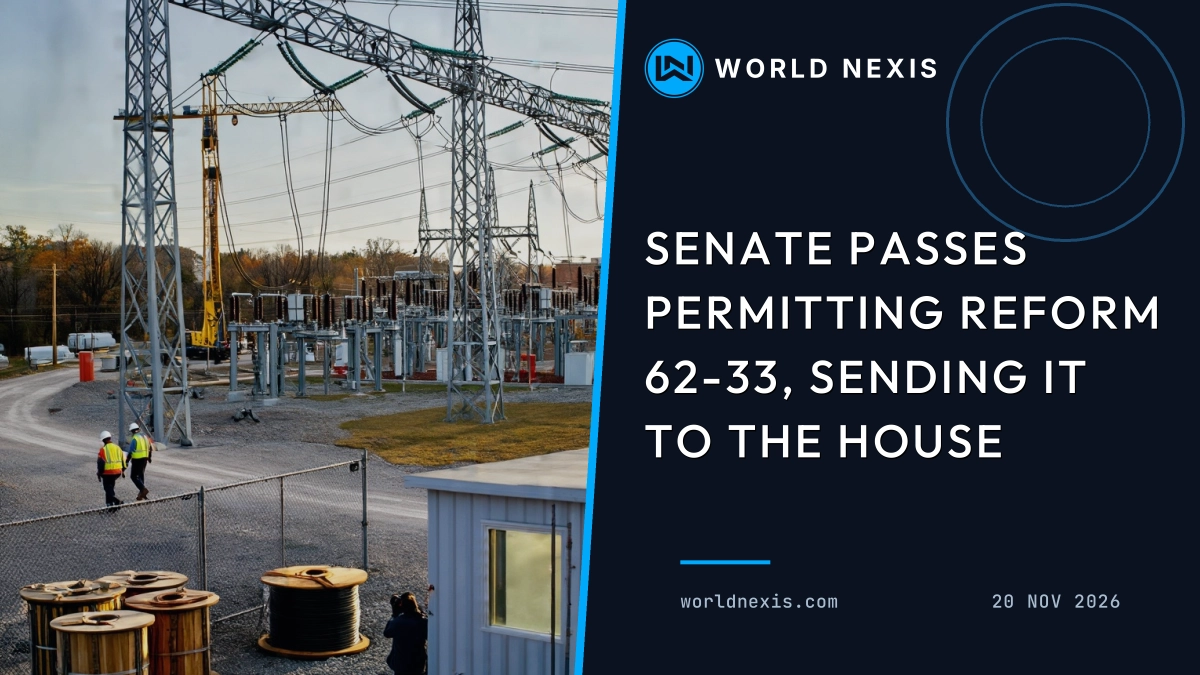
The permitting reform bill passed the Senate on Thursday in a 62-33 vote, sending the Bipartisan American Affordability and Jobs Act to the House after years of stalled negotiations over how Washington approves energy projects. Fifteen Democrats joined nearly all Republicans to back the measure. It aims to shorten federal reviews for power plants, transmission lines, pipelines and mines, and to make data centers pay for the electricity they draw.
Key points
- The Senate passed the permitting reform bill 62-33, with 15 Democrats voting yes.
- Republicans Mike Rounds of South Dakota and Josh Hawley of Missouri were the only two GOP senators to vote no.
- The bill rewrites major environmental laws and limits legal challenges to approved projects.
- It now goes to the House, which approved a narrower, industry-friendly version last year.
What the permitting reform bill would change
Supporters describe the legislation as the biggest rewrite of federal infrastructure approvals in a generation. It would shorten the timeline to start large energy projects and streamline environmental and judicial reviews. It would also amend the National Environmental Policy Act, the Clean Water Act and the Endangered Species Act, changes critics say reach far beyond paperwork.
Senator Shelley Moore Capito of West Virginia, who negotiated the deal, said it showed Republicans and Democrats “sitting down, identifying a problem” that has festered “for at least a decade.” She called it “a major step toward making it faster and more efficient and easier to build infrastructure projects, certainly without giving up any of the strong protections for our environment.”
Senator John Barrasso of Wyoming, who worked on the issue for years, told the chamber: “In America today, it takes too long, and it costs too much to build.” He argued that limiting lawsuits and speeding reviews are common-sense reforms, and that Congress can expand energy production and protect the environment at the same time.
Why the Senate vote took so long
The permitting reform bill followed years of on-and-off talks. Negotiators announced a breakthrough in September with what they called a historic agreement on federal environmental review. Majority Leader John Thune said on the floor: “This bill is years in the making.”
Anger over rising electricity prices, and over the power demands of data centers, pushed the issue up the agenda. President Donald Trump urged approval, calling the bill a “BIG WIN for U.S. ENERGY INDEPENDENCE and DOMINANCE” in a social media post and saying it would help in “lowering Energy Costs for American Families.”
Democrats split as green groups warn of rollbacks
Thirty-one Democrats voted no, mostly citing environmental concerns. Senator Jeff Merkley of Oregon said: “Getting more renewable electrons where they are needed doesn’t tackle climate change if you simultaneously promote the burning of more fossil fuels. Unfortunately, this bill does exactly that.”
Merkley and Senator Ron Wyden, both of Oregon, sought votes on amendments, including a ban on data centers on public lands. They also raised concerns about states’ rights to protect clean water and air, and about tribal rights. Republicans stymied the amendment push, and the permitting reform bill passed without changes offered from the floor.
Environmental groups condemned the outcome. Jen Duggan, executive director of the Environmental Integrity Project, called the bill “a gift to some of the biggest polluters in America” and said the deal would “pave the way for even more fossil fuel projects.”
Why it matters
Permitting delays reach households through electricity bills. Projects that wait years in review carry financing costs that utilities pass on to customers, and backers say faster approvals are the quickest route to more supply. The data centers energy costs provision matters too: as server farms expand, the question of who pays for new generation and transmission is landing on residential bills.
The permitting reform bill also changes the terms of public involvement. Communities that once challenged a pipeline or a plant in court would face shorter windows and narrower grounds for action.
Analysis
Having covered Congress for World Nexis News for five years, I look first at the process, because process is where promises go to die. On the substance, I think the case for this permitting reform bill is stronger than its loudest critics allow. A transmission line that takes a decade to approve is not a protected landscape; it is a bill that households pay while nothing gets built.
Where I side with Merkley and Wyden is the amendment fight. The bill rewrites the National Environmental Policy Act and narrows judicial review, yet it reached the floor without a single rank-and-file amendment vote. When sponsors promise a robust amendment process and then block it, the bipartisan label becomes a shield rather than a description of the work.
Supporters will fairly answer that open amendment votes are how energy bills die in the Senate, and that a presidential signature is waiting. That may be true, but a 62-vote coalition that never tests its own language on the floor has not finished the job. Speed is worth having; it is not worth buying with silence.
What happens next
The permitting reform bill now goes to the House, which passed a more limited, industry-friendly version last year. The two chambers must settle on a single text before anything reaches the president’s desk, and Trump’s public support gives the Senate version a strong tailwind.
What we don’t know yet
The timing of a House vote is not yet settled, and it is unclear whether the data center provisions survive in that chamber. Nor is it clear how far the final text will go in reshaping the National Environmental Policy Act.
Related coverage
- War powers resolution defeated 48-51 in Senate Iran vote
- Jeffries speaker nomination triggers major Trump probes
- Nvidia scandal: major Huang hearing set for 1 December
Further reading
- Senate passes bipartisan permitting reform bill designed to boost energy projects
- Senate approves bill to speed up permitting reviews, force data centers to pay for energy costs
About the author: Ayesha Rahman is the Senior Political Correspondent & Columnist at World Nexis News (WNN), covering politics & opinion. The analysis section reflects the writer’s view.

Ayesha Rahman
Ayesha Rahman covers politics and opinion for World Nexis News from London, focusing on elections, legislatures and the policy choices that shape everyday life in the US and UK. She writes analysis and columns that separate what is confirmed from what is claimed, working from…



