War powers resolution defeated 48-51 in Senate Iran vote
The Senate rejected a war powers resolution to halt fighting with Iran in a 48-51 vote on Thursday, while Republicans rushed Trump's nominees through.
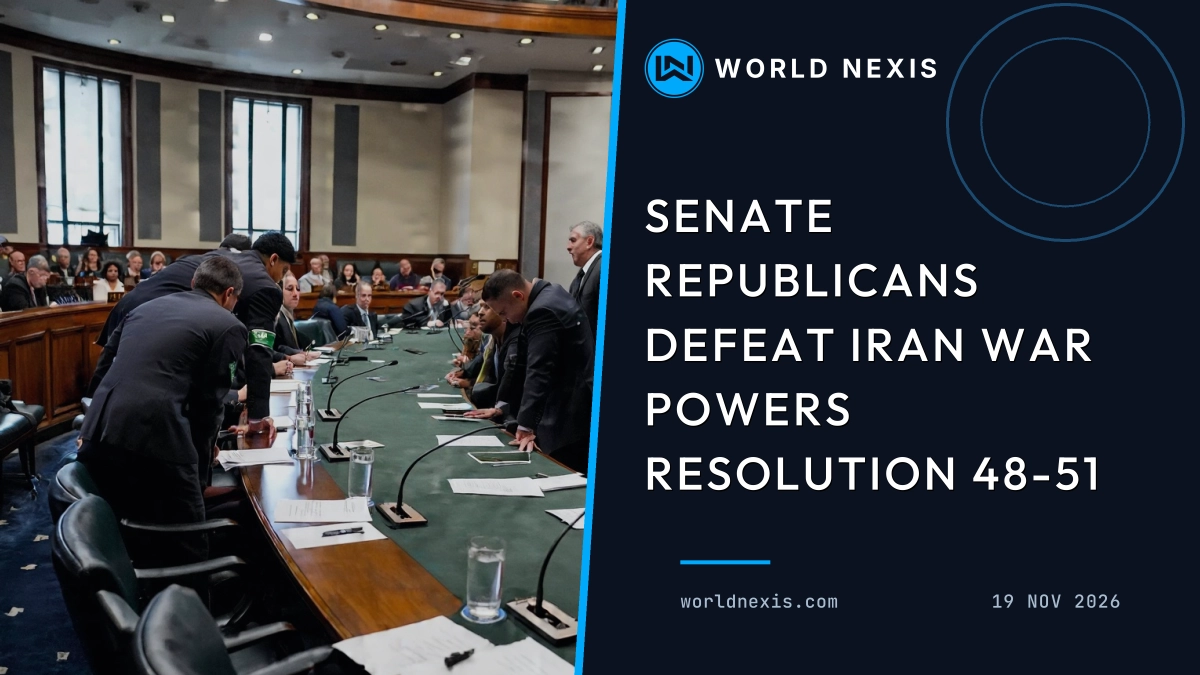
The Senate rejected a war powers resolution aimed at forcing President Donald Trump to halt fighting with Iran on Thursday, defeating the measure 48-51 in the first vote either chamber has taken on the conflict since this month’s midterm elections.
The resolution cleared the House of Representatives in September. Its defeat leaves the war, which began in late February with a joint US and Israeli attack on Iran, in the president’s hands.
Key points
- The Senate voted 48-51 against a war powers resolution that would have required Trump to end US involvement in the Iran war.
- The House passed the same measure in September, before this month’s midterm elections.
- Republicans, who lost both chambers of Congress, largely stood behind the conflict.
- Also on Thursday, a Senate panel questioned Trump’s nominees to lead the Government Accountability Office and the Cybersecurity and Infrastructure Security Agency.
War powers resolution defeated in near party-line vote
Senators voted just over two weeks after midterm elections that cost Republicans control of both the House and the Senate. Democrats take power in January, and with it the committee gavels that shape what reaches the floor.
The war powers resolution drew almost no support from the Republican majority. Democrats fell short of the votes they needed, and the fighting in Iran continues without a congressional check.
The vote was the first measure of how the war plays politically after voters had their say. The conflict and its costs featured heavily in a campaign that ended with sweeping Republican losses.
Democrats have introduced a steady stream of war powers resolutions since the war began. Each one tests whether Congress will use the 1973 War Powers Act, the law that gives lawmakers a route to force a president to end hostilities.
Republicans have backed the campaign and voted down the measures put before them. The result is a familiar pattern: a Democratic attempt, a Republican bloc, and a war that carries on.
Watchdog and cyber nominees face senators
Hours before the Iran war vote, the Senate Homeland Security and Governmental Affairs Committee questioned two of Trump’s nominees. Republicans want both confirmed before Democrats take control of Congress in January.
Eric Ueland, picked to lead the Government Accountability Office, told the panel he would not act as a rubber stamp for the administration. “I’m not here as a plant, a stooge, a lackey for anybody,” he said.
Ueland is currently deputy director of the White House Office of Management and Budget. Confirmation would put him in charge of the GAO, Congress’s main investigative arm and auditor, for a 15-year term.
Democrats on the committee raised concerns about his independence from the administration he serves. They also objected to the shortened process used to advance him.
Ueland pointed to more than two decades of work across the executive and legislative branches as evidence he would act in a nonpartisan way.
CISA nominee declines to call Jan. 6 an attack
Michael LoSapio, nominated to run the Cybersecurity and Infrastructure Security Agency, declined to describe the January 6, 2021, storming of the US Capitol as an attack.
“No, I don’t believe it was an attack,” LoSapio said, when a Democratic senator put the question to him directly. “I wasn’t involved in politics. I know what I saw on the news.”
Asked who won the popular vote in 2020, he refused to answer. “I’m not going to answer the question about an election six years ago,” he said, adding that his only involvement in that election was voting for Trump.
LoSapio is currently chief information security officer at the artificial intelligence firm Palantir. CISA sits within the Department of Homeland Security and works on election security and the protection of critical infrastructure.
Why it matters
The war powers resolution vote settles, for now, whether US forces stay in the Iran campaign. Congress has declined to stop the fighting, and the consequences run through military families, the federal budget and the balance of power between the branches.
The confirmation hearings settle something quieter but just as durable. They decide who audits federal spending and who helps guard American elections, both posts meant to sit outside the political weather of the moment.
Analysis
Having covered accountability reporting and constitutional law for World Nexis News for five years, I look first at the margin rather than the headline. A war powers resolution that fails 48-51 is not a rout. It is a close split in a chamber where opponents of the war needed only a handful of Republicans to cross over.
Democrats say Congress never authorised this campaign. I think they are right, and a chamber that keeps declining to say so plainly is not exercising the check the Constitution hands it. The fairest counter-argument is that the vote was close, and that war-making power has drifted towards presidents of both parties for decades, so the failure is structural rather than Republican.
Where I side with the committee’s Democrats more firmly is on Eric Ueland. A comptroller general drawn straight from the budget office, handed a 15-year term, is the wrong shape for an independent watchdog. His pledge not to be a stooge is welcome, but a promise is not a structure, and GAO audits of this administration would carry more weight from someone it had never employed.
What happens next
The Senate is expected to vote on both nominations before Democrats take control in January. Each nominee needs a simple majority in the full chamber.
Democrats have said they will keep pressing for an end to the Iran campaign. From January they will hold the committee gavels, which lets them schedule hearings and force further votes.
What we don’t know yet
It is unclear whether either nominee has the votes, or whether Democrats will try to reopen the GAO selection once they hold the majority. Nor is there any signal of when, or whether, the Senate will take up another war powers resolution.
Related coverage
- Alaska Senate race: Begich’s House win blunts Democratic sweep in Alaska
- Alaska Senate race: Peltola seals stunning flip to 56 seats
- FDA nominee Heidi Overton dropped one day before major vote
Further reading
- Senate Republicans rejects war powers bill to halt fighting in Iran
- Trump’s CISA pick rejects Jan. 6 as an ‘attack,’ won’t name 2020 election winner
About the author: Ayesha Rahman is the Senior Political Correspondent & Columnist at World Nexis News (WNN), covering politics & opinion. The analysis section reflects the writer’s view.

Ayesha Rahman
Ayesha Rahman covers politics and opinion for World Nexis News from London, focusing on elections, legislatures and the policy choices that shape everyday life in the US and UK. She writes analysis and columns that separate what is confirmed from what is claimed, working from…



