Stormont budget: Treasury must act or spending halts
DUP leader Gavin Robinson warns Stormont will run out of ability to spend next year unless the Treasury moves, as the Stormont budget deadlock deepens.
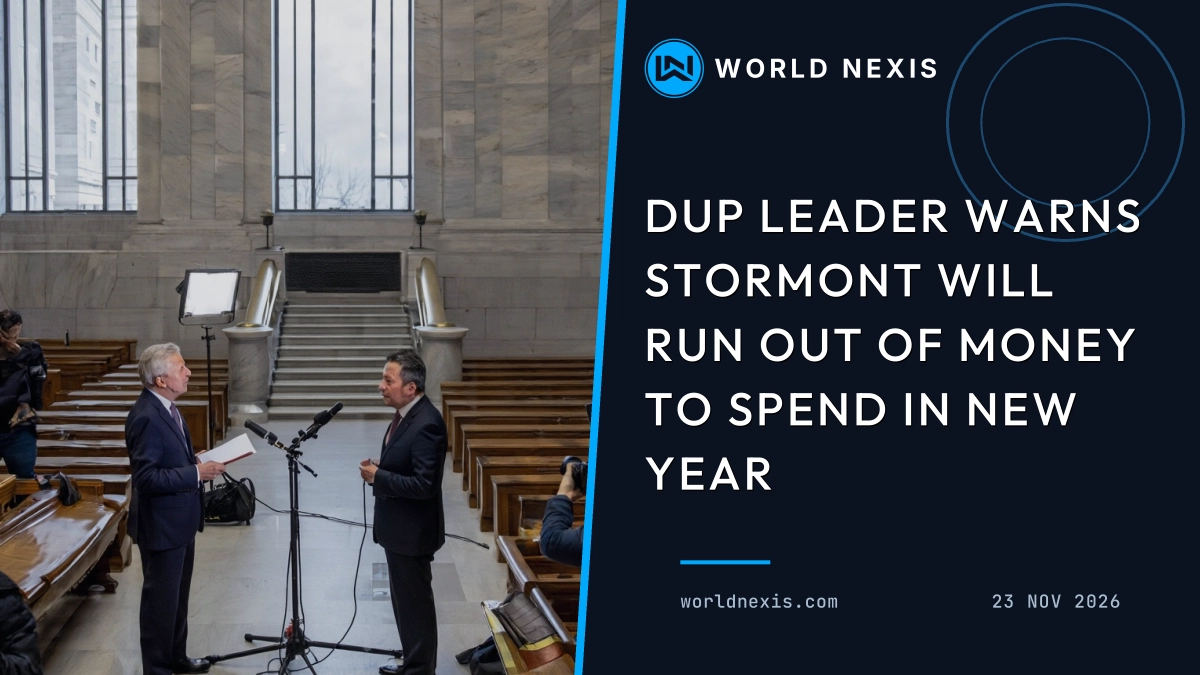
Northern Ireland’s Stormont budget is in deadlock, with DUP leader Gavin Robinson warning that the region will run out of the legal ability to spend money early in the new year unless the Treasury provides more funding. Speaking at Parliament Buildings on Monday, he said the Executive cannot agree a spending plan for 2026-27 on the money currently on offer.
Departments are already operating on contingency budgets of 95% of last year’s spend. Robinson called the financial position “precarious” and argued that the pressure to move sits with the Treasury rather than with ministers in Belfast.
Key points
- Stormont ministers say they cannot strike a 2026-27 Stormont budget without extra Treasury support.
- The UK Government has offered about £1.5 billion over three years, including £525 million delivered this year.
- Robinson said Northern Ireland can “run out of the ability to spend money on public services early in the new year”.
- Opposition leader Matthew O’Toole warned Stormont is on course to run out of money next March.
Stormont budget impasse: what each side is saying
Ministers say the offer does not cover the cost of running public services. Last month’s UK Budget added £131 million for Northern Ireland in the current financial year and £270 million across three years, on top of the earlier package. Neither figure, in the Executive’s view, closes the Stormont budget gap.
Robinson was blunt about the arithmetic. “In Northern Ireland we can only spend the money that is allocated to us from the Treasury,” he said. He added that the Treasury “know that it doesn’t match all that is required in Northern Ireland”.
His warning was carefully worded. He said the danger was “not a threat, that’s a reality”. He also argued that a budget passed by the Executive “wouldn’t pass muster” because it could not balance, and that a plan set from London would leave the same shortfall.
Secretary of State Sir Chris Bryant has pressed the other side of the argument. Last week he said Northern Ireland is heading for a “major crisis” unless the Executive is willing to make “unpalatable, unpopular decisions”. He added it was “well past the time” local ministers set a budget.
Where the Stormont funding gap bites
Contingency budgeting at 95% of last year’s spend does not mean departments stop. It means they plan cautiously, hold back new commitments and prepare for cash limits part-way through the year. For schools, hospitals and road maintenance, that usually shows up as deferred work rather than immediate closures.
How the Stormont budget standoff began
The deadlock is not purely financial. The DUP is withholding co-operation in protest at Sinn Féin ministers backing demonstrations on the Garvaghy Road earlier this year against the Drumcree Orange parade proceeding along the route for the first time in almost 30 years. Robinson indicated on Monday that deputy First Minister Emma Little-Pengelly would not co-operate with a request from First Minister Michelle O’Neill to seek a meeting with Prime Minister Andy Burnham about the budget.
That leaves the Executive unable to agree a plan and unable to force one through. O’Toole called the impasse unacceptable and said the region was heading to run out of money next March. He warned that a budget set by the UK Government, for the first time ever, would leave local legislators with “zero control” over its contents.
“Ultimately, it’s about failure of leadership and responsibility,” O’Toole said, adding that ministers “accept the ministerial salary, the cars, and all the perks” and should take responsibility for setting a budget.
Robinson’s answer is that leadership means refusing to sign off a plan that cannot be delivered. “There will be a need for the Treasury to move, and the Prime Minister understands that,” he said, arguing the standoff now carries a risk to political stability as well as to public services.
Why it matters
For households in Northern Ireland, the practical question is whether the services they use can plan past March. A Stormont budget agreed late, or imposed from London, freezes recruitment, delays repairs and pushes cuts into the middle of the financial year. That is harder to manage than a difficult plan agreed on time.
The constitutional stakes are just as high. If Westminster legislates the Northern Ireland budget for the region, devolution continues in name while the most important annual decision in government is taken elsewhere. Voters would then have no local lever to pull on the numbers that shape their schools and hospitals.
Analysis
Having covered devolution and public services for World Nexis News, I look first at who has the power to end a standoff. Here both sides can move, but only one of them has so far declined to legislate at all. My reading of the facts is that the funding offer is genuinely tight and the Executive’s complaint about the total is credible. The Treasury has not produced a settlement that matches the cost pressures ministers describe, and on that point Robinson is on solid ground.
Where I part company with him is the leap from a bad offer to no budget at all. An executive can pass a Stormont budget it regards as inadequate, publish the size of the gap and keep pressure on the Treasury while departments get certainty. Refusing to legislate does not extract an extra penny; it moves the deadline closer and hands London the pen. O’Toole’s warning about “zero control” is the strongest argument in this whole exchange.
The counter-argument deserves respect. Ministers cannot vote for figures they believe are undeliverable, and a plan that cannot balance is a fiction that stores up a mid-year crisis. That is fair. But it argues for a time-limited, conditional budget with a stated shortfall, not for drift into March. In my view the Executive should set a budget and the Treasury should improve the Stormont funding offer.
What happens next
The Stormont budget question will be settled by whether the Treasury improves its allocation before departments reach the limit of their contingency spending. O’Toole’s March warning is the clearest deadline in the public record. Bryant’s pressure from Westminster and Robinson’s call for Treasury movement are the two levers being pulled in public.
What we don’t know yet
It is not confirmed whether the Treasury will table a revised offer, or when. Nor is it clear whether the Executive would accept one, given the DUP’s wider protest. The possibility of Westminster legislating a budget for Northern Ireland remains open but unscheduled.
Related coverage
- South East Water loss hits £22.9m after supply failures
- Alastair Campbell speech: media told to be braver
- Brexit debate warning as Sunak tells Burnham not to reopen
Further reading
- Stormont will run out of ability to spend if Treasury doesn’t act – Robinson
- Stormont will run out of ability to spend if Treasury doesn’t act – Robinson
About the author: Liam O’Connor is the UK Politics Reporter at World Nexis News (WNN), covering uk politics. The analysis section reflects the writer’s view.

Liam O'Connor
Liam O'Connor is UK Politics Reporter at World Nexis News, covering Westminster, devolved politics and the issues that matter to voters across England, Scotland, Wales and Northern Ireland. Based in London, he reports from primary sources — Hansard, official statements, published data — and explains…



