Alastair Campbell speech: media told to be braver
Alastair Campbell speech: the former Blair spin doctor told Australian journalists to be braver on populism, Pauline Hanson and young voters.
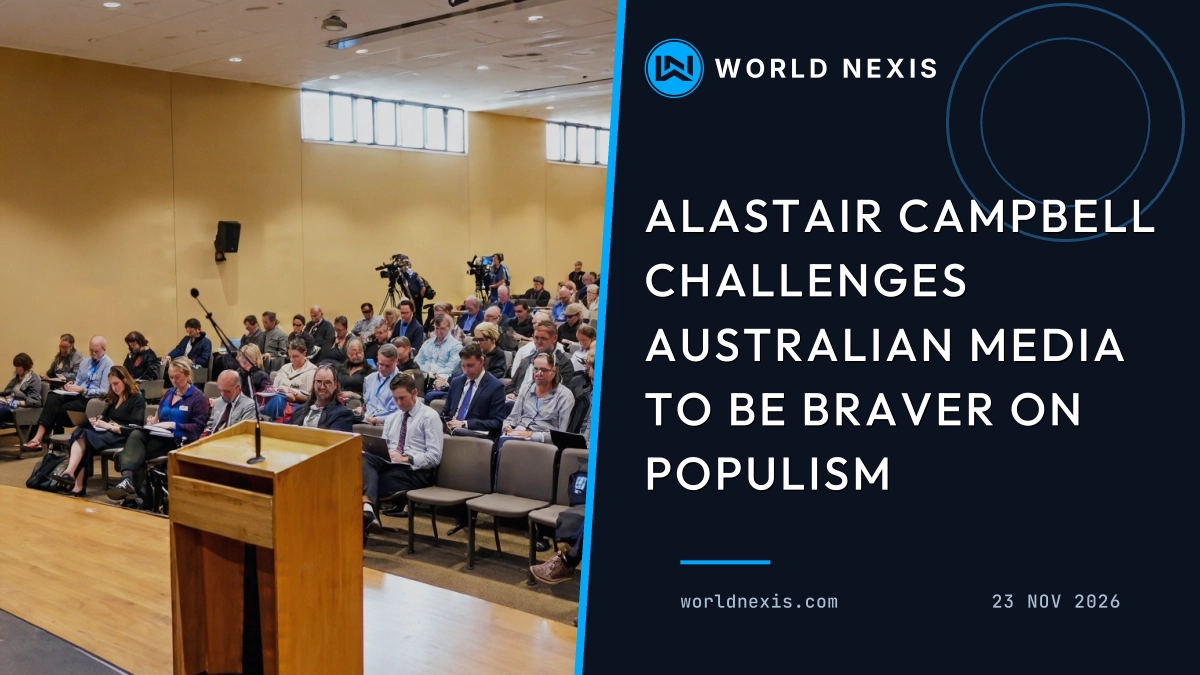
The Alastair Campbell speech at Canberra’s National Press Club on Monday turned into a direct challenge to Australian journalism, as the former Downing Street communications chief urged reporters to be braver, to test populist arguments instead of repeating them, and to offer young audiences something better. Campbell ran communications for Tony Blair and now co-hosts the Rest is Politics podcast with former Conservative frontbencher Rory Stewart. He addressed a standing-room-only crowd, and the programme he fronts ranks third on Spotify in the UK and 25th in Australia.
Key points
- Alastair Campbell, Tony Blair’s former spin doctor, spoke at the Canberra National Press Club on Monday.
- He said journalists should “expose and challenge the populists, not ventriloquise”.
- He compared One Nation’s ties to Gina Rinehart, Australia’s richest person, with a much-criticised £5 million gift accepted by Reform UK leader Nigel Farage in 2024.
- Russia’s ambassador to Australia, Mikhail Petrakov, was in the audience.
Inside the Alastair Campbell speech
The address ranged widely, from former prime minister Paul Keating’s advice on handling Rupert Murdoch to cricket’s Sandpapergate affair. On the ball-tampering episode he was brief. “I wouldn’t have gone for that forum thing – I’m not sure that’s going to cut it,” he said with a wry grin.
The core of the Alastair Campbell speech was a sustained critique of how political journalism now works. He insisted his frustration with the trade came from affection rather than contempt, framing reporting as a public good and not simply a commercial product.
“I’m overwhelmingly critical of the media and what it’s become over my lifetime, but … my criticism comes from a place of love.”
Populists should be exposed, not amplified
His central argument was that newsrooms have learned to relay populist claims rather than test them. That, he said, rewards politicians who treat problems as material to exploit rather than issues to solve.
“When the politicians are driven by the populism of my definition – politics as problem exploitation, not problem solving – then the media should expose and challenge the populists, not ventriloquise.”
He then asked: “Is it too much to expect journalists to stand up for each other once in a while in defence of the legitimate role they play?”
Putin, Petrakov and the Hanson question
Campbell argued that Vladimir Putin had mastered populism, polarisation and post-truth to convince people that “nothing is true, and everything is possible”. The remark landed in a room that included Russia’s ambassador to Australia, Mikhail Petrakov, who has become a regular at the club after attending Greens Leader David Shoebridge’s address in October.
Turning to money in domestic politics, he questioned whether Australians were comfortable with Senator Pauline Hanson receiving millions in donations, a property deal and a private jet from Gina Rinehart, the country’s richest person. He likened that arrangement to Farage’s relationship with a cryptocurrency magnate who gave him the £5 million gift.
“Are you Australians entirely comfortable … because I don’t think we should be,” he said.
One media oligarchy replaced by another
Campbell said his early optimism about social media had broken down, because the platforms had swapped one media oligarchy for another. He was more encouraged, he added, by young people’s appetite for being properly informed.
“(Young people are) interested but disappointed with a lot of what they see from politics and a lot of what the media offers them too – and they’re not wrong.”
The question most young people want answered, he said, is what is happening in the world and why. He added that many politicians spend too much time responding and not enough devising and implementing. Pressed on shrinking attention spans, he insisted the problem belonged to communicators, not their audience.
Why it matters
For British readers the questions are familiar ones: who pays for political campaigns, what donors expect in return, and whether newsrooms treat those links as a story or as background noise. The Alastair Campbell speech put two separate funding rows into a single frame, and asked voters in both countries to look at the money before the message.
The second consequence is generational. If younger audiences conclude that politics is performance and that coverage rewards the loudest voice, they drift away. The politicians who gain most from that drift are the ones Campbell accuses of exploiting problems rather than solving them.
Analysis
Covering Westminster for World Nexis News, I look first at the British version of this argument, because the pattern Campbell describes is not confined to Australia. His distinction between solving problems and exploiting them is the useful part. A newsroom that repeats a populist’s framing without testing it is not being neutral; it is finishing the job. The Farage comparison strengthens the case, since a £5 million gift from a cryptocurrency magnate in 2024 is exactly the kind of transaction that belongs in a funding story rather than a personality one.
I accept the strongest counter-argument. Campbell is an awkward messenger: a man who spent years shaping coverage is now diagnosing its failures, and some of the trust deficit he describes was built by the trade he practised. Shrinking budgets and audience demand also explain more timid reporting than cowardice ever does.
Even so, I side with his reading of the problem. The cost of amplifying populists falls on readers, who end up told what a politician said and not what it would do to them. His point about young audiences is the test I would apply to my own beat: if political reporting cannot explain what is happening and why in plain terms, we should not be surprised when they look elsewhere.
What happens next
No formal follow-up was attached to the Alastair Campbell speech. The press club programme continues, and the Rest is Politics podcast keeps publishing to its UK and Australian audiences. The practical test is whether newsrooms take up his challenge on donation and gift coverage in the weeks ahead.
What we don’t know yet
There is no public response yet from Senator Hanson or One Nation to his remarks. Nor is it clear whether Australian outlets will change how they cover that funding, or whether the scrutiny he demands will be applied to the Reform UK gift with the same energy.
Related coverage
- Brexit debate warning as Sunak tells Burnham not to reopen
- Co-op Live tear gas: major incident as 12,000 evacuated
- PIP review: major overhaul to tailor disability benefits
Further reading
- Political spinner tells media to be braver and better
- Political spinner tells media to be braver and better
About the author: Liam O’Connor is the UK Politics Reporter at World Nexis News (WNN), covering uk politics. The analysis section reflects the writer’s view.

Liam O'Connor
Liam O'Connor is UK Politics Reporter at World Nexis News, covering Westminster, devolved politics and the issues that matter to voters across England, Scotland, Wales and Northern Ireland. Based in London, he reports from primary sources — Hansard, official statements, published data — and explains…



