NDA ban: Burnham vows watershed moment in January crackdown
The NDA ban takes effect in January, voiding clauses that silence harassment victims. Andy Burnham says it is a watershed moment for women and girls.
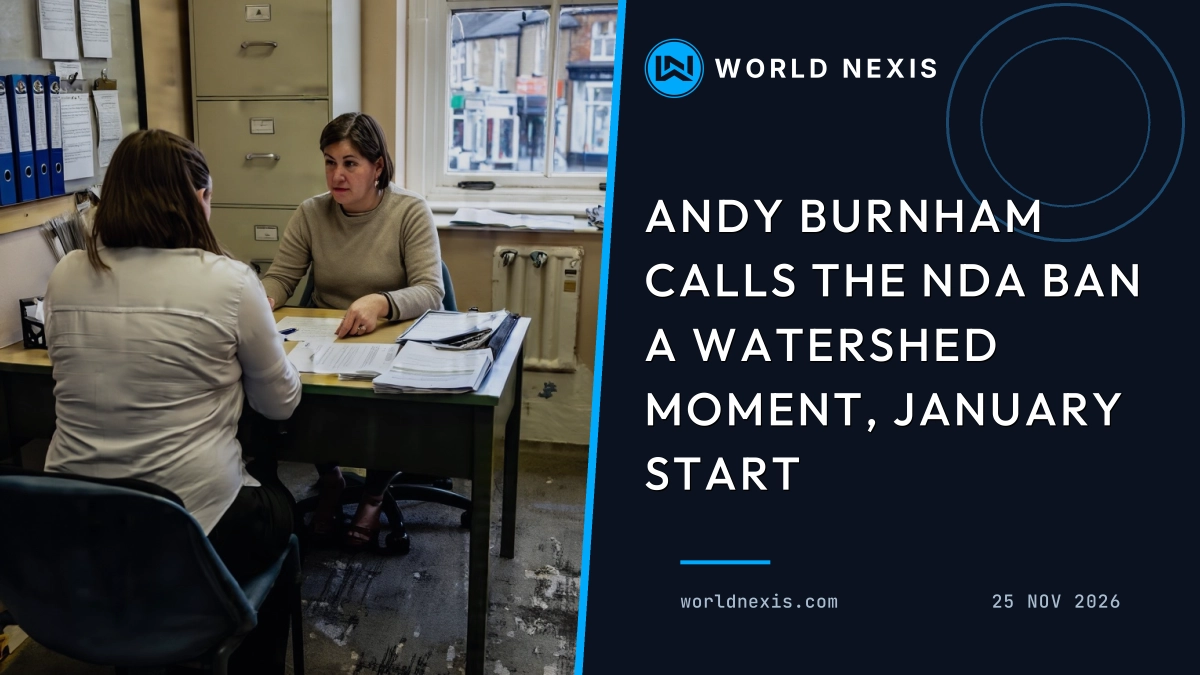
The NDA ban the Government has brought forward will take effect in January, voiding clauses used to silence workers and victims of crime under two Acts of Parliament. Prime Minister Andy Burnham used a signed article this week to call for a “watershed moment” after the rape conviction of Russell Brand. The changes sit in the Employment Rights Act and the Victims and Courts Act.
Key points
- From January, confidentiality clauses cannot gag employees who have suffered harassment or discrimination, or stop victims reporting criminal conduct.
- The new rules cover only agreements signed from January onwards, so existing NDAs stay in force.
- Burnham says victims will be free to speak to police, family, friends, victim services or the media, with “no loopholes for lawyers to exploit”.
- Ministers have signalled protection for freelancers and fans, and opened a debate on a staggered age of consent.
What the NDA ban changes from January
Under the changes, a clause in a new NDA is void if it is used to silence a worker over harassment or discrimination at work. A clause is equally void if it stops a victim of crime from passing information about criminal conduct to police, family, friends, victim services or journalists. Confidentiality terms covering someone who witnessed harassment at work also lose their force.
The NDA ban is narrower than the language around it suggests. It reaches only agreements signed from January onwards. Every settlement already in place, and every worker already bound by one, remains under the old rules.
Who is still outside the rules
Ministers have signalled that protection will be extended to freelancers and to fans who experience abuse, two groups that fall outside ordinary employment contracts. The Government has not yet set out how that extension would work, or when it would arrive.
Why the NDA ban has followed the Brand conviction
Burnham’s intervention comes after weeks in which the use of gagging orders by famous men moved from legal argument to the centre of national debate. Russell Brand’s rape conviction, and allegations against David Walliams, which he denies, have both renewed questions about how such agreements are drafted and who they protect.
“Too often, the powerful have been protected and the vulnerable exploited,” Burnham said. “We need to get to a place where women and girls feel confident that if they report a crime, they will be treated with dignity and compassion and action will be taken.”
He argued that non-disclosure agreements should protect sensitive business information or commercial interests, not men who have abused, harassed or discriminated against women. Victims, he wrote, would be able to tell their story “to whoever they choose”, with “no exceptions”.
Campaigner Zelda Perkins, who broke an NDA to become a whistleblower against Harvey Weinstein, said the promises “have the potential to transform lives” and uphold the integrity of a legal system that must never protect perpetrators at the expense of victims. “These promises are hugely significant,” she said. “Now we need to make sure they become reality.”
Why it matters
For anyone handed a settlement or a contract containing a confidentiality clause, the practical effect is blunt: from January, the gag cannot be enforced on new agreements where harassment, discrimination or a criminal allegation is involved. An employer loses the main legal tool used to keep such cases quiet.
The rights of workers and victims are only part of the story. Public trust in reporting crime rests on the belief that speaking up leads somewhere, and confidentiality clauses have long been blamed for convincing people to stay silent. Small businesses and charities, meanwhile, will have to redraft template contracts before the deadline.
Analysis
I watch Westminster for World Nexis News, and the first question I ask of any new right is simple: when does it start, and who does it cover? On both counts this package is narrower than the word watershed suggests. A worker who signed a gagging order last month, or last year, gets nothing in January. The people the Brand case made visible are, in most cases, already bound.
The strongest counter-argument comes from employers, who will say settlements collapse if neither side can rely on confidentiality, and that NDAs still legitimately shield commercial information. Burnham concedes that point himself. Even so, the evidence supports his direction of travel: a clause that exists to stop a harassment victim speaking serves no public interest, and the law should not enforce it. Perkins is right that the promises are significant, and right that significance is not the same as delivery.
My concern is the January deadline. Promises accelerated under political pressure tend to arrive as narrow commencement orders, and the two most interesting commitments here, freelancers and fans, are the ones with no detail attached. I would rather ministers published the wording early and got it right than met the date with a gap.
What happens next
The core changes come into force in January, when the relevant provisions bite on new agreements. Until then, NDAs signed under the current rules stay exactly as they are.
The Government has said it will consider extending protection to freelancers and to fans who experience abuse, and has opened a consultation on a staggered age of consent. Parents, young people, victim support services and the wider public are being invited to share their experiences to inform the process.
Perkins said she will work with ministers to make sure the protections “go far enough” and genuinely cover everyone in society who needs them.
What we don’t know yet
- Whether any route will open for people already bound by an NDA, or whether January draws a clean line through the past.
- How freelancers and fans would be covered in law, and on what timetable.
- Whether the review of the age of consent will lead to legislation at all.
Related coverage
- Energy price cap confirmed: 26% rise to £2,166 from January
- Burnham TikTok row sparks major backlash over No 10 stunt
- Met Police knife crackdown: 266 arrests, 500 knives seized
Further reading
- Burnham calls for ‘watershed moment’ as Government moves to limit NDAs
- Burnham calls for ‘watershed moment’ as Government moves to limit NDAs
About the author: Liam O’Connor is the UK Politics Reporter at World Nexis News (WNN), covering uk politics. The analysis section reflects the writer’s view.

Liam O'Connor
Liam O'Connor is UK Politics Reporter at World Nexis News, covering Westminster, devolved politics and the issues that matter to voters across England, Scotland, Wales and Northern Ireland. Based in London, he reports from primary sources — Hansard, official statements, published data — and explains…



