Burnham TikTok row sparks major backlash over No 10 stunt
The Burnham TikTok row has deepened after an influencer mouthed explicit lyrics outside No 10, with Kemi Badenoch accusing the PM of undermining the office.
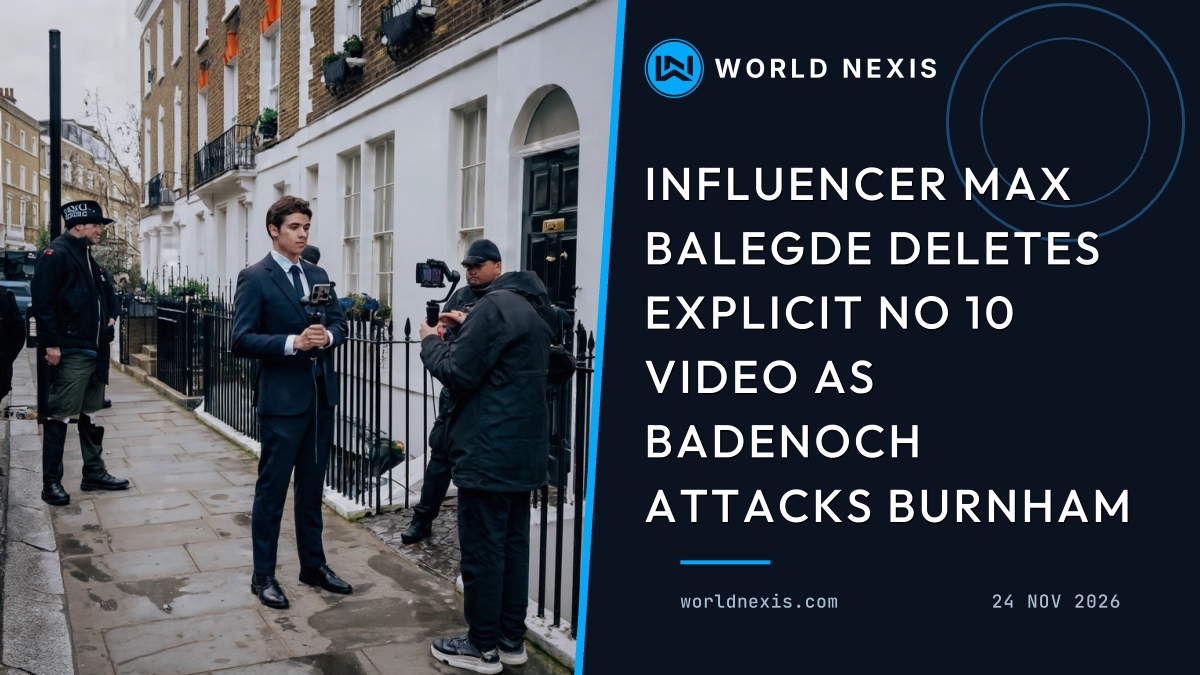
The Burnham TikTok row has turned a Downing Street push to reach online audiences into a public argument about the dignity of the office, after an influencer filmed himself mouthing explicit lyrics outside No 10. Max Balegde posted the clip during a visit by content creators arranged as part of Andy Burnham’s effort to connect with online personalities. The video has now been deleted, and the prime minister’s official spokesman said it was “clearly not acceptable”.
Key points
- Max Balegde filmed himself mouthing the words of an explicit viral meme song outside 10 Downing Street.
- The clip was posted during a Downing Street visit for online creators and has since been taken down.
- Safeguarding minister Satvir Kaur condemned the language but defended the prime minister’s media strategy.
- Conservative leader Kemi Badenoch accused Burnham of undermining the dignity of his office.
How the Burnham TikTok row unfolded
Balegde was invited to Number 10 as part of a deliberate attempt by the prime minister to speak to audiences who take their news from social platforms rather than newspapers or broadcast bulletins. During the visit he filmed himself mouthing the words of a viral meme song, a lyric built around Jamaican profanity, and published the result to his followers.
Criticism followed quickly. The Max Balegde video was pulled, and Downing Street welcomed the decision rather than defending the content. The spokesman said: “It’s clearly not acceptable, and that is reflected by the fact that it has been taken down.” He added: “Content creators are obviously responsible for what they choose to post.”
Asked repeatedly whether Downing Street had requested the deletion, the spokesman declined to say. He did defend the Downing Street influencer visit programme, arguing it was right for the prime minister to listen to creators who reach millions of people who do not get their news from traditional media.
Safeguarding minister condemns the language
Satvir Kaur, the safeguarding minister, was blunt about the words used. “Would I use that language? Absolutely not,” she said. “Do I want to hear that kind of language anywhere, wherever it is?”
She then drew a line between criticising the content and policing the guest list. Kaur said it was right for the prime minister to talk to “lots of different people and lots of different media outlets”, and rejected the suggestion that No 10 should control what creators say or film outside the building. “I’m sure you wouldn’t want me saying that I can control, or the Prime Minister should control, what broadcasters say outside No 10,” she said.
Badenoch says the office has been made a joke
The Burnham TikTok row widened when Kemi Badenoch, the Conservative leader, argued that the problem began with the invitation itself. She accused the prime minister of undermining the dignity of his office by bringing influencers into Downing Street, and compared it with the discipline she says she encountered as a new MP.
“When I was a new MP, we had to hand in our phones as we stepped into 10 Downing St, so it’s jarring to see a Labour PM turn it into a bit of a joke. Hugh Grant could dance through No 10 in Love Actually because he was pretending to be Prime Minister. At a time when Trump, Xi and Putin are projecting power on the world stage, and people across Britain are anxious about the future, this looks extremely unserious. Being relatable doesn’t mean treating the public as though they are children who need entertaining.”
Her remarks tie the Burnham TikTok row to a much wider argument about how a modern prime minister should present himself. They also point to a tension inside the strategy: the same informality that makes a leader watchable on a phone screen can read as trivial when the setting is the door of government.
Why it matters
For most readers this is not really about one song. It is about who gets access to the building where decisions are made, and on what terms. A government that opens No 10 to creators in exchange for reach is making a trade: audiences it would not otherwise touch, in return for a looser grip on the message.
The Burnham TikTok row also tests how far ministers are willing to defend that trade in public. Kaur’s answer, condemning the language while keeping the strategy, is the one most of Whitehall will privately prefer. Whether it satisfies voters who expect the prime minister’s street to look serious is a different question.
Analysis
Having spent the past year covering how Westminster talks to the public, I read the Burnham TikTok row as two arguments wearing one coat. The first is about a guest’s vocabulary, and it is settled: the clip was crass, the creator took it down, and nobody seriously thinks the prime minister wrote the lyric. The second is about whether creators should be walking up that street at all, and that is where I think Badenoch overplays her hand.
I side with Kaur’s framing rather than the Conservative leader’s. Condemning words while defending the strategy is a coherent position that treats adults as adults. Badenoch’s claim that a phone-based format degrades the office is weaker than it sounds; the phone amnesty she remembers was about security and discipline, and it never stopped spin, leaks or briefing wars inside the same building.
The strongest counter-argument is that informality curdles into unseriousness, and Downing Street has not helped itself by refusing to say whether anyone asked for the clip to come down. That silence points to improvisation rather than rules. Even so, the Burnham TikTok row is evidence of a process gap, not proof that the whole approach is a joke.
What happens next
Downing Street has announced no further action beyond welcoming the deletion, and the spokesman declined to discuss private exchanges with the creator. The government continues to defend the outreach that produced the visit, so the question of ground rules will return with the next guest.
What we don’t know yet
It is not clear whether No 10 asked for the video to be removed, or whether future creator visits will come with written standards. Whether Balegde will address the row directly is also unresolved.
Related coverage
- ICE arrests spark major backlash after 3 high-profile cases
- ICE airport arrest of two sparks major Seattle outcry
- Wales devolution refusal sparks urgent meeting demand
Further reading
- Prince William meets Burnham on first Downing Street visit
- Influencer under fire for mouthing explicit lyrics outside 10 Downing Street
About the author: Liam O’Connor is the UK Politics Reporter at World Nexis News (WNN), covering uk politics. The analysis section reflects the writer’s view.

Liam O'Connor
Liam O'Connor is UK Politics Reporter at World Nexis News, covering Westminster, devolved politics and the issues that matter to voters across England, Scotland, Wales and Northern Ireland. Based in London, he reports from primary sources — Hansard, official statements, published data — and explains…



