Irish-medium education bill blocked 43-30 by unionist veto
Stormont MLAs backed the Irish-medium education bill 43-30, but a DUP petition of concern blocked it, prompting claims of anti-Irish bigotry.
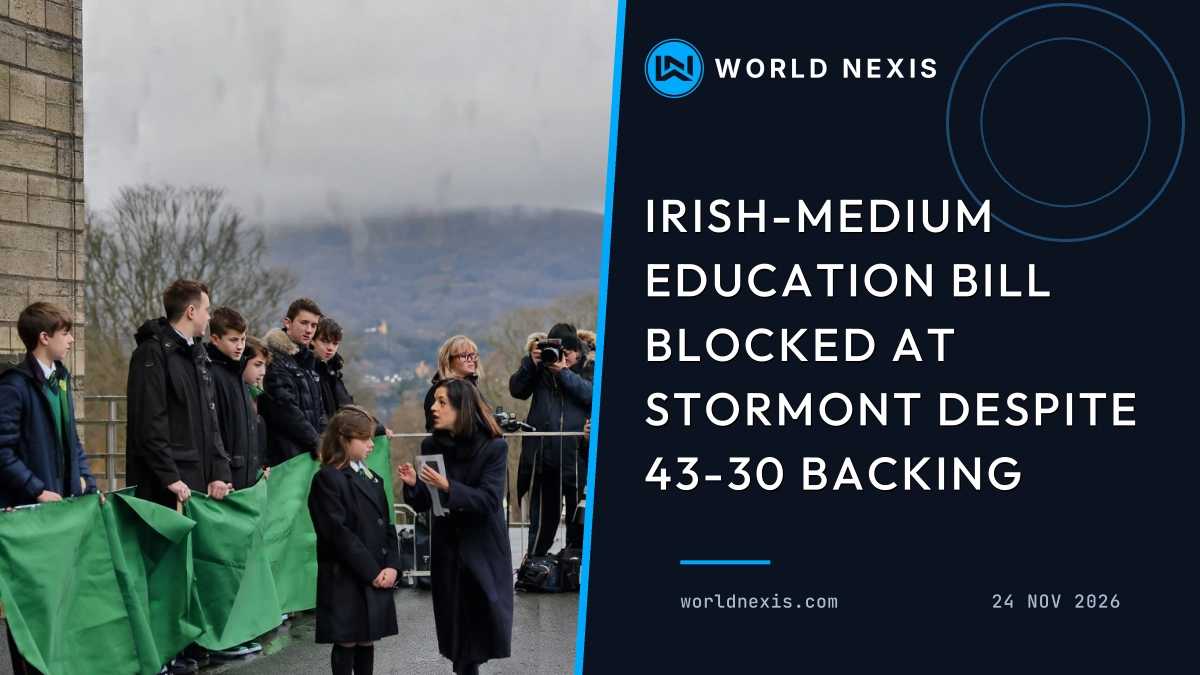
A Bill to strengthen Irish-medium education in Northern Ireland has been blocked at Stormont, despite 43 MLAs voting in favour and 30 against. The Irish-medium Education (Workforce Plan) Bill, brought by Sinn Féin’s Pat Sheehan, fell at its final stage on Tuesday after the Democratic Unionist Party deployed a petition of concern, a mechanism requiring majority backing from both unionist and nationalist members.
Seventy-three MLAs voted in total, giving the Bill 58.9% support in the chamber. It was backed by all 27 nationalists who voted and by 15 others, yet just one of the 31 unionists who cast a vote supported it. That split was enough to stop the legislation in its tracks.
Key points
- MLAs backed the Irish-medium education Bill by 43 votes to 30 at its final stage.
- The DUP’s petition of concern demanded cross-community support, which the Bill did not win.
- The law would have obliged the Department of Education to prepare a workforce plan for Irish-medium schools.
- Alliance MLA Nick Mathison called the veto “an absolute disgrace”.
How the Irish-medium education Bill was blocked
The proposed law was deliberately narrow in scope. It would have required Stormont’s Department of Education to draw up a workforce plan for Irish-medium schools, matching teacher supply to pupil numbers in a sector that has expanded steadily.
Sheehan called it a “modest measure” to support the sector. Speaking partly in Irish, he said the petition of concern had been “used to attack schoolchildren who are learning through a minority language”.
“A safeguard intended to protect minorities is being turned against children educated through a minority language – shame on political unionism,” he said.
He added that unionists on the opposite benches should be “apologising to these schoolchildren and young people, who are being denied the opportunity of equality within our education system”. His remarks drew applause from the public gallery, where Irish-language campaigners and pupils had gathered for the vote.
A safeguard turned into a weapon
The petition of concern forces a cross-community vote, so a Bill must carry majority support from both unionist and nationalist MLAs before it can pass. Sheehan described that safeguard, in this instance, as part of the “same ugly pattern of anti-Irish bigotry”.
Reaction: ‘absolutely disgraceful’
Nick Mathison, the Alliance MLA who chairs the Assembly’s education committee, called the use of the veto “an absolute disgrace”.
“This is a very moderate, very modest piece of legislation that aims to just bring some administrative equality to how we plan the workforce for the Irish-medium sector,” he said.
Mathison said the decision would leave teachers, children and young people in the sector feeling “really hurt, really let down” by what he called an “undemocratic intervention”.
First Minister Michelle O’Neill said blocking the Bill was “absolutely disgraceful” and accused unionist parties of “anti-Irish bigotry”. She told reporters: “This is another display of anti-Irish bigotry. So I stand with all of these young people and I assert their right to be able to learn through the medium of Irish.”
She also said: “If the DUP think they’re going to stop the growth of the Irish language, they may give their heads a shake.”
Conradh na Gaeilge president Ciarán Mac Giolla Bhéin said the DUP had “failed spectacularly to learn the lessons” of the Líofa controversy a decade ago, when funding for an Irish-language bursary scheme was cut days before Christmas.
Supporters of the sector, including students and teachers, had organised a demonstration at Parliament Buildings against the use of the veto, and campaigners watched the division from the public gallery.
DUP defends its record on Irish-medium education
Communities Minister Gordon Lyons rejected the charge, arguing that workforce planning for the sector is already in place under his party colleague, Education Minister Paul Givan.
“Sinn Féin are obviously trying to get some votes out of this, to score some political points,” he said.
Lyons said Givan had “continued the funding for Irish-medium education and has put a workforce plan in place”, adding: “It’s very different from what Sinn Féin are actually saying.”
He also pointed to his own department’s coordination of a planned Irish language strategy for the Northern Ireland Executive, and accused Sinn Féin-led departments of delays in responding.
Earlier this month, DUP leader Gavin Robinson said the party’s move was an outworking of its response to Sinn Féin’s “arrogance” over the Drumcree parading dispute.
Why it matters
For parents who want their children taught through Irish, the immediate effect is that teacher supply keeps being planned without a statutory obligation. The Irish-medium education sector will go on relying on the workforce plan the Education Minister says is already in place, with no legal duty on his department to publish or refresh it.
More broadly, the vote shows how quickly the Assembly’s cross-community architecture can absorb a routine proposal. Any future Bill touching Irish-medium education or language rights now carries a predictable risk of a veto, whoever brings it forward.
Analysis
Having covered devolution and Northern Ireland for World Nexis News, I look first at what a veto is for, not who used it. The petition of concern exists to protect a community that fears being outvoted on something existential. A requirement to write a staffing plan for Irish-medium education does not meet that test, which is what makes Mathison’s bafflement land.
In my view the facts favour the Bill’s supporters. A measure that passed 43 to 30, drew support from 15 MLAs outside the nationalist designation and asked only for administrative planning was stopped by a mechanism built for emergencies. Sheehan’s argument that a safeguard for minorities is now aimed at children taught in a minority language is the stronger one, and Alliance is right that the veto needs reform.
The counter-argument deserves a hearing: Lyons says a workforce plan already exists and that Sinn Féin is harvesting votes. If that plan is real and funded, the Bill’s practical value shrinks. Yet that case is an argument for publishing the plan, not for killing the legislation.
What happens next
The Bill cannot proceed. It falls at final stage, and the workforce plan it sought will not become a statutory duty, leaving Irish-medium education without the guarantee its supporters wanted.
Alliance has said it will keep pressing for reform of the institutions, arguing the veto should be taken out of Northern Irish politics. The Executive’s wider Irish language strategy, coordinated by Lyons’ department, remains in preparation.
What we don’t know yet
It is unclear what the workforce plan the Education Minister says is in place actually contains, or whether it will be published in a form campaigners can scrutinise. No timetable has been given for the Executive’s Irish language strategy, and no alternative route for the Bill has been set out.
Related coverage
- Troubles Bill has ‘no perfect answers’, Bryant admits
- Victims commissioner warns of crisis in 6,000-victim survey
- Winter Fuel Payment: DWP confirms who gets £100, £200 or £300
Further reading
- Irish-medium education: Law on Irish schools blocked as unionists deploy Stormont veto
- Use of veto on Irish-medium education Bill ‘an absolute disgrace’
About the author: Liam O’Connor is the UK Politics Reporter at World Nexis News (WNN), covering uk politics. The analysis section reflects the writer’s view.

Liam O'Connor
Liam O'Connor is UK Politics Reporter at World Nexis News, covering Westminster, devolved politics and the issues that matter to voters across England, Scotland, Wales and Northern Ireland. Based in London, he reports from primary sources — Hansard, official statements, published data — and explains…



