Troubles Bill has ‘no perfect answers’, Bryant admits
Northern Ireland Secretary Sir Chris Bryant says the Troubles Bill will not give families 'perfect answers' as the legislation is debated in the Lords.
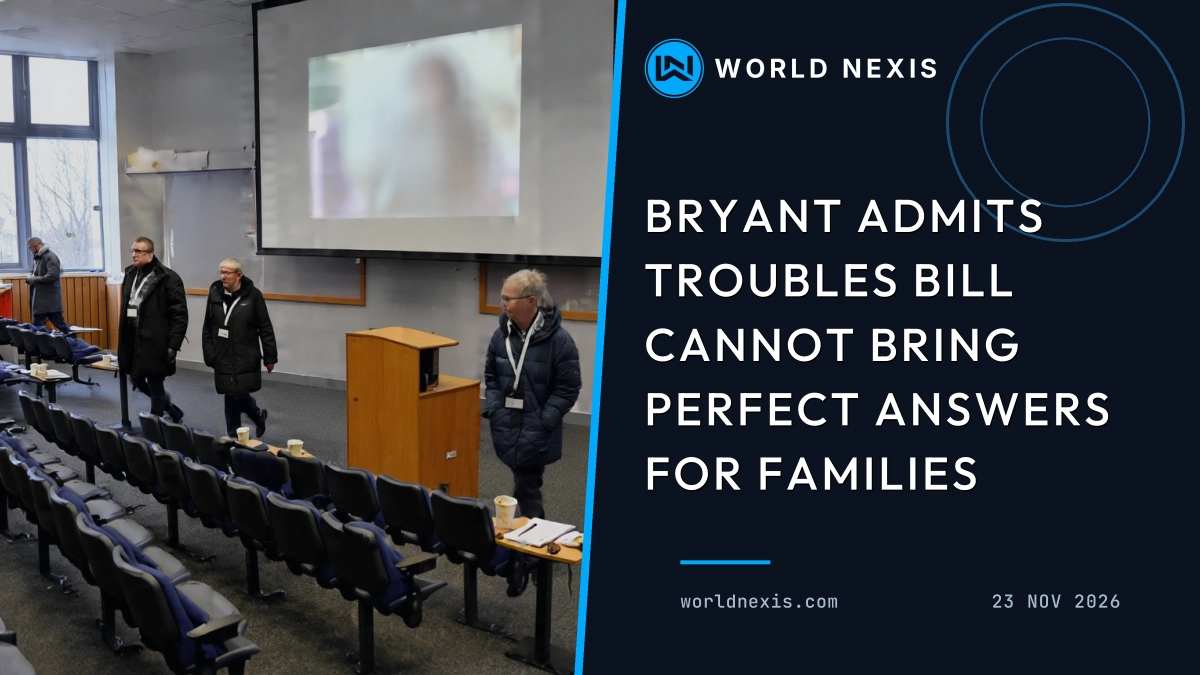
The Troubles Bill will not deliver “perfect answers” to families bereaved during the Northern Ireland conflict, the Secretary of State has said, as the legislation continues its passage through the House of Lords. Sir Chris Bryant told the first day of a conference at Queen’s University, Belfast on Monday that the draft law must be human rights compliant and must give relatives a real account of what happened to their loved ones.
Speaking in a video message, he described the previous government’s Legacy Act as “fatally flawed”. He also warned that the replacement legislation cannot promise certainty in every case, because the evidence does not always exist.
Key points
- Sir Chris Bryant said the Troubles Bill will not provide “perfect answers” for bereaved families.
- He called the Legacy Act “fatally flawed” and pledged that its replacement will be human rights compliant.
- The draft law is being considered in the House of Lords.
- It emerged last week that the Bill contains a clause requiring consent from the Advocate General for Northern Ireland or the Attorney General for England and Wales before indictable-only Troubles-related crimes can be prosecuted.
What the Northern Ireland Secretary said about the Troubles Bill
Sir Chris drew on his time working in Argentina with people who had suffered as a result of past events there. He said he has since met people in Northern Ireland with similarly painful experiences, including one person who described going to Marks & Spencer and seeing the person who killed their father.
“That’s why I think it’s so important in a society like ours, just as it was in Argentina and so many other countries as well, that families are able to get answers about what actually happened,” he said. Without those answers, he argued, the damage is carried from generation to generation.
Turning to the British Army and its veterans, he rejected the idea that the institution is best defended by shielding it from scrutiny. “I want to make it absolutely clear that you don’t defend the British Army by defending the indefensible – that just doesn’t make any kind of sense at all,” he said.
He said the Bill is not primarily about veterans but about families, while noting that veterans’ families also want answers because their loved ones were killed by paramilitaries. The vast majority of people killed during the Troubles were killed by paramilitaries, he added.
He then set out the limits of what the Troubles Bill can achieve, and did so without softening the message. “There won’t be perfect answers,” he said, warning that there “may be large lacunas of lack of evidence”. In some cases, he accepted, the Legacy Commission will have to tell a family it has gone as far as it can.
Even so, he insisted the process being assembled is human rights compliant and will produce answers. “I don’t think we end up with a reconciled society in Northern Ireland or, for that matter, across the island of Ireland unless we get answers,” he said.
The consent clause at the centre of the Troubles Bill debate
Attention has focused on a clause, which emerged last week, that would prevent indictable-only Troubles-related crimes being prosecuted unless the Advocate General for Northern Ireland or the Attorney General for England and Wales has given consent.
Sir Chris defended the arrangement by describing the test law officers already apply. The first question is whether a prosecution is in the public interest, and the second is whether there is more than a 50% chance of a successful prosecution.
“I’m very confident that this does not breach our human rights obligations and is entirely human rights compliant.”
He argued that consistency matters because most cases happened in Northern Ireland but some happened in Great Britain. Under the Troubles Bill, the final decision would sit with the Attorney General after consideration by the Director of Public Prosecutions in Northern Ireland, or in England and Wales.
Why it matters
For bereaved families, the question is not constitutional theory but whether they ever learn what happened. A process that admits its limits may still serve them better than one that promises closure and cannot deliver it.
For everyone else in Northern Ireland, the stakes are about trust in the bodies handling the past. Because the Troubles Bill moves the last word on some prosecutions to a law officer, relatives will judge the whole system by how that power is used.
Analysis
Having covered Northern Ireland and devolution for World Nexis News, I look first at where discretion actually sits in any legacy mechanism. On families, Sir Chris is on solid ground. Honesty about evidence gaps is better than another round of promises that cannot be kept, and he is right that the Troubles Bill’s central purpose is answers for relatives rather than reputational protection for any institution.
The consent clause is where I part company with the government’s framing. I think requiring the Attorney General to sign off before an indictable-only Troubles-related case can proceed hands a political office a judgement that families will inevitably read as political, however carefully the public interest and 50% tests are applied. The strongest counter-argument is consistency: without a single gatekeeper, similar cases could be handled differently in Northern Ireland and in Great Britain. That is a genuine problem, but it is a problem of how prosecutions are organised, not a reason to place the final word with a minister’s law officer.
My view, then, is that the prosecution decision should stay with prosecutors, subject to published guidance that families can scrutinise themselves. Sir Chris’s assurance that the Troubles Bill is human rights compliant is clearly sincere, but if the clause survives unchanged I expect it to be tested in court rather than settled in the Lords.
What happens next
The Troubles Bill remains under consideration in the House of Lords, where peers continue their scrutiny of the draft law. Sir Chris used the Belfast conference to set out the government’s case, and his remarks suggest ministers intend to defend the consent clause rather than drop it.
What we don’t know yet
No date has been given for the next substantive stage of the Bill, and it is not clear whether peers will try to amend the consent clause. Nor is it known how the Legacy Commission will handle cases where evidence gaps leave a family without the answer it sought.
Related coverage
- Chris Bryant refuses to apologise for jokes as NI Secretary
- Stormont budget: O’Neill seeks PM crisis talks on £1.5bn
- Ian Huntley murder trial: ‘cold-blooded’ attack planned
Further reading
- ‘No perfect answers’ in Government’s Troubles Bill, says Sir Chris Bryant
- ‘No perfect answers’ in Government’s Troubles Bill, says Sir Chris Bryant
About the author: Liam O’Connor is the UK Politics Reporter at World Nexis News (WNN), covering uk politics. The analysis section reflects the writer’s view.

Liam O'Connor
Liam O'Connor is UK Politics Reporter at World Nexis News, covering Westminster, devolved politics and the issues that matter to voters across England, Scotland, Wales and Northern Ireland. Based in London, he reports from primary sources — Hansard, official statements, published data — and explains…



