Measles elimination status lost after record 5,400 cases
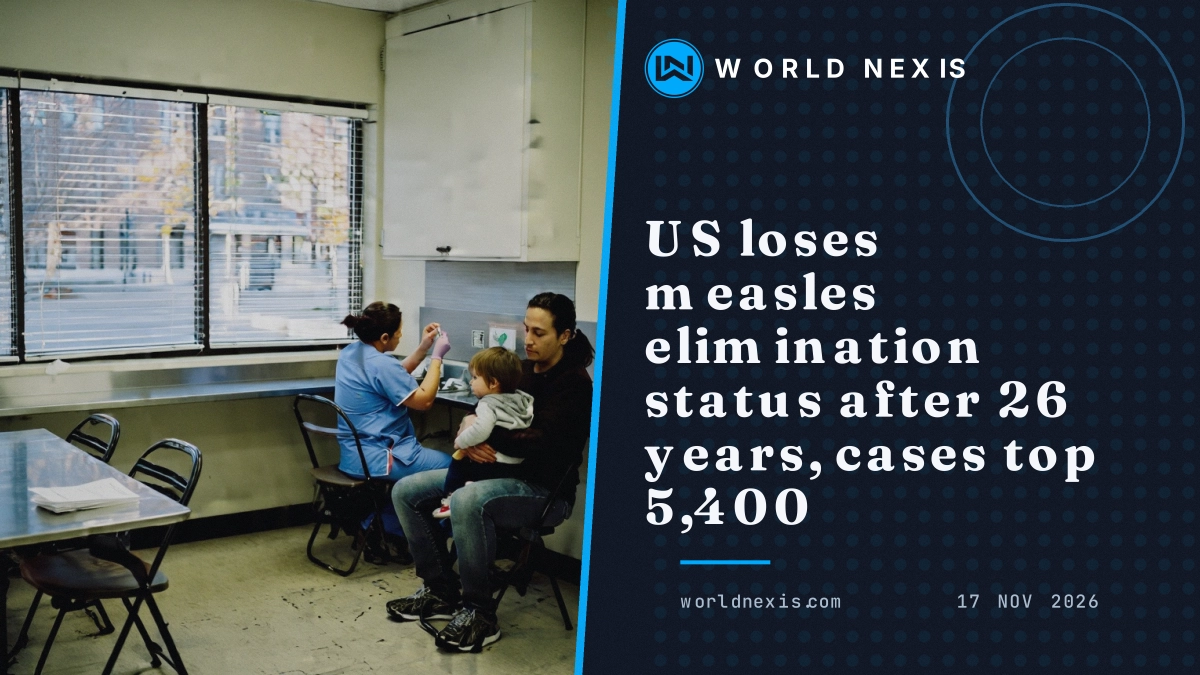
The US has lost its measles elimination status after 26 years, with more than 5,400 cases and mounting deaths. PAHO revoked the designation on Tuesday.
Updated 18 Nov 2026, 21:01 (UK time): Pennsylvania confirmed its eighth measles-related death this year and reported 1,589 cases across 46 counties, while Reuters highlighted a state-federal death count discrepancy.
Pennsylvania’s Department of Health confirmed the state’s eighth measles-related death this year on Wednesday, Reuters reported. The patient was an unvaccinated resident of Clinton County who had tested positive for measles, the agency said.
The state has now recorded 1,589 confirmed measles cases across 46 counties in 2026, with 315 hospitalizations and about 32% of cases in people under 18, according to state health department data cited by Reuters. Three deaths were in Lancaster County, two in Jefferson and one each in Clinton, Mifflin and Montour counties.
The new state figure sits alongside a separate federal count: the CDC confirmed six measles-related deaths nationally last week, Reuters reported. The outlet said the gap arose after the CDC, under Health Secretary Robert F. Kennedy Jr., began using National Center for Health Statistics mortality data instead of state figures. Immunologist Frederic Bertley told Reuters the discrepancy risks confusing the public, obscuring the severity of the outbreak and fueling skepticism about government tracking.
My take: a state health department putting a precise local death count on the record is a real development, and the state-federal gap is now part of the story rather than a footnote.
The United States has lost its measles elimination status after 26 years, the Pan American Health Organization announced on Tuesday, following more than 5,400 cases and multiple deaths in 2026.
PAHO, the World Health Organization’s regional office for the Americas, said the same strain of the virus has now spread without interruption inside the country for more than 12 months. Mexico and Bolivia lost the designation on the same day.
Key points
- The US first eliminated measles in 2000. PAHO revoked its measles elimination status on Tuesday after a year of uninterrupted transmission.
- The Centers for Disease Control and Prevention has counted 5,412 cases this year, more than double the 2,242 recorded in 2025.
- Health Secretary Robert F Kennedy Jr says he still recommends the MMR vaccine and has pledged to win the designation back.
- Mexico and Bolivia lost measles elimination status too. Canada lost its own designation last year.
How the US lost its measles elimination status
A country holds the designation only while it records no locally transmitted infections or outbreaks lasting 12 months or longer, according to the WHO definition cited by CBS News. The US met that standard from 2000 until this year.
Dr Jarbas Barbosa, PAHO’s director, told a news conference the figures were “a serious warning for our region”. “Measles is resurging globally amid persistent gaps in vaccination,” he said.
The Guardian reported that this is now the worst US measles outbreak since 1991. Accounts of the death toll differ: the BBC put it at 10, the Guardian at eight, and CBS News at no fewer than six, with some states reporting additional fatalities.
CBS News also reported more than 590 hospitalizations. About a third of this year’s cases are tied to outbreaks that began in 2025 and kept spreading into 2026.
Washington’s response under scrutiny
Kennedy, a longtime vaccine skeptic, has pushed sweeping changes to US vaccine recommendations and policies, the BBC reported. He has argued that cases were already climbing before he took the helm at the Department of Health and Human Services, and that neighboring countries saw more infections too.
In a post on X late on Tuesday, he wrote that officials “will stop measles outbreaks, protect American families, and work to regain U.S. measles elimination status”. He added: “I continue to recommend MMR vaccination as the most effective way to prevent measles.”
The Guardian reported that President Donald Trump called for the MMR combination shot to be split into separate vaccines, arguing without evidence that “together, there could be a possibility they’re quite lethal”.
Dr Annie Andrews, a Democratic senator-elect, said: “As a pediatrician, I saw firsthand how decisions made in Washington hurt our children and families.” Newsweek reported that former New York mayor Michael Bloomberg also assailed the administration’s handling of the crisis.
Epidemiologists quoted by the Guardian called Kennedy’s work at the health department “malpractice” and likened it to a “crime scene”. CDC Director Erica Schwartz countered that the label itself never protected anyone. “Vaccination does,” she said, noting $100 million invested in state and local health departments.
Why vaccination gaps matter
Measles is among the most contagious viruses known to medicine and needs about 95% community vaccination coverage to prevent outbreaks. Two MMR doses are 97% effective, and US guidance recommends them for children aged one to six.
Coverage has slipped in pockets of the country after pandemic-era disruption and years of misinformation, the Guardian reported. The virus can cause encephalitis and immune amnesia, which resets the immune system.
Barbosa praised the US for stronger surveillance, faster case detection and targeted vaccination drives. He described misinformation’s role in transmission as “dynamic” and urged health departments to tailor campaigns to undervaccinated communities.
Noel Brewer, a behavioral scientist at the University of North Carolina at Chapel Hill who contributed to the scientific work behind the ruling, cautioned against pinning the outbreak on one administration. “There is a profound problem with measles in all three North American countries,” he said.
The setback is not confined to the Americas. The UK, Spain and Austria lost their measles-free status earlier this year, along with Russia, Azerbaijan and Uzbekistan, the BBC reported.
Analysis
Having covered vaccination coverage and patient safety on this beat, I look first at the trend line rather than the single announcement. On the evidence, the critics have the stronger case. Coverage slid for years, warnings from the top were contradictory, and the loss of measles elimination status follows from both.
The clearest illustration is the suggestion to split the MMR shot into three separate jabs. No study supports it, and in the middle of an outbreak it invites parents to delay protection. Schwartz is right that a bureaucratic label never stopped a virus, yet that logic cuts both ways, because a virus does not erase a 26-year achievement on its own.
The fairest counter-argument, and one I take seriously, is Brewer’s: measles was already resurging across North America and misinformation long predates this administration. Kennedy inherited a weakening system. Still, inherited problems are judged by what a secretary does with them, and here the messaging made a difficult job harder.
What happens next
PAHO said the countries that lost the designation must submit corrective action plans setting out how they will raise vaccination rates, according to Daniel Salas, its executive manager of immunizations.
The CDC said it would encourage MMR vaccination, expand access and help communities close gaps in protection. Kennedy said officials would work with trusted health care providers and community leaders.
Canada offers a regional example: it lost measles elimination status last year but has made strides this year in interrupting transmission, Barbosa said.
Related coverage
- Measles elimination status lost as US cases top 5,400
- Grammy nominations 2027: Raye leads with record 11 nods
- AAA Thanksgiving travel dips to 81.5 million on record fuel
Sources
- US loses measles elimination status after 26 years amid record case numbers (bbc.co.uk)
- US loses measles elimination status amid worst outbreak since 1991 (theguardian.com)
- The U.S. has lost measles elimination status. Here (cbsnews.com)
- US officially loses measles elimination status, PAHO says (abcnews.com)
- As measles cases mount, new report highlights safety of early vaccination for infants (umn.edu)
About the author: Sofia Alvarez is World Nexis News’s Health & Medicine Reporter, covering health & medicine. The analysis section reflects the writer’s view.

Sofia Alvarez
Sofia Alvarez is Health & Medicine Reporter at World Nexis News, covering public health, clinical research, mental health and the policy decisions that shape care. Based in Manchester, she prioritises evidence over anecdote, checks claims against peer-reviewed research and official guidance, and explains uncertainty plainly…