Iowa lead azide blast cleared as Rob Sand declines sign-off
The Eighth Circuit has cleared the Iowa lead azide detonation, but governor-elect Rob Sand declined to sign off, leaving the Middletown blast in doubt.
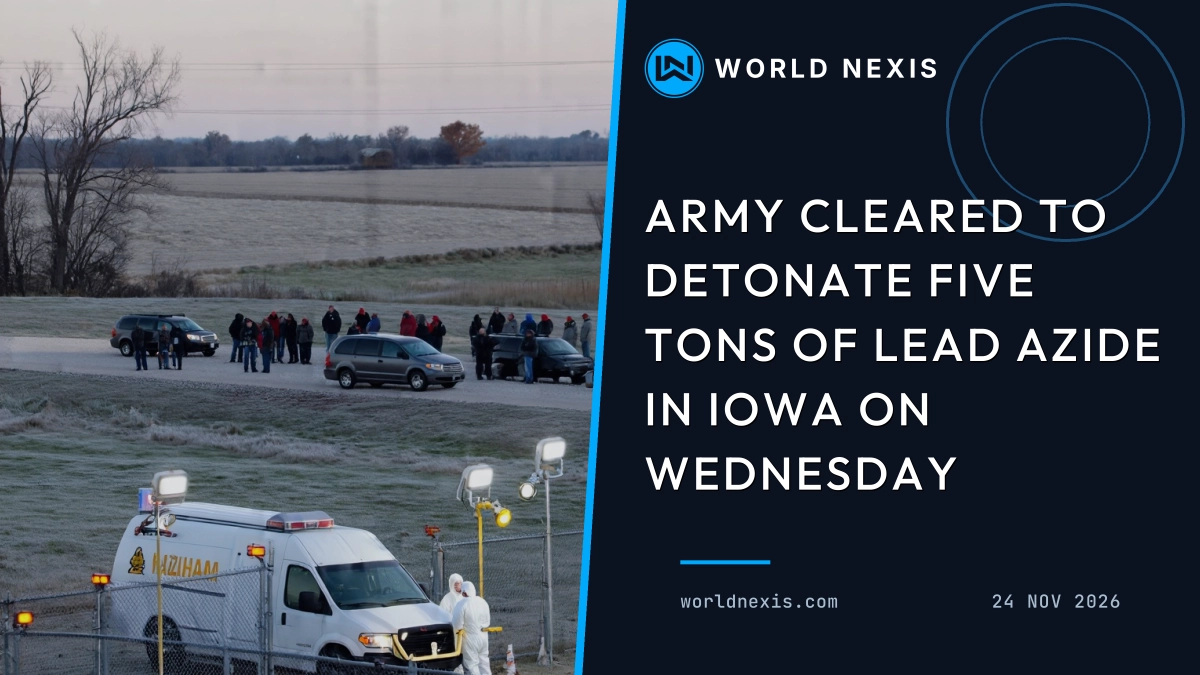
The Iowa lead azide detonation at the Iowa Army Ammunition Plant in Middletown is legally cleared for Wednesday. A federal appeals court refused an emergency bid to block it on Monday. But governor-elect Rob Sand has declined to sign off, leaving the destruction of five tons of degraded explosive in limbo.
Key points
- The Eighth Circuit Court of Appeals denied an emergency request from the Iowa Environmental Council and the Sierra Club on Monday, lifting the pause it imposed last week.
- President Donald Trump says the military will not go ahead unless both the court and Sand agree to the operation.
- Sand declined to approve or reject the blast and asked the federal government to publish the briefing he was given.
- The Army now plans to destroy five tons of unstable lead azide at Middletown on Wednesday.
Why the Iowa lead azide stockpile cannot simply be moved
The Army’s environmental assessment says the material was found in March 2026 during a proactive safety review. Lead azide is a highly sensitive primary explosive used in munitions detonators. Over time it had degraded and crystallized, turning a production component into unserviceable hazardous waste.
In that state the compound becomes extremely sensitive to shock and friction, the assessment says. As a result it cannot be moved safely to standard demolition facilities off site. A controlled detonation where it sits became the Army’s chosen route.
Timing is the second factor in the Iowa lead azide case. The Justice Department told the court that temperatures are expected to fall below 30F (-1C) within days. Freezing conditions make the crystals easier to break, which raises the risk of an explosion nobody chose.
Inside the Iowa lead azide court fight
The two groups sued on Thursday and won a temporary pause. Even so, the Justice Department told the court the Army intended to proceed, citing an immediate risk that the material could explode on its own. The groups say the government is skirting the judicial process.
Trump had already ordered the military to hold off until the Eighth Circuit agreed. In the same post he made the decision “fully subject to the incoming Governor Elect, Rob Sand, agreeing to the operation”. He warned he would hold Sand responsible for “any and all death or destruction” if either refused.
Hours later the appeals court denied the emergency request. It framed the case around two possible outcomes rather than three.
“Here we are faced with a situation in which the risk is between a controlled detonation and an unplanned explosion, not between the risk of a controlled detonation and no explosion at all,” the court said.
Sand answered on Monday evening, neither approving nor rejecting the plan. He wrote that the administration should decide using the advice of the people it sent to Middletown weeks ago.
“Everyday Iowans are entitled to know how Middletown came to this situation, and learn why the administration believes this is the best path forward,” he wrote.
The schedule has slipped repeatedly. The blast was first set for Friday and has since moved to Wednesday, to allow better weather and time to put mitigation measures in place. Middletown’s mayor, Rodney Johnson, said in a statement that the operation “must take place” and that “every possible precaution” had been put in place.
What nearby residents were told about the Iowa lead azide plume
An Army advisory says extensive modeling predicts lead particle levels in the air may be elevated. It adds that those levels should stay well below the threshold at which the EPA would require protective action. The Middletown detonation will still send a plume containing lead particles over the surrounding area.
The EPA says no level of lead exposure is considered safe. Inhaled or ingested lead carries serious health risks for people and animals, particularly children.
Earthjustice attorney Thien Chau said the Army seemed “more concerned over the weekend with finding a way to sidestep the judicial process than on meeting the public’s demands for greater transparency, notice to affected communities, and far stronger protection of people, property, and the environment from serious harm”.
Why it matters
For households around Middletown, the practical question is exposure. The plan is designed to stop a decaying stockpile going off on its own, but it puts lead into the air near homes, schools and farmland that never asked for the risk.
The wider test is institutional. A president, a federal agency, a court and an incoming state governor are now jointly responsible for one decision. The Iowa Army Ammunition Plant blast will be judged on how much of that reasoning the public is allowed to see.
Analysis
Having covered environmental enforcement for World Nexis News, I look first at whether an agency has documented the risk it is asking people to accept. Here the record is thinner than the stakes. The modeling exists, but the public has seen the summary, not the workings.
I think the Eighth Circuit got the Iowa lead azide question right. The realistic choice is a controlled detonation against an unplanned one, and an unstable compound sitting through a cold snap is clearly the worse outcome. Sand’s refusal to sign is understandable, but it does not create a third option. My strongest reservation is that “well below” a protective threshold is a promise nobody outside the Army has been able to check, and the EPA’s view that no lead exposure is safe makes it harder to accept. The counter-argument is real: a state should not be asked to bless a plume it never approved, which is exactly why the briefing should be published.
What I will watch is the monitoring, not the politics. If readings around Middletown come back low and stay low, the Army’s case improves considerably. If they do not, the decision to press ahead quickly will look less like competence and more like convenience.
What happens next
The plan remains to destroy the material on Wednesday, at what the Army calls the latest possible moment before the forecast temperature drop. Trump’s condition means the operation now depends on whether the Army treats the court ruling alone as sufficient authority.
Sand has asked for the federal briefing to be released as soon as possible. Air monitoring results from the plume, and readings from surrounding communities, are the numbers to watch once the Iowa lead azide detonation is over.
What we don’t know yet
It is not clear whether the Army will wait for Sand’s agreement or proceed on the court’s clearance. It is also unclear how quickly the briefing will be published, and what the monitoring will show.
Related coverage
- Lead azide detonation in Iowa pushed to Wednesday
- Fit to Lead report: 71% of Australian MPs harmed by job
- Iowa detonation: Trump orders Army to wait for court approval
Further reading
- Trump orders Army not to detonate explosives in Iowa without court approval
- Federal appeals court clears Army to detonate volatile Iowa explosives as Dem gov-elect refuses to sign off
About the author: Hannah Lindqvist is the Climate & Environment Reporter at World Nexis News (WNN), covering climate & environment. The analysis section reflects the writer’s view.

Hannah Lindqvist
Hannah Lindqvist is Climate & Environment Reporter at World Nexis News, based in London. She covers climate policy, extreme weather, the energy transition, conservation and climate finance, grounding stories in scientific research, official data and documented commitments rather than slogans. She is interested in how…