Iowa detonation: Trump orders Army to wait for court approval
The Iowa detonation of 68 drums of unstable lead azide is set for Tuesday, as the Army says it will bypass a federal court pause on safety grounds.
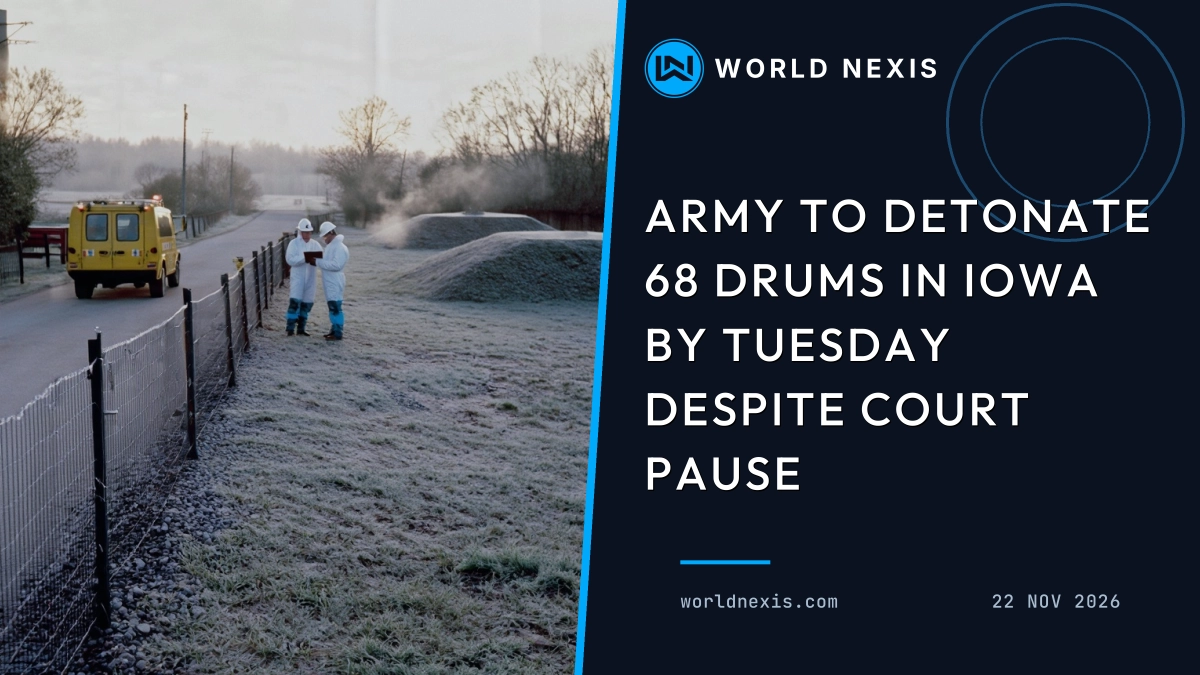
Updated 23 Nov 2026, 21:50 (UK time): President Trump ordered the Army to hold the Iowa detonation until it obtains court approval, putting the newly announced Wednesday date on hold.
President Trump said on Monday that he has ordered the Army not to carry out the Iowa detonation of 68 drums of unstable lead azide until it secures court approval, putting the Wednesday date on hold barely a day after the service named it.
Trump said he will wait for the courts and for Iowa Governor-elect Rob Sand to agree with the Army’s plan. That hands the decision back to the judges who paused the operation on Friday at the request of the Iowa Environmental Council and the Sierra Club, and it undercuts the Army’s position that it can proceed under an emergency munitions exclusion to its EPA permit.
What changes for households downwind is that they again have no named day, only a standoff. The Army’s filing had warned that temperatures falling below 30F (-1C) make an unplanned explosion more likely and said the bunker doors were already off. Nothing in the order addresses the hour, the evacuation map or the notice residents say they never received.
I have been asking for the hour and the map since Friday, and a pause is not a plan. If the material really is as unstable as the filings claim, a court calendar is an odd place to store it.
Updated 23 Nov 2026, 17:41 (UK time): The Army has pushed the Iowa detonation from on-or-by Tuesday to Wednesday, announcing the new date publicly on Sunday night and citing “optimal weather conditions” and time to put mitigation measures in place.
The Army has moved the Iowa detonation of 68 drums of unstable lead azide to Wednesday, announcing the date in a Sunday night social media post. It said the extra day allows for “optimal weather conditions and all mitigation measures to be emplaced.” The government’s court filing a day earlier had promised to act on or by Tuesday.
This is the first timetable the public has been given since the 8th US Circuit Court of Appeals paused the operation indefinitely on Friday. The Army maintains it does not need to follow that pause because of the risk that the degraded material goes off on its own, and it is relying on an emergency munitions exclusion to its EPA permit.
The service has not explained what changed in the forecast to make Wednesday safer. Its own filing warned that temperatures dropping below 30F (-1C) would crack the crystals in the waste. The Iowa Environmental Council and the Sierra Club answered on Sunday with a motion to submit more evidence, including three expert and local government declarations that challenge the Army’s risk assessment and question the notice given to residents. Their lawyers argue “this emergency is of the Army’s own making.”
The revised date does one useful thing: households downwind now have a named day instead of a deadline. What is still absent is the hour and the evacuation map.
Residents around the Iowa Army Ammunition Plant in Middletown should expect the Iowa detonation of 68 drums of unstable lead azide on or by Tuesday 24 November, after the Department of the Army told a federal court it will act despite an indefinite pause. The filing landed late on Saturday, a day after a federal appeals court halted the operation, and it sets up a direct collision between a live safety hazard and the judges weighing it.
Key points
- The Army intends to carry out the Iowa detonation of 68 drums of degraded lead azide on or by Tuesday.
- A federal appeals court paused the operation indefinitely on Friday after two environmental groups sued.
- The Army says it will use an emergency exemption to the Environmental Protection Agency permit that covers the blast.
- Temperatures are forecast to fall below 30F (-1C), which the government says raises the risk of the material going off by itself.
The Army’s case for a controlled blast
Government lawyers argue that leaving the material where it sits is now more dangerous than destroying it in place. Lead azide is a highly volatile compound used to trigger explosions, and the stores at Middletown have degraded and begun to recrystallize. The Iowa detonation would eliminate material that officials judge too risky to move.
The Saturday filing warns that temperatures are set to drop below 30F (-1C) within days. It also notes that the Army has already removed the doors from the bunker holding the barrels, which leaves the waste more exposed to temperature swings that can crack its crystals.
In the government’s words, a controlled detonation is “by far safer than an uncontrolled explosion”. The Army adds that it will apply the permit’s mitigation measures even if those measures no longer bind it legally.
“To protect its personnel and the surrounding communities, the Army needs to take swift action,” the Justice Department told the court. “Protection of human health and the environment demand action now, not delay.”
Why the Iowa detonation is being pushed through
The pause was granted on Friday, after the Iowa Environmental Council and the Sierra Club sued to stop the blast. The Army’s answer is procedural. It says the emergency exemption attached to its permit allows it to act on public safety grounds without waiting for the litigation to finish.
The mechanism is an emergency munitions and explosives exclusion, a carve-out that sidesteps the ordinary terms of the agency permit. In effect, the service is telling the court that the risk of an unplanned blast outweighs the court’s own hold.
The EPA issued the emergency permit for the 68 drums after concluding the danger “presented an imminent and substantial threat to human health and the environment”. No timetable has been published for the rescheduled Iowa detonation.
Officials had been planning the operation since March, when the recrystallization was identified. On Friday the military said it was working with the Department of Health and Human Services and the EPA, and that agencies were “prepared to take the most extreme mitigation measures available” to keep the public safe.
What residents were told
Two controlled explosions were originally scheduled for Friday 20 November, before the court stepped in. Households inside the affected zone were earlier advised to leave home for six hours, with an advisory warning “all humans” to stay out of the area while dust from the blast settled.
Why it matters
Lead is the issue for households in the corridor. Court records warn of lead particles spreading in a dust plume across parts of Iowa and Illinois, and the Environmental Council says there is no safe level of lead exposure.
“There is no safe level of lead exposure, and Iowans were given just days to prepare for the November 20 detonation,” the Iowa Environmental Council said.
Beyond the immediate health question, the case tests how far an emergency exemption can carry a federal agency past a court order. If the Army’s reading holds, a pause granted by judges can be undone by the executive branch’s own assessment of danger, a template other agencies may study closely.
Analysis
Having covered emergency response and court filings for World Nexis News, I look first at what people were actually told. On that test the Army’s record is weak. Pulling the bunker doors before the legal fight was settled, and giving households a matter of days to plan around a possible lead plume, is exactly how a technical decision becomes a public trust problem.
On the substance, though, I think the government’s safety argument is the stronger of the two. Degrading lead azide that cannot safely be moved is a genuine hazard, cold weather will not make it more stable, and nobody wants to explain afterwards why a controlled blast was postponed until an uncontrolled one happened. The environmental groups are right that delay carries less risk than the Army claims, but less risk is not no risk.
My real worry is the precedent rather than the physics. An emergency carve-out that lets an agency proceed through a live court pause, justified by its own experts, is a wide door. The counter-argument is fair: judges should not second-guess bomb disposal in real time, and courts can review afterwards. Even so, the Army should have published a detonation window and a clear evacuation map before Tuesday, because transparency here costs little and buys a great deal.
What happens next
The Iowa Environmental Council and the Sierra Club filed a fresh motion on Sunday asking the court to let them submit more evidence before anything is detonated. Their filing includes declarations from environmental experts and local officials who question the Army’s risk assessment and the notice given to residents.
“The Army seemed more concerned over the weekend with finding a way to sidestep the judicial process than on meeting the public’s demands for greater transparency, notice to affected communities, and far stronger protection of people, property, and the environment from serious harm,” said Earthjustice attorney Thien Chau.
The Army’s own deadline is Tuesday 24 November. After that, the cold-weather argument underpinning the emergency exemption weakens by the day.
What we don’t know yet
No detonation time has been published, and it is unclear whether households will again be asked to leave. It is also unclear whether the appeals court will rule on the Sunday motion before Tuesday, or whether the Army’s exemption simply makes the pause moot.
Related coverage
- Lead azide detonation in Iowa set for November 24 deadline
- California king tides: urgent flood warning for Thanksgiving
- East Lothian car theft: urgent appeal after woman, 44, hurt
Further reading
- US Army to detonate tonnes of unstable explosives in Iowa despite court order
- U.S. Army plans to carry out detonation at Iowa plant despite indefinite pause, court records say
About the author: Tariq Al-Mansoori is the Breaking News Reporter at World Nexis News (WNN), covering breaking news. The analysis section reflects the writer’s view.

Tariq Al-Mansoori
Tariq Al-Mansoori is a Breaking News Reporter at World Nexis News, covering major incidents, official statements and developing stories across the UK, US and internationally. Based in London, he works to confirm details before publication, attributes information to named sources where possible and updates stories…



