COP31 collapse: longest UN climate talks fail on 1.5C pledge
The COP31 collapse in Antalya leaves the 1.5C target unprotected after the longest UN climate talks in history ended without a deal on fossil fuels.
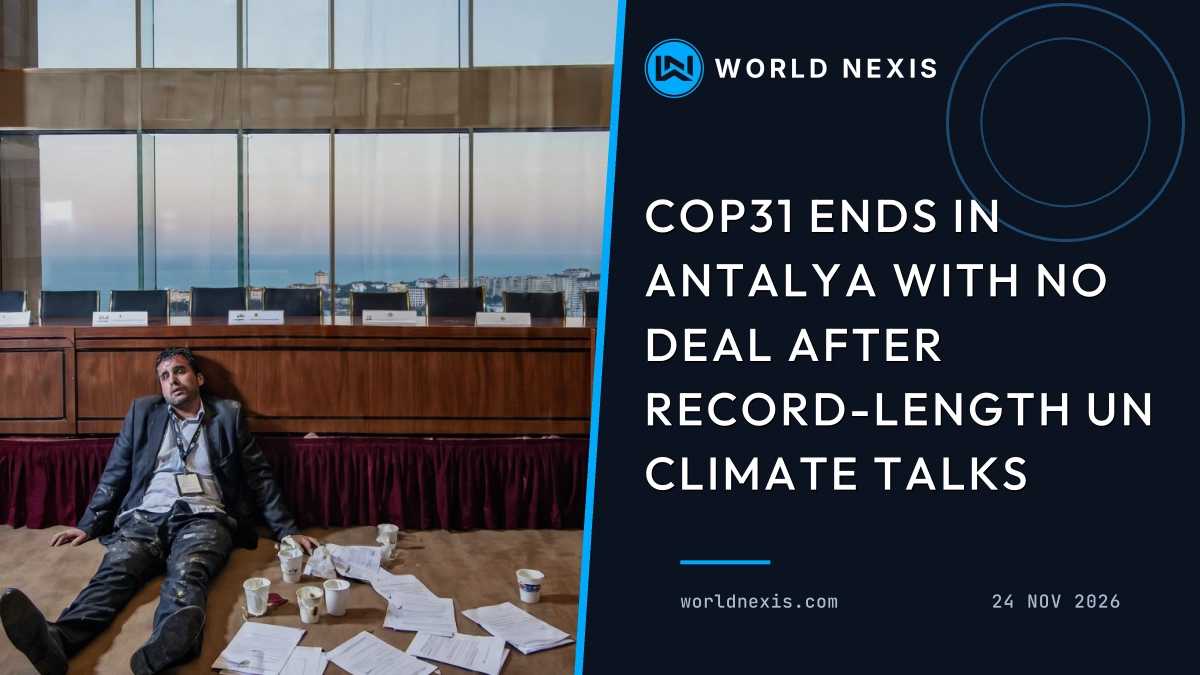
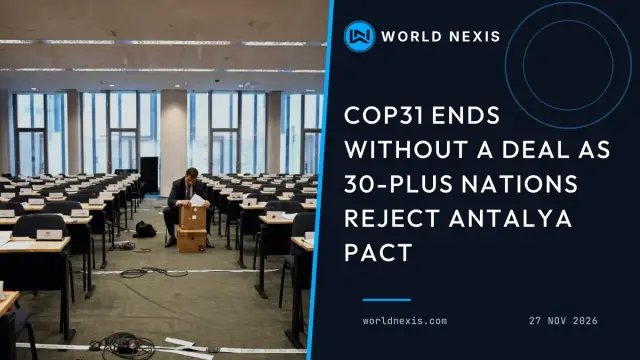
The COP31 collapse in Antalya has left the Paris Agreement’s 1.5C guardrail without a fresh negotiated commitment, after the longest-running UN climate summit in history closed without the central political deal its Australian and Turkish hosts had promised. Negotiators were tasked with agreeing the Antalya Pacts, a package meant to speed up climate action this decade. Instead the summit ended in walkouts on its final day over the absence of any mention of fossil fuels and over money.
Key points
- Australia and Turkey jointly led the talks, which ran longer than any previous UN climate summit and still produced no agreement.
- Countries walked out of the closing session over fossil fuel language and over finance, sinking the Antalya Pacts.
- Warming is now expected to overshoot 1.5C, the threshold countries agreed to pursue under the Paris Agreement in 2015.
- Rich nations failed to put a figure on extra adaptation money, despite an existing pledge to triple climate finance from $40bn by 2035.
How the Antalya talks fell apart
The Antalya climate summit was the first since the UN projected that global temperatures will push past 1.5C above pre-industrial levels, the line countries promised not to cross in Paris. An early draft of the agreement was ready to concede that action so far has missed that most important of targets. That concession turned out to be the easy part.
On the core text, delegates could not bridge their differences over fossil fuels, even though the same pledge had been made only three years earlier at COP28 in Dubai. Being unable to restate a promise already given raises hard questions about whether the forum can function at all as the crisis accelerates.
Geopolitics did the rest. Chris Bowen, the Australian minister who co-led the negotiations, said the summit had opened in “the most complicated and fraught geopolitical environment in living memory.” The EU’s representative, Darragh O’Brien, was blunter, saying the talks had been “hijacked by some oil states.” Russia’s delegate, Sergei Kononuchenko, switched from Russian into English to accuse the EU of giving climate finance to developing countries only in the form of loans. A US boycott added to the strain.
Money is the second fault line
Finance split the room almost as badly as fossil fuels. Rich countries went home without naming a sum for additional adaptation funding. A commitment struck last year to triple climate finance from $40bn by 2035 still stands, but what that pledge actually requires remains contested.
Why the COP31 collapse matters for the 1.5C target
Holding warming to 1.5C rather than 2C is not a rounding error. The UN’s climate science body, the IPCC, set out the gap a decade ago: sea levels 10cm higher, exposing another 10 million people to flooding; oceans turning more acidic, with irreversible damage to some marine life; and extreme heat in every inhabited part of the world.
UK Energy Secretary Miatta Fahnbulleh said the summit had at least tried to face those numbers. “This COP sought to confront hard truths – that global warming is set to overshoot 1.5C and that we must act with even more urgency to reduce emissions,” she said at the close of the talks.
The COP31 collapse removes even the minimal step of writing that overshoot into an agreed text. The draft had floated carbon dioxide removal, which pulls greenhouse gases back out of the atmosphere, in a way no COP agreement had done before. Planting trees can do some of that work within limits, while technological options remain controversial and immature. None of it survived.
Reform, national action and more heat
The COP31 collapse does not stop climate policy, but it changes where that policy is made. Experts expect the next phase to lean more heavily on individual nations and companies acting alone rather than on jointly negotiated targets, and on reform of the negotiating machinery itself. Analysts also warn that failure at this level tends to deepen climate inequality, because the countries least able to pay for adaptation are the ones most exposed.
Michael Mann, a climate scientist at the University of Pennsylvania, said the outcome was “an enormous failure,” adding that “two degrees Celsius is still too much warming of the planet.”
Not everyone is ready to write off the process. Canada’s environment minister said the result was not what Ottawa had hoped for.
Why it matters
The COP31 collapse matters most for people who cannot insure their way out of the consequences. On the IPCC’s own figures, missing 1.5C exposes 10 million more people to flooding and brings extreme heat to every inhabited region, with the poorest countries least able to fund sea walls, irrigation or cooling. Wealthier nations will feel it through heavier disaster spending and harder budget choices.
It also matters for trust. When UN climate talks fail this completely, a forum that cannot restate commitments its own members already made gives governments little reason to bring their hardest decisions to the table next time.
Analysis
Having covered climate finance and the energy transition for World Nexis News, I look first at who holds a veto, and after the COP31 collapse the answer is uncomfortable. If the EU’s reading is right and a handful of oil states hijacked the room, then the evidence supports the reform camp: consensus on every comma hands a blocking minority power it should never have had over a promise the same governments made three years ago. I side with those calling for majority votes on procedure, published national positions and a lower bar for coalitions of the willing to move first.
The strongest counter-argument is serious, and I accept part of it. Small island states and the poorest nations rely on the UN format precisely because it gives them a seat and a microphone they would lose in a patchwork of bilateral deals. That is why I would reform COP rather than walk away from it, and why the walkouts in Antalya were the right instinct even though they produced no text.
What I watch now is narrower than any communiqué: whether the disputed pledge to triple adaptation finance from $40bn is finally defined in plain numbers, and whether national plans replace summit language as the real scorecard. Heat does not wait for consensus, and neither should the countries already paying for it.
What happens next
In the aftermath of the COP31 collapse, the experts’ view is that action shifts from the negotiating hall to national capitals and boardrooms, alongside pressure to change how the talks are run. Overshooting 1.5C is now treated as close to certain rather than as a risk to be avoided, so the argument moves to how small and how short that overshoot can be kept.
What we don’t know yet
No one has set out how the Antalya Pacts could be revived, or whether the countries that walked out will return to the same table. The size of any additional adaptation money is unresolved, and the pledge to triple finance from $40bn by 2035 still has no agreed meaning.
Related coverage
- COP31 talks collapse as EU and UK reject fossil fuel deal
- COP31 talks risk collapse on day 2 as fossil fuels omitted
- Stormont budget: O’Neill seeks PM crisis talks on £1.5bn
Further reading
- Five takeaways from the failed climate talks COP31
- PBS: Panic Broadcasting Service on ‘Rapid Destabilization’ of Climate
About the author: Hannah Lindqvist is the Climate & Environment Reporter at World Nexis News (WNN), covering climate & environment. The analysis section reflects the writer’s view.

Hannah Lindqvist
Hannah Lindqvist is Climate & Environment Reporter at World Nexis News, based in London. She covers climate policy, extreme weather, the energy transition, conservation and climate finance, grounding stories in scientific research, official data and documented commitments rather than slogans. She is interested in how…