Small Business Saturday 2026: 88% of shoppers go local
Small Business Saturday falls on Nov. 28 with 88% of US shoppers planning to buy local, as 36.2m small firms battle cost and hiring pressures.
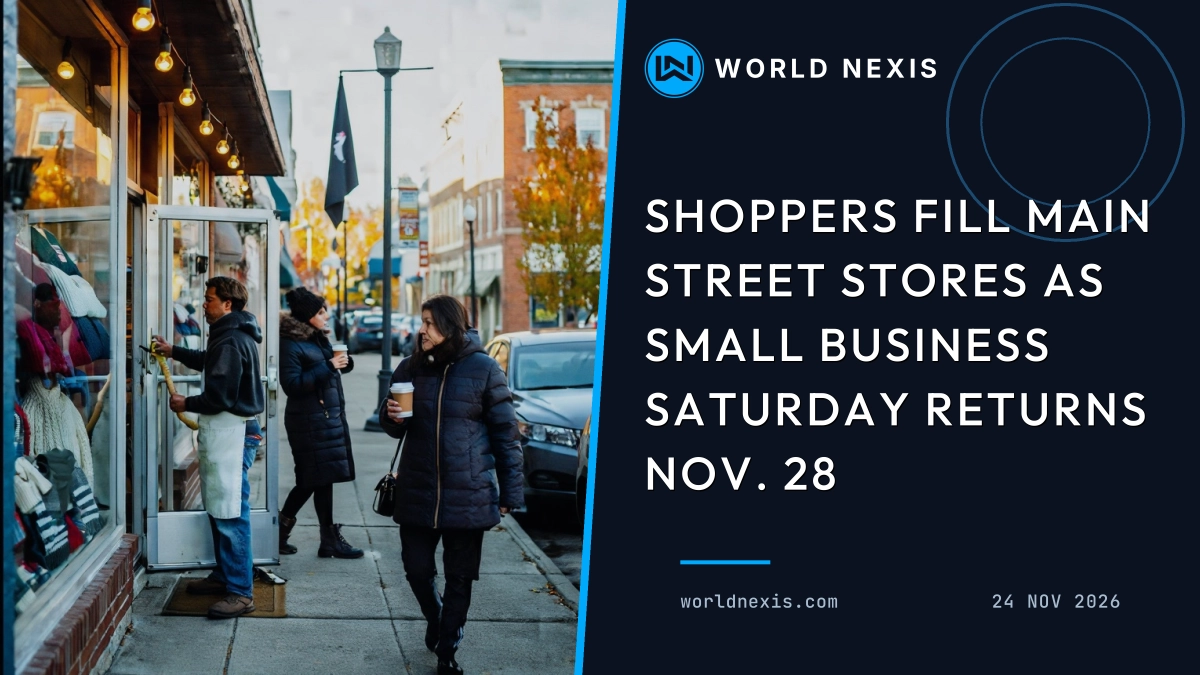
Small Business Saturday returns on Nov. 28 with 88% of American consumers saying they plan to shop at independent retailers this holiday season, the highest share since 2012, and with the country’s 36.2 million small firms hoping the day turns goodwill into revenue.
The event, created by American Express in 2010 and co-sponsored by the US Small Business Administration since 2011, sits between Black Friday and Cyber Monday. It gives independent shops a designated date to compete for attention against chains and online marketplaces at the start of the busiest spending stretch of the year.
Key points
- Small Business Saturday falls on Nov. 28, sixteen years after American Express launched the promotion.
- Small firms make up 99.9% of US businesses, employ about 46% of private-sector workers and generate more than 43% of economic output, according to the Small Business Administration.
- American Express estimates consumers spent around $18 billion at small businesses on the day last year.
- The National Federation of Independent Business says small business optimism is holding steady, but uncertainty remains historically high.
Small Business Saturday 2026: a collective voice against national noise
Danny Reynolds, owner of the clothing store Stephenson’s of Elkhart in Indiana, said he is “all in” on the day. His shop has served its community for nearly 100 years, and he has taken part since the campaign began. He now works as a “neighborhood champion”, recruiting other owners to join.
Reynolds said the date gives small businesses “a collective voice” to cut through the “national noise being made by large retailers with large advertising budgets”. He called small businesses the “backbone of all communities” and described the relationship with shoppers as mutual. “I always consider it kind of a reciprocal thing, that the community supports us and enables us to support the community,” he said.
For Reynolds, Small Business Saturday is less about discounting than about being seen. The structure behind the slogan matters too: a payments company, a federal agency and thousands of independent owners share one calendar date, while champions on the ground do the local organising that no national campaign can copy.
Brad Close, president of the National Federation of Independent Business, said it is “crucial” that the public remembers what local firms contribute. “When you look at the local baseball leagues, the drama clubs, the high school activities, the folks that are supporting those are local small business owners,” he said.
The typical NFIB member employs five to 10 people, and about a third of members are retailers, the sector most exposed to the day’s footfall. Close argued that the combined scale of the sector is routinely underestimated. “If you took it by its whole, it’s the third largest economy in the world after the U.S. economy and China,” he said, describing it as a “massive job creation machine”.
Costs, hiring and the mood on Main Street
Behind the promotional messaging, owners are dealing with the same pressures as their customers. Close described the overall health of small businesses as “decent” but said entrepreneurs are “suffering the same cost pressures” as other Americans.
Hiring is the sharper constraint. “I think there are a lot of small businesses, if you look at our survey, that will say, ‘I want to grow, and I have room to grow, but I can’t find qualified employees,’” he said.
The group’s monthly survey shows small business optimism holding steady against persistent price, labor and tax pressures, while its uncertainty reading sits at historically high levels. For an owner weighing whether to take on staff or stock deeper for spring, that gap between steady confidence and elevated doubt is what holds investment back.
The Small Business Saturday message lands against that backdrop. Independent businesses employ about 46% of private-sector workers and produce over 43% of economic output, and almost every business in the country, 99.9%, is classed as small. That is the scale the day is trying to reach.
Why it matters
For households, the shop local pitch is straightforward: buy the gift from a store on the high street rather than a warehouse or a website. The timing is pointed, because discretionary budgets are largely set by then, and a single purchase can tip a marginal week into profit for a shop with a handful of staff.
For the wider economy, the stakes run past one weekend. Nearly half of private-sector jobs sit with small employers, so their decisions on hiring, pay and investment shape national growth far more than any single retail promotion. A day that lifts confidence without easing costs changes the mood, not the arithmetic.
Analysis
Having covered retail economics and small-business finance for World Nexis News, I look first at what a single Saturday can and cannot fix. The demand signal is real: 88% of shoppers saying they will buy local is the strongest reading since 2012, and about $18 billion changing hands in one day is meaningful money for a store with eight employees. Anyone who dismisses the campaign as pure marketing is ignoring revenue that arrives on the right side of the year.
But the same owners telling the NFIB they cannot find qualified workers, and cannot absorb higher input costs, are describing problems a busy Saturday does not touch. Footfall does not train a new hire or settle a rent review. In my view, the argument that Small Business Saturday is a valuable shop window with limited structural reach fits the evidence better than the claim that it changes the trajectory of Main Street.
The counter-argument deserves a hearing: visibility compounds. A first-time customer in late November can become a regular in February, and the shared date gives independent owners a platform none of them could buy alone. That is precisely why the event has lasted 16 years. It remains a supplement to policy on credit, hiring and costs, not a replacement for it.
What happens next
Small Business Saturday runs on Nov. 28, with participating shops staging events and offers across the weekend that follows Thanksgiving. Owners will be watching whether the strong stated intent converts into sales rather than browsing.
The clearer test comes afterwards, when the NFIB publishes its next monthly survey and holiday retail sales data lands. Those figures will show whether a day of heavy footfall shifted the cost and hiring pressures that owners say are holding them back.
What we don’t know yet
Nobody can yet say how many of the 88% who say they will shop small will actually spend, or whether heavy discounting will eat into margins. The $18 billion figure for last year is an estimate based on what consumers reported, not audited sales data.
Related coverage
- Turkey pardon 2026: two birds at Willard as final vote opens
- Belfast Christmas campaign: Blue Lights star fronts 2026
- Virginia measles death: child under 5 is first of 2026
Further reading
- ‘A collective voice’: Small Business Saturday rallies holiday shoppers to keep it local
- ‘A collective voice’: Small Business Saturday rallies holiday shoppers to keep it local
About the author: Daniel Whitmore is the Business & Markets Editor at World Nexis News (WNN), covering business & markets. The analysis section reflects the writer’s view.

Daniel Whitmore
Daniel Whitmore is Business & Markets Editor at World Nexis News, based in New York. He leads coverage of companies, economies, markets and the forces that move them, from central bank decisions to corporate earnings and the cost-of-living pressures facing households on both sides of…



