AI stock selloff: Nasdaq drops 10% in worst week since 2020
The AI stock selloff wiped 10% off the Nasdaq this week, its worst since March 2020, and pushed the S&P 500 and Dow into correction. Here is what it means.
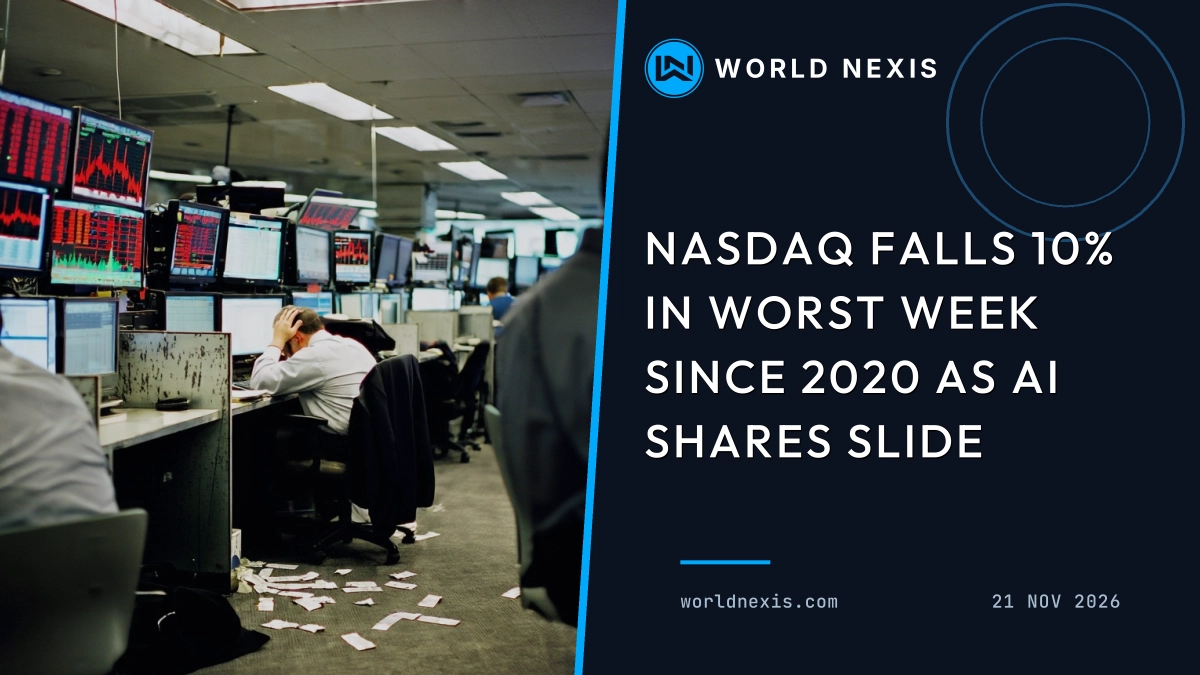
An AI stock selloff wiped 10% off the Nasdaq this week, the index’s worst five-day stretch since the pandemic shutdowns of March 2020, and dragged the S&P 500 and the Dow Jones Industrial Average into correction territory by Friday’s close. The rout landed in the same week that Anthropic, the most anticipated listing in years, began trading — a debut investors had hoped would steady the market rather than mark its peak.
Key points
- The Nasdaq fell 10% for the week, its steepest weekly decline since March 2020.
- The S&P 500 and the Dow both finished Friday in a correction, meaning they sit 10% below their recent highs.
- Anthropic rose 17% on its first day but ended the week down more than 8%, back near its IPO price.
- The Federal Reserve raised interest rates in September for the first time in more than three years, making the borrowing behind data centers more expensive.
How the AI stock selloff unfolded
AI-related shares had powered markets to record highs and helped support the wider economy. For weeks, though, investors had been circling one question: whether the trade rested on earnings that could actually be delivered. Friday answered it violently. The AI stock selloff spread beyond chipmakers into the rest of the market, and the selling accelerated into the close.
Anthropic was the clearest illustration. The company gained 17% on its debut, then slumped more than 8% to finish Friday near the price at which it listed. A flotation meant to confirm the sector’s strength instead became evidence of how quickly sentiment has turned.
Rates, politics and Nvidia
Much of the AI stock selloff traces back to September, when the Federal Reserve raised interest rates for the first time in over three years. AI companies still need to borrow billions of dollars to build the data centers that drive their growth, and higher rates make that debt dearer.
Politics has added a second pressure. Democrats took over both chambers of Congress in the midterm elections, promising a tougher regulatory approach to the AI sector and a slower build-out of data centers, which have proved unpopular with voters. Democrats also won governorships in states central to that build-out, including Texas, where Gina Hinojosa won her race.
Then there is Nvidia. Chief executive Jensen Huang resigned this month amid suspicions of an affair with a woman believed to have been spying for China, throwing the leadership of the top AI chip company into turmoil. Even so, Nvidia posted strong results this week.
Is this another dot-com bust?
AI bubble fears have revived an old argument. Some investors see a repeat of the dot-com crash of 2000, when money poured into technology companies that often had no profits and, in many cases, no revenue at all. Hank Smith, head of investment strategy at Haverford Trust, does not accept the comparison.
He argues the trade is powered by established giants such as Meta and Apple, which are not about to vanish the way so many dot-coms did. The prospects for AI, he said, are “not based on a pie in the sky.”
Smith is also skeptical of a rapid rebound. “I think it has taken the market the better part of the last two or three weeks to realize it is not going to be like the previous sell-offs,” he said, adding that AI could fall “out of favor” through next year. “It’s just going to take a little bit of time to heal,” he said of the tech market.
What remains open, in his view and in plenty of others, is whether investors will see the sizable returns they are counting on — and how deeply AI companies are now wired into one another, with Nvidia sitting at the center of many of those relationships.
Why it matters
For ordinary savers, the AI stock selloff is not an abstract story about Silicon Valley. AI shares have carried broad index funds and retirement accounts to record highs, so a sustained fall feeds straight into household wealth. It also raises the cost of the capital that pays for data centers, and that eventually shows up in investment decisions across the economy.
The Nasdaq correction also tests a political bet. Democrats campaigned on slowing data center construction, and they now inherit a market that is repricing exactly that business. If the AI stock selloff deepens, the new Congress will be judged on whether regulation steadied the sector or hastened its fall.
Analysis
Having covered market structure for World Nexis News, I look first at what actually changed this week, and the honest answer is financing costs rather than demand. September’s rate rise made the debt behind data centers more expensive, and a market that had priced AI for a world of cheap money had to adjust. That is a repricing, not a funeral.
So I side with Smith’s core argument: Meta and Apple are not dot-coms, and Nvidia’s results this week show real revenue behind the story. Where I think he is too relaxed is the interconnection risk. When one chipmaker sits inside the financing, the supply chain and the order books of so many other companies, a leadership crisis at the top becomes a system-wide event rather than a single-stock problem. The counter-argument — that returns are still unproven and the bears deserve more weight — is fair, but it explains why valuations should fall, not why the industry disappears.
The AI stock selloff has exposed something most coverage is missing: this is now a political market as much as a technology one. A new Congress promising to slow data center construction can move valuations as fast as any earnings report.
What happens next
Attention now turns to whether the AI stock selloff becomes a deeper correction. Smith expects AI shares to stay out of favor well into next year, which means the sector’s next test is whether earnings keep arriving while borrowing stays expensive. Nvidia’s leadership question also remains unresolved after Huang’s resignation.
What we don’t know yet
It is still unclear whether investors will see the returns they have been promised, and how far the ties between AI companies run through each other’s balance sheets. Nor is it settled how aggressively the new Democratic majority will pursue the data center slowdown it campaigned on.
Related coverage
- Australian shares lose $174bn in worst week since March 2020
- Stock market correction deepens as Nasdaq erases 2026 gains
- Nvidia subpoena: record 7-week slump as California probes
Further reading
- The AI boom had a really bad week — and it’s raising loud alarms
- The AI boom had a really bad week — and it’s raising loud alarms
About the author: Daniel Whitmore is the Business & Markets Editor at World Nexis News (WNN), covering business & markets. The analysis section reflects the writer’s view.

Daniel Whitmore
Daniel Whitmore is Business & Markets Editor at World Nexis News, based in New York. He leads coverage of companies, economies, markets and the forces that move them, from central bank decisions to corporate earnings and the cost-of-living pressures facing households on both sides of…



