Threatt Filling Station rescue marks Route 66’s 100 years
The Threatt Filling Station, the only known Black-owned gas station on Route 66, is being restored by the founder's grandchildren as the road turns 100.
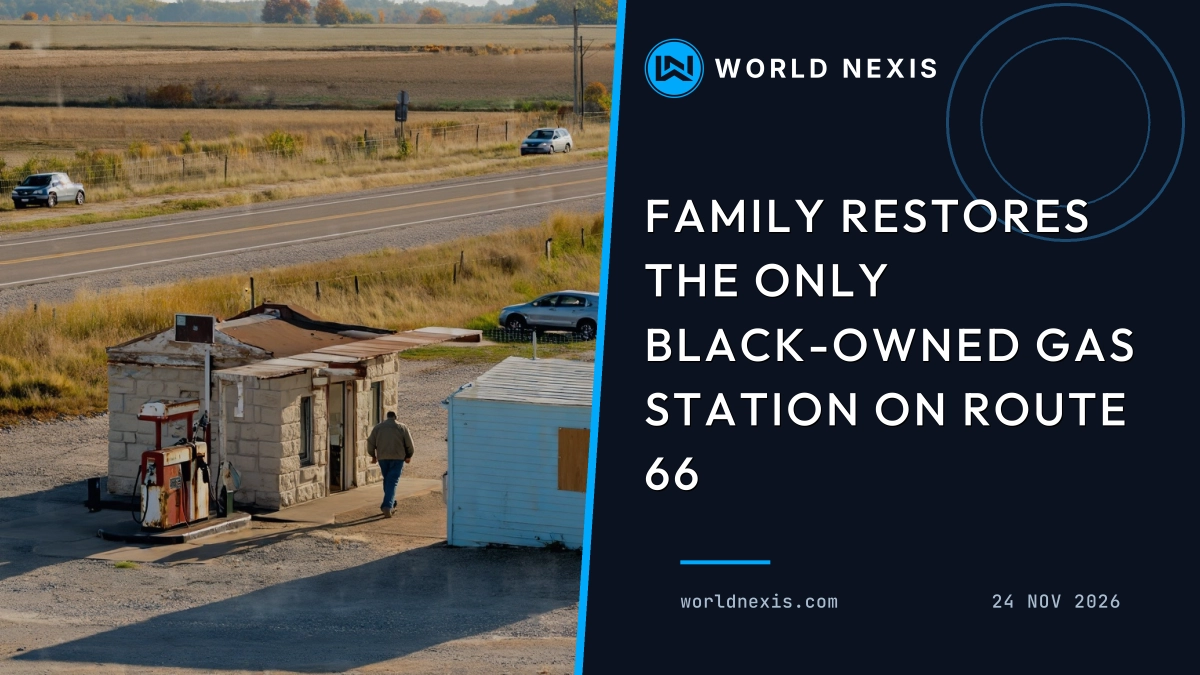
The Threatt Filling Station, the only known Black-owned and operated gas station on Route 66, is being brought back from dereliction near Luther, Oklahoma, as the highway it once served marks its 100th anniversary. Three grandchildren of its founder are leading the work, and the family still owns the station plus the 150 acres around it.
Key points
- The Threatt Filling Station sits just east of Oklahoma City, on a stretch of Route 66 where Black motorists once had almost nowhere to stop.
- Allen Threatt Sr.’s grandchildren began restoring the building several years before its 2021 listing among America’s most endangered historic places.
- The National Trust for Historic Preservation identifies it as the only known Black-owned and operated gas station on the highway.
- The blue building beside the pumps is set to house a restaurant.
Why the Threatt Filling Station mattered to Black travelers
Route 66 carried families more than 2,000 miles from Chicago to Los Angeles. In the Jim Crow era, Black travelers leaned on the Green Book to find lodging, meals and a usable bathroom, and many set out with food and spare fuel because most restaurants, filling stations and motels turned them away.
The Threatt Filling Station offered fuel, food and a bed for the night on the same patch of ground. Linda Fisher, the founder’s granddaughter, described grandparents who filled whatever gap a traveler arrived with.
“If they didn’t have any food, they fed them,” she said. “If they needed some kind of shelter or blankets or those types of things, Grandpa and Grandma made sure they got those kinds of things.”
Danger framed the route as well. Fisher said there was a “sundown town” on either side of the filling station during Jim Crow, meaning all-white communities that warned non-white people to leave before dark or face violence or police harassment. Inside the station’s grounds, she said, “everyone was welcome.”
The property did more than sell gasoline. Dances were held in the restaurant next door, social clubs met on the site, and the grounds hosted barbecues. Now and then, Negro Leagues players took the field on its baseball diamond.
From a roadside corner to the National Register
Allen Threatt Sr. left Alabama for the farming community of Luther in the early 1900s, part of the Great Migration. His father had been born into slavery, and he and his wife, Alberta, wanted a farm of their own.
Oklahoma then allowed Black migrants to buy land and build towns. Between 1865 and 1920, Black Americans settled more than 50 all-Black municipalities there, the most in any state, though many had vanished by the Great Depression.
Threatt built his first filling station in 1915, after watching cars pass a corner of his land on the old Ozark Trail. Route 66 arrived in 1926 and the traffic thickened. When fire destroyed the wooden building, he replaced it with a sandstone one shaped like a modest house.
He and Alberta raised 11 living children, and a couple of them took over the business in the 1950s. Then the Interstate Highway System, begun under the Eisenhower administration, drained the old road. By the mid-1970s the Threatt Filling Station had closed to the public.
It is now on the National Register of Historic Places. In 2021 the National Trust for Historic Preservation put it among America’s 11 Most Endangered Historic Places, by which point the building was derelict and the family’s rebuilding plan was already several years old.
The Threatt Filling Station restoration and the Route 66 centennial
The Threatt Filling Station restoration has been paid for with nonprofit grants, topped up with a great deal of work by cousins. The blue building next door to the pumps is due to become a restaurant, turning a roadside monument into somewhere travelers can eat.
The timing is not accidental. Route 66 is marking its centennial year, and the anniversary has made the old Chicago-to-Los Angeles corridor a pilgrimage route again. Small stops that survived the interstates are the ones drawing the cars.
Why it matters
A restored Threatt Filling Station is a local business, but it is also evidence. For decades the physical record of how Black Americans moved through hostile country was left to rot at the roadside, and this building is one of the few surviving pieces of it.
Practical effects follow. Heritage travelers spend money in small towns, and Route 66 traffic gives a place like Luther a reason to be visited rather than passed through. The question residents should ask is who captures that spending once the cars stop.
Analysis
Having covered accountability reporting for World Nexis News, I look first at who ends up paying. The Threatt Filling Station earned a place on the National Register and on a national endangered list, yet the reconstruction has leaned on charitable grants and family labor. In my view that gap between recognition and funding is the real story, and it is the part the anniversary coverage tends to skip.
I side with the preservationists who say that honoring Black heritage without paying to keep it standing leaves the bill with the family that already carried the burden. The Threatts held 150 acres through Jim Crow, through sundown towns and through the collapse of Route 66 traffic. That endurance, not a grant, is what saved this building.
The strongest counter-argument is that outside money arrives with outside control, and a family that kept its ground for a century has earned the right to set the terms. I accept that. It still does not explain why the default rescue plan for Black history in America is a group of relatives with tools.
What happens next
The clearest next step is the restaurant planned for the blue building beside the pumps, aimed at Route 66 travelers during the centennial year. Because the land stayed in the family, the project has room that most endangered sites never get.
What we don’t know yet
No reopening date for the Threatt Filling Station has been confirmed, and the total cost of the work has not been made public. It is also unclear whether fuel will be sold there again or whether the site will run purely as a heritage stop. Those answers decide whether it becomes a working roadside business or a museum piece.
Related coverage
- Winter Fuel Payment: DWP confirms who gets £100, £200 or £300
- Poundland rescue talks: 11,000 jobs at risk before deadline
- DEA fentanyl pills: 1.4 million left to flow in major probe
Further reading
- Black travelers on Route 66 weren’t welcome at most gas stations — except this one
- Black travelers on Route 66 weren’t welcome at most gas stations — except this one
About the author: Ayesha Rahman is the Senior Political Correspondent & Columnist at World Nexis News (WNN), covering politics & opinion. The analysis section reflects the writer’s view.

Ayesha Rahman
Ayesha Rahman covers politics and opinion for World Nexis News from London, focusing on elections, legislatures and the policy choices that shape everyday life in the US and UK. She writes analysis and columns that separate what is confirmed from what is claimed, working from…



